
You are currently browsing the category archive for the ‘Silicon Valley Housing Market’ category.

Carole Rodoni spoke to REALTORS® in Palo Alto early this month.
The current slowdown in home sales is attributed to seasonal factors, combined with higher home prices and a rise in interest rates. This development does not disturb some experts in the real estate industry.
According to Carole Rodoni, president of Bamboo Consulting, Inc. and formerly president of Fox and Carskadon Real Estate, chief operating officer of Cornish and Carey Real Estate, and president of Alain Pinel Realtors home prices have come back an average of 24 percent in the Bay Area. In Silicon Valley, she said the market has been “on fire.” In some places like Palo Alto, prices are up 40 percent.
A speaker at the Palo Alto District’s January tour meeting, Rodoni said the San Francisco Bay Area is experiencing an “economic revolution,” attracting investors, international buyers and those with cash. Compared to the rest of the state and nation, real estate in Silicon Valley moves at a different pace.
“Silicon Valley is the heart of technology. At the end of the day, it’s a good thing because you cannot own or run a business today without technology,” said Rodoni.
Many baby incubator tech companies are sprouting in the region and mammoth giant companies based here, like Apple, Google and Yahoo, are acquiring more companies and workers every day. Start-ups that succeed will go public and give birth to more millionaires, according to Rodoni.
Rodoni predicts this year Silicon Valley will continue to have multiple segment markets, depending on price point, location and area. Buyers need to decide which type of market they are in – is it a negotiable market or a multiple offer market. If it is the latter, are they willing to pay the premium price?
It is still a very good time to buy. While an interest rate of 2.5 percent last year would be better than 3 or 4 percent this year, it is still better than the average 7 percent, said Rodoni.
“At these still very low interest rates, you gain equity on your property and it doesn’t have to appreciate,” explained Rodoni.
Rodoni said she has been asked if the slowdown is a sign of a bubble bursting. She believes not. The market is merely “taking a breath” for now. It doesn’t mean it is in a bad state; it is merely readjusting, said Rodoni. Expect more action in the spring. It will be a good market moving forward, she said.
The Silicon Valley Association of REALTORS® informed its members and their clients that Fannie Mae and Freddie Mac will postpone plans to increase mortgage guarantee fees. The news was recently announced by Rep. Mel Watt, D-N.C, incoming director of the Federal Housing Finance Agency, which oversees the government-sponsored enterprises (GSEs). Watt said he will delay the planned increases in mortgage fees until he has time to review the rationale behind it.
Fannie Mae and Freddie Mac said last month that they intend to charge more to lenders who guarantee loans for borrowers with mid-range-or-below credit scores, as well as borrowers who don’t meet certain down payment guidelines. The fees were set to take effect in March and April of 2014.
Critics in the mortgage and housing industry had argued that the fees were too high. Fee hikes on lenders are usually passed on to borrowers via higher interest rates
On Dec. 31, 2013 the extension of the Mortgage Forgiveness Debt Relief Act will expire. Without an extension, homeowners who negotiate a short sale, loan modification (including any principal reduction) or foreclosure will be subject to federal income tax liability on debt written off by lenders as a result of these distressed transactions. REALTORS® say at a time when the housing market is on the mend, now is not a good time to let this important tax relief measure expire.
One of the major successes Congress reached in the “fiscal cliff” negotiations at the end of 2012 was the extension of the Mortgage Forgiveness Debt Relief Act of 2007 for another year. Without an extension, homeowners will now be subject to federal income tax liability on debt written off by lenders as a result of these distressed transactions.
“Not having the Mortgage Forgiveness Debt Act extended causes uncertainty for homeowners. Homeowners shouldn’t be forced to pay tax on money they’ve lost with cash they never received,” says Carolyn Miller, president of the Silicon Valley Association of REALTORS®.
Since early this year the National Association of REALTORS® (NAR) has been working with Congress to extend this important real estate tax provision. NAR has aggressively sought co-sponsors for both Senate and House bills, S. 1187 the “Mortgage Forgiveness Tax Relief Act” and H.R.2994 “Mortgage Forgiveness Tax Relief Act of 2013.” With the U.S. House of Representatives now adjourned, it is unlikely Congress will act before December 31 to extend the Mortgage Forgiveness Debt Relief Act. However NAR is confident Congress will most likely address individual tax provisions retroactively in 2014.
As was the case with the previous extension, Congress is expected to retroactively apply mortgage cancellation relief to include transactions between January 1, 2014 and the enactment of the extension. In the meantime, NAR is asking REALTORS® and homeowners to continue to express the importance of this issue to their legislators.
California’s troubled homeowners who sell their homes in a short sale may not have to worry. Both the Internal Revenue Service and California Franchise Tax Board recently clarified that underwater home sellers are not subject to state income tax liability for debt written off by lenders in short sales.
In any issue involving taxes, Miller advises homeowners involved in a distressed transaction, such as short sale, to seek the advice of a tax professional on their particular situation.
Rising interest and capitalization rates top the list of issues that have future implications for real estate. That’s according to industry expert Scott Muldavin, chair of the Counselors of Real Estate and senior advisor at the Rocky Mountain Institute in San Rafael, Calif.
Muldavin shared his insights on the 10 top issues that could affect real estate in the coming years at the National Association of REALTORS® 2013 Conference and Expo last November. Members of the Silicon Valley Association of REALTORS®, along with about 20,000 REALTORS® from across the country and around the world, attended the conference held in San Francisco Nov. 8-11.
1. Rising Interest and Capitalization Rate Risks
Record low interest rates have driven the economy and real estate markets in recent years. Rising interest rates could raise capitalization rates, which could create anxiety about investing in real estate.
“Interest rates are going to rise significantly, so my advice is to be careful about your investments today and lock in those low rates if you can,” said Muldavin.
2. Health Care
Health care is an important issue with implications for real estate. As the population ages, there will be greater demand for senior housing, requiring a change in the configuration and size of available housing, including composition of households. A growing number of seniors will require greater medical care, leading to expansion in medical facilities.
3. Capital Market Resurgence
A continued capital market resurgence will be good for real estate, according to Muldavin. Underwriting is still tighter for the residential sector than commercial, but rates are near historic lows and affordability is still high in many parts of the country.
4. Event Risks
Major global events, such as war and acts of terrorism, will continue to dominate headlines. Their impact on the stock market and global economies trickle down to real estate.
“The risk of future events is high, and while it’s always hard to anticipate these risks, they need to be considered because their impact is often great,” said Muldavin.
5. Implications of Climate Change/Weather on Coastal Property Markets
Climate change will continue to have a strong impact on properties across the country. Property owners in areas hit by Hurricanes Katrina and Superstorm Sandy are now dealing with changes in zoning standards and higher insurance premiums.
6. Echo Boomer Housing Demand
Future housing demand is likely to come from echo boomers, the 80 million Americans born between 1982 and 1995. This generation prefers a more flexible and active urban lifestyle, relies heavily on mass transit, and is more willing to trade home size for location.
“We are the only developed country that has had an echo boom, and that’s a positive thing if the country can react and respond to it,” said Muldavin.
7. Implications of Increased Natural Gas and Oil Reserves on the U.S. Economy
While increased natural gas and oil production creates more jobs and reduces U.S. dependence on foreign oil, the increase in fracking has raised concern about the environment. More new homes and offices are being built with environmental friendly features.
“Older buildings have become functionally obsolete,” remarked Muldavin.
8. Global Real Estate Growth and Risk
The global economy cannot be ignored. Unemployment in Europe and the global debt crisis affect foreign investment in real estate.
9. Impact of Technology on Office Space
Technology will continue to impact office space. The office market has the highest vacancy rate because technology has introduced new ways of doing business at the expense of employees and space. Work-from-home and telecommuting have allowed people to work when and where they want. This significantly reduces office space requirements and changes neighborhoods, as more people stay home.
10. Retail Malaise and Repositioning
The impact of the Internet on retail stores is causing retail malaise and repositioning. Retail demand is down due to increased Internet sales, which are expected to rise from the current 6.5 percent to nearly 15 percent by 2020.
“Many people are replacing physical items with electronics and free or virtual products, such as e-books and smartphones enabled with cameras, GPS and flashlights. This means businesses will continue to require less retail space, so I believe the trend in the future will be for fewer and smaller stores,” said Muldavin.
The Silicon Valley Association of REALTORS® has received an update from the National Association of REALTORS® regarding Mortgage Cancellation Tax Relief, which is set to expire on December 31, 2013. NAR has been working with Congress since early this year to extend this important real estate tax provision. Without an extension, homeowners who have any amount of a mortgage forgiven by a lender either in a short sale or foreclosure would be subject to paying “phantom income tax” on the amount of the forgiveness at the federal level. To this end NAR has aggressively sought co-sponsors for both Senate and House bills, S. 1187 the “Mortgage Forgiveness Tax Relief Act” and H.R.2994 “Mortgage Forgiveness Tax Relief Act of 2013.”
The U.S. House of Representatives adjourned the first session of the 113th Congress without taking action on H.R. 2994. While Congress will not act before December 31st to extend the Mortgage Debt Forgiveness Act, Congress will most likely address individual tax provisions retroactively in 2014.
There are still many procedural obstacles to overcome, but NAR is confident Congress will move on an extension of Mortgage Cancellation Tax Relief in 2014. As was the case with a previous extension, Congress is expected to retroactively apply Mortgage Cancellation Tax Relief to include transactions between January 1, 2014 and the enactment of the extension.
In the meantime, NAR is asking its members to continue to express the importance of this issue to your Senators and Members of Congress and how it is causing uncertainty in the market. Homeowners shouldn’t be forced to pay tax on money they’ve already lost with cash they never received – and never will receive.
REALTORS® with clients involved in a distressed transaction, such as short sale, should encourage clients to speak with a tax professional for advice on their particular situation.
The California Association of REALTORS® (C.A.R.) announced on Wednesday that it received a letter from the California Franchise Tax Board (FTB), obtained by Board of Equalization member George Runner, clarifying that California families who have lost their home in a short sale are not subject to state income tax liability on debt forgiveness “phantom income” they never received in a short sale.
Last month, in a letter to California Senator Barbara Boxer, the Internal Revenue Service (IRS) recognized that the debt written off in a short sale does not constitute recourse debt under California law, and thus does not create so-called “cancellation of debt” income to the underwater home seller for federal income tax purposes. Following the IRS’s clarification, C.A.R. sought a similar ruling by the California FTB. With the FTB’s clarification, underwater home sellers are now assured that they are not subject to state income tax liability, rescuing tens of thousands of distressed home sellers from California tax liability for debt written off by lenders in short sales.
“We are pleased with the recent clarifications issued by the IRS and the California Franchise Tax Board, which protect distressed homeowners from debt relief income tax associated with a short sale in California,” said C.A.R. President Kevin Brown. “We would like to thank Senator Boxer and BOE member Runner for their leadership in obtaining this guidance from the IRS and FTB. Distressed California homeowners can now avoid foreclosure or bankruptcy and can opt for a short sale instead, without incurring federal and state tax liability, even after the Mortgage Forgiveness Debt Relief Act of 2007 expires at the end of this year.”
One of the major successes Congress reached in the “fiscal cliff” negotiations at the end of 2012 was the extension of the Mortgage Forgiveness Debt Relief Act for another year. The measure will continue to exempt from taxation mortgage debt that is forgiven when homeowners and their mortgage lenders negotiate a short sale, loan modification (including any principal reduction) or foreclosure.
While debt relief had been extended at the federal level, the state exemption expired at the end of 2012. In order to conform state law to the federal law that recently passed extending mortgage debt forgiveness, C.A.R. sponsored Senate Bill 30 (Calderon, D-Montebello) so California homeowners on the brink of foreclosure could get much-needed debt relief. That measure has stalled at the state level.
“Senator Boxer’s request to the IRS to provide guidance on whether mortgage debt forgiveness in a lender-approved short sale would be taxable and the subsequent rulings by the IRS and California FTB help clarify the state income tax status of distressed home sellers in California. Many have been worried about it and have contacted our association seeking clarification. We are glad the issue has been resolved,” said Carolyn Miller, president of the Silicon Valley Association of REALTORS® (SILVAR).
The National Association of REALTORS® (NAR) has issued a nationwide Call for Action, urging members to contact their Members of Congress in both houses and bring the Homeowner Flood Insurance Affordability Act (H.R. 3370 and S. 1610) to the floor for immediate consideration and a vote in each chamber. This legislation aims to fix some of the unintended consequences from the implementation of the 2012 Biggert-Waters Flood Insurance Reform Act.
REALTORS® and homeowners across the country are reporting significant increases in annual premium rates as a result of National Flood Insurance Program (NFIP) rate changes that took effect on October 1. This is raising concerns among consumers and REALTORS® about decreased property values and a stalled housing market recovery. This drastic increase in flood insurance premiums for coverage under the NFIP is negatively impacting transactions and the nation’s real estate recovery.
REALTORS® need to ensure that this is a priority for Congress and is brought up for vote immediately. Congress has very few working days left of this session, so it is imperative that members answer this Call for Action. Tell Congress we support the “Homeowner Flood Insurance Affordability Act.”
NAR is asking Congress for a four-year time-out to fully correct some of the implementation problems that will threaten real estate transactions where flood insurance is required to obtain a mortgage. Tell Congress to delay changes to the NFIP and that we support the “Homeowners Flood Insurance Affordability Act”.

Brokers share a light moment during their discussion. Left to right are Tom Tognoli, Intero Real Estate Services; Ryan Iwanaga, Sereno Group; Carol Burnett, Alain Pinel Realtors; and Don Tornincasa, Coldwell Banker.
Brokers/managers from SILVAR’s Los Gatos/Saratoga District educated members on the do’s and don’ts of the business at Wednesday’s tour meeting. The panel included Don Tornincasa, Coldwell Banker; Carol Burnett, Alain Pinel Realtors; Tom Tognoli, Intero Real Estate Services; and Ryan Iwanaga, Sereno Group. District Chair Karen Trolan served as moderator.
The brokers said all top agents are educated about the marketplace, they go on tour, keep in constant touch with their database, work long hours, and make it a point to meet potential clients every day, even during the holidays. They encouraged agents to pick up the phone, touch base with clients, send holiday cards.
“We’re in a relationship business. Take advantage of the holidays. It’s an opportunity to connect with people and thank your clients,” said Burnett.
The panel said
Iwanaga observed that the most successful agents are those who work hard in the first quarter of the year, which can define the whole year. He encouraged agents to start contacting potential clients and cultivate relationships now.
“Don’t wait for January 1 to do it,” said Iwanaga.
More than in the past, the real estate business is changing, and changing fast. There are now micro-markets that are also changing. Agents need to be open-minded, flexible, and embrace new things. Read, dedicate yourselves to improving your skills and look forward, said Tornincasa.
“Keep your eyes out in front of you,” added Tognoli.
Passing the exam is not enough. Agents need to invest in themselves, take seminars and learn.
“Preparation means opportunity,” said Tornincasa.
On technology, the brokers recommended embracing social media, but while engaging in social media is good, most important is building a good website because that is where people eventually come to find out more about the agent.
“You need to make sure your website says something to the world,” said Burnett.
The brokers set standards in their offices, discuss the Code of Ethics at office meetings, and some provide training, but in the end, it is up to the agent.
“You can’t teach ethics and honesty,” said Tognoli. Agents needs to care about their image, their behavior and their reputation.
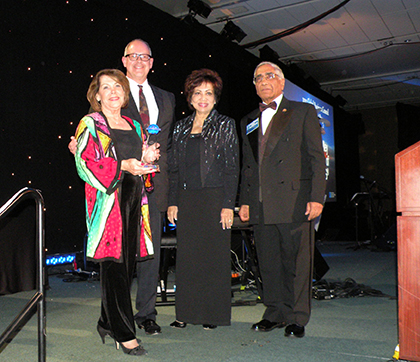
The Silicon Valley Association of REALTORS® (SILVAR) received the platinum award from the National Association of REALTORS® for its global council program at the 2013 REALTORS® Conference & Expo in San Francisco. Pictured here are (left to right) SILVAR president Carolyn Miller and executive officer Paul Cardus, who received the award from Nancy Suvarnamani and Furhad Waquad, 2014 and 2013 chair, respectively, of the NAR Global Business and Alliances Committee.
At the 2013 National Association of REALTORS® (NAR) Conference & Expo last week, NAR recognized SILVAR with a platinum award for its 2013 Global Business Council Achievement Program. SILVAR was one of a number of groups to be honored as Silver, Gold, and Platinum Councils. Of the over 100 existing global business councils, only five were awarded Platinum Council status, the program’s highest distinction, for having demonstrated exceptional commitment to building members’ awareness of the global and multicultural business opportunities in their local markets.
To help members reach out to a growing number of foreign buyers interested in purchasing property in the region, SILVAR formed a global business council at the beginning of last year. The council chaired by Jennifer Tasto took a lead in planning global programs, hosting global education courses, and building awareness among members of international business opportunities.
In the past year, SILVAR offered two Certified International Property Specialist Institutes attended by REALTORS® across the country. Upon completion of the week-long courses and other requirements, 43 attendees earned their CIPS designation – 32 were SILVAR members. They were recognized at a breakfast ceremony hosted by NAR on Saturday.
California Association of REALTORS® President Kevin Brown announced this morning the successful outcome of C.A.R.’s work with U.S. Senator Barbara Boxer (D-CA) to protect distressed homeowners from debt relief income tax associated with a short sale in California. As part of this effort, Senator Boxer requested the Internal Revenue Service (IRS) to provide guidance on whether mortgage debt forgiveness in a lender-approved short sale would be taxable income under federal law, given California’s recent non-recourse laws for short sales, which were hard fought victories by C.A.R.
The IRS has clarified in a letter that California’s troubled homeowners who sell their homes in a short sale are not subject to federal income tax liability on “phantom income” they never received. The IRS recognizes that the debt written off in a short sale does not constitute recourse debt under California law, and thus does not create so-called “cancellation of debt” income to the underwater home seller for federal income tax purposes. This clarification rescues tens of thousands of distressed home sellers from personal liability upon expiration of the Mortgage Forgiveness Debt Relief Act of 2007 on December 31, 2013.
C.A.R. is seeking a similar ruling from the California Franchise Tax Board (FTB), which has been awaiting the IRS action. C.A.R. anticipates the FTB will act promptly. Short sales may raise other tax issues and, as always, homeowners should speak with their tax professional regarding the tax consequences of a short sale.


 Silicon Valley Association of REALTORS® says ...