Both Freddie Mac and Fannie Mae are temporarily suspending all scheduled evictions involving foreclosed occupied single-family 1- to 4- unit residences with owned mortgages beginning December 19, 2011 through January 2, 2012.

The suspension will apply only to eviction lockouts related to Freddie Ma and Fannie Mae owned REO properties and will not affect other pre- or post-foreclosure processes. During this period, legal and administrative proceedings for evictions may continue, but families living in foreclosed properties will be permitted to remain in the home.

A recent survey by Houselogic.com, the consumer website from the National Association of REALTORS®, finds that jobs and the housing market will be two of the most important issues for voters in the 2012 election. Nearly one-third of respondents said housing will be the top issue on their mind when they head to the polls next November.

Respondents were asked “What issue area will have the greatest impact on your vote in 2012?” National security, health care, and energy/environment trailed housing and unemployment by wide margins. Here are the results:

Jobs/Unemployment – 54 percent
Housing – 27 percent
National Security – 8 percent
Health Care – 4 percent
Energy/Environment – 2 percent
Other – 4 percent

With unemployment still high, it is easy to see why so many Americans are concerned about the job market. However, employment and the housing market are inextricably linked because economic growth and job creation cannot occur without a housing recovery.

Housing accounts for more than 15 percent of the U.S. Gross Domestic Product, a key driver of the national economy. Home sales generate jobs. NAR estimates that for every two homes sold, one job is created. New spending on homebuilding products, furniture, and other residential investments also have a significant economic impact.

Some recent indicators show that the economy might be starting to rebound, with pending home sales rising strongly in October, according to NAR’s Pending Home Sales Index. However, any changes to current programs or incentives must not jeopardize a housing and economic recovery. Unemployment, consumer confidence and consumer spending will not rebound until a number of issues are addressed.

This HouseLogic survey shows Americans understand that a housing recovery is essential to the nation’s economic recovery, and many of those housing-related issues will be on the minds of voters in 2012.

The U.S. Census Bureau reports more Americans chose to buy a home during the third quarter of 2011. Home ownership jumped to 66.3 percent during that period, up from the 13-year low of 65.9 percent from the previous quarter, according to the bureau’s report.

“Housing affordability has been at a record high this year,” says Gene Lentz, president of the Silicon Valley Association of REALTORS®. “This is a golden opportunity for people with secure jobs and good credit who want to achieve the American dream of homeownership.”

“Whether somebody is buying or selling a home, finding a good REALTOR® and understanding his or her role should be the first step in what could be the most important transaction in a lifetime,” adds Lentz.

Lentz notes that not all real estate agents or brokers are REALTORS®. A REALTOR® is a licensed real estate agent or broker who is a member of National Association of REALTORS®, the world’s largest professional trade association. The “REALTOR®” designation is used by real estate agents and brokers who must adhere to a strict Code of Ethics and actively pursue continuing education to increase their professionalism and skill. The Code of Ethics sets REALTORS® apart from other real estate licensees and protects all parties to the real estate transaction, not just a REALTOR®’s client. If a local Association of REALTORS® finds a REALTOR® in violation of the Code of Ethics, disciplinary action can be imposed.

REALTORS® must complete ethics training by taking at least 2.5 hours of instruction at least once every four years to keep membership in NAR. For a REALTOR®, living with the Code of Ethics means being honest and dependable, never putting your interests ahead of your client’s, and speaking the truth to all parties.

When evaluating a potential real estate agent, there are certain questions you should ask. First, ask whether the agent is a REALTOR®. Then ask the following questions:

  • Does the agent have an active real estate license in good standing? To find this information, you can check with your state’s governing agency.
  • Does the agent belong to the Multiple Listing Service? Multiple Listing Services are cooperative information networks of REALTORS® that provide descriptions of most of the houses for sale in a particular region.
  • Is real estate their full-time career?
  • What real estate designations does the agent hold?
  • Which party is he or she representing–you or the seller? This discussion is supposed to occur early on, at “first serious contact” with you. The agent should discuss your state’s particular definitions of agency, so you’ll know where you stand.
  • In exchange for your commitment, how will the agent help you accomplish your goals? How will the agent show you homes that meet your requirements and provide you with a list of the properties he or she is showing you?

Visit the Silicon Valley Association of REALTORS® website at www.silvar.org for a list of REALTORS® by location.


Congress passed and President Obama signed into law on November 18 a bill to reinstate the Federal Housing Administration (FHA) loan limit in high-cost areas through 2013. In Santa Clara County, this would mean the maximum size of mortgages FHA can insure will be raised back up to $729,750.

The higher Fannie Mae, Freddie Mac, and FHA conforming loan limits of $729,750 expired September 30 and were subsequently reduced to $625,500. Loan limits for loans backed by Fannie Mae and Freddie Mac were not increased and remain at the reduced level.

The Silicon Valley Association of REALTORS® and its state and national partner associations have long advocated for Congress to reinstate all the loan limits permanently. “We are pleased that Congress agreed to reinstate the FHA loan limits, though we are disappointed that our lawmakers did not reinstate the higher loan limits for Fannie Mae and Freddie Mac backed loans, as well,” said Gene Lentz, president of the Silicon Valley Association of REALTORS®. “The reinstated FHA loan limits will allow qualified, creditworthy borrowers access to affordable mortgage financing.”

FHA provides mortgage insurance to borrowers without enough of a down payment to qualify for prime loans. With an FHA loan, home buyers can put down as little as 3.5 percent on a mortgage loan.

The REALTORS® believe continued a government role in housing financing will ensure stability in mortgage markets and enable home buyers in high-cost areas to refinance and obtain financing for new home purchases more easily. The conforming loan limit determines the maximum size of a mortgage that government-sponsored enterprises (GSEs) Fannie Mae and Freddie Mac can buy or guarantee. Non-conforming or jumbo loans typically carry higher mortgage interest rates than conforming loans, increasing monthly payments and hampering the ability of families in California to purchase homes by making them less affordable.

The GSEs and FHA currently back 90 percent of new home loans. The Obama administration and some lawmakers want to reduce government’s role in the mortgage business and have said the lowering of loan limits is a first step to prompting private capital to return to the market.

In addition to extending the FHA-insured mortgages, the new law provides for a short-term extension of the National Flood Insurance Program (NFIP) through Dec. 16, 2011.  REALTORS® want to ensure that millions of home and business owners across the country have access to affordable flood insurance and had strongly urged Congress to work on a five-year NFIP reauthorization bill to provide certainty and avoid further disruption to real estate markets.

Last night Congress passed an omnibus bill, which included an increase to the Federal Housing Administration (FHA) loan limit and extension of the National Flood Insurance Program. If the bill is signed by President Obama, the FHA loan limit will be increased to $729,750 for San Mateo and Santa Clara counties and the flood insurance program will be extended until December 16.
 
The bill, which passed by a 298-121 vote in the House and 70-30 vote in the Senate, did not include an increase to the conforming loan limit. The Fannie Mae and Freddie Mac loan limits for high cost areas will remain at $625,000.
 
The extension and increase would not have been possible without REALTORS®’ response to the Call For Action in contacting their members of Congress over the last several months. Thank you for your support!

California Association of REALTORS® Deputy Chief Economist Robert Kleinhenz echoed remarks C.A.R. Chief Economist Leslie Appleton-Young made at the C.A.R. EXPO in September and again at last week’s Los Gatos/Saratoga District – the economy has improved, and for a while, there appeared to be surge in the housing market, but wild cards in the domestic and international arena dampened consumer confidence and, as a consequence, recovery has stalled. The engine of growth must come from consumers; businesses won’t spend if consumers don’t, said Kleinhenz.

Kleinhenz presented SILVAR REALTORS® with performance targets which can help them gauge how good or bad the economy is doing. With these indicators in mind, he said REALTORS® can lay out expectations to clients so clients “have the appropriate expectations from the beginning and end up being satisfied in the end.”

  • GDP – The country needs GDP (Gross Domestic Product) at 3 percent or higher. C.A.R. only expects GDP to be at 1.7 percent by year-end and forecasts GDP will only be at 2 percent in 2012.
  • Unemployment Rate – The unemployment rate has got to come down to 6 percent at best, so consumer confidence can  rise. It’s at 9 percent nationwide and 12 percent in California. C.A.R. projects the national unemployment rate will be 9 percent by year-end.
  • Job Growth – The country lost 8.4 million jobs during the recession, and though it has gained back 1.1 million jobs, job growth needs to be at 3 percent or a gain of 400,000 jobs per month.
  • Home Sales – To be sustainable, statewide sales should be at 500-550,000 units per year. C.A.R. projects 496,000 unit sales in 2012.

Kleinhenz said California has had a decent level of sales and is seeing stability in its median price, expected to hit quicker than in other parts of the country. C.A.R. projects the median price to hit $296,000 in 2012. California’s median price bottomed in February 2009 at $245,230.

Kleinhenz is optimistic the market is slowly on the mend. “In California, we have our economic fundamentals that are carrying us through in the years to come,” said Kleinhenz.

He saidthe state’s assets continue to attract people and businesses. The best news of all is the Silicon Valley labor market has been the star of the California economy.

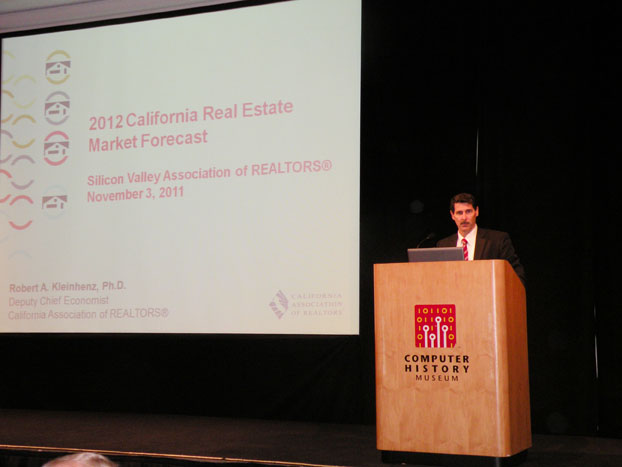
“The economy has shown marginal improvement with nuggets of good news, but it has taken us a lot longer to grow out of this recession because of the financial crises that have paralyzed several aspects of the economy,” California Association of REALTORS® Deputy Chief Economist Robert Kleinhenz told SILVAR members at the Silicon Valley Association of REALTORS® Economic Seminar and General Membership Meeting last week.

“Fundamentally, affordability hasn’t been as good as this in Santa Clara County and the state. Homes are at the right price with the right mortgage rates. The problem is consumers are so concerned about prices bottoming out they are losing sight of the opportunities,” said Kleinhenz.

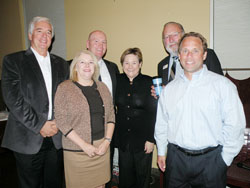
Pictured left to right are past C.A.R. President Jim Hamilton, SILVAR President-elect Suzanne Yost, Los Gatos/Saratoga District Chair Doug Evans, C.A.R. Vice President and Chief Economist Leslie Appleton-Young, SILVAR President Gene Lentz, and Los Gatos/Saratoga District Co-chair Chris Rasmussen.

California Association of REALTORS® Vice President and Chief Economist Leslie Appleton-Young told SILVAR members at last Wednesday’s Los Gatos/Saratoga District tour meeting that while the worst is over, the market continues to struggle with not much relief in sight.

“The tide has turned for housing, but now it’s stuck,” said Appleton-Young.

C.A.R.’s chief economist explained that the economy started to gain a bit of traction and seemed to be moving forward at the beginning of this year, but things happened one after another – Japan’s earthquake and tsunami, oil price spikes, uprisings in the Middle East, stock market volatility, the U.S. debt and the debt crisis in the euro zone. As a result, the housing market that appeared to be recovering is now stalled.

Lenders aren’t lending and consumer and entrepreneurial confidence continue to be low. As long as the jobs problem continues, she doesn’t expect consumer spending to improve by much. Mortgage rates have experienced a historical drop, “but you can’t push on a string. You can’t make people borrow; you can’t make lenders lend,” she said.

The good news is Santa Clara County is doing better than most parts of the state with just a 9.6 unemployment rate. In Santa Clara County, 35 percent of homes that closed escrow in September were distressed, but this is a far cry from places like Solano County, where in September 73 percent of homes that closed escrow in September were distressed sales.

The Bay Area has the best economy in California, in terms of income and job growth. “Companies in this valley are in the cutting edge, leading growth in the economy,” said Appleton-Young.

September single-family home sales were at 487,940 units. Absent more wild cards that could upset the economy, C.A.R. expects 491,000 unit sales by year-end and 496,000 unit sales in 2012, just a 1 percent increase from this year. California’s median price was $287,440 in September, down 8.3 percent from September 2010, but way above from when it bottomed in February 2009 at $245,230. C.A.R. expects the median price to hit $291,000 by the end of 2011 and to increase 1.7 percent to $296,000 in 2012.

Troubles are ahead because all levels of government will have to wrestle with issues of pensions and cost of health and other benefits for public employees. Appleton-Young said ultimately, everyone will have to answer for the deficit.

“It’s hard to do when in some places, the coffers are empty. You can’t spend more than you take in, even if you are the U.S. government. Everyone is going to have to give up something in the end,” she said.

Appleton-Young said in 2012, REALTORS® will need to watch the following federal issues closely – the future of Fannie Mae and Freddie Mac, changes in the tax treatment of real estate, including the definition of the QRM (Qualified Residential Mortgage), which could mean purchasing a home will be even more difficult and costly for consumers.

The restoration of the FHA loan limits is vital to both home ownership and our economy. On October 1 the mortgage loan limits declined in 669 counties in 42 states. This immediately reduced mortgage liquidity and home buyers’ ability to obtain a mortgage. The House and Senate are now deciding whether or not to restore the loan limits. The restoration of the loan limits to their prior levels has been included in an Appropriations bill being deliberated by Congress this week.

Your Senator is a member of the group of Congressional leaders who will decide whether Congress will restore the loan limits. This is why they need to hear from you today.

Why is this so important? Without the restoration of the loan limits the availability of safe, affordable, reliable mortgage financing will continue to diminish. If this happens, many potential home buyers run the risk of being priced out of the American Dream of home ownership. Even worse, this could hold back the housing recovery.

In the Silicon Valley region, the conforming loan limits of $729,750 were reduced by $104,250. This means buyers who need mortgages for more than $625,500 are now forced into the jumbo market, which means they would be paying higher interest rates, or unable to buy a home.

The California Association of REALTORS® (C.A.R.) estimates more than 30,000 California families now face higher down payments, higher mortgage rates, and stricter loan qualification requirements with conforming loan limits on mortgages backed by FHA, Fannie Mae, and Freddie Mac now reduced. In Santa Clara County, C.A.R. estimates nearly 8 percent of potential home sales would be rendered ineligible under the lower GSE loan limit, and 12.2 percent would be deemed ineligible under the lower FHA limit. 

“The loan limits provision is fully paid for, and won’t cost taxpayers a dime. If families cannot obtain financing to buy, home prices will continue to fall. This will further erode the wealth of families in our community and across the country, and will prolong the nation’s economic recovery,” said Lentz. “As individuals and families everywhere are trying to gain a foothold in these trying times, we need to give them the resources to do so.”

Buying property in Silicon Valley makes perfect sense, according to Referral Realty broker Moise Nahouraii. Nahouraii recently showed SILVAR members why.

Nahouraii said in addition to the advantages of historic low mortgage interest rates, low home prices and high rents, property appreciates in Silicon Valley three times more than anywhere else in the state. The top three industries leading the country out of the recession are high tech, energy and medical industries, which all exist in Silicon Valley.

“Land here is gold!” exclaimed Nahouraii.

Additionally, in a survey of Silicon Valley CEOs, 84 percent considered housing as a top problem in the region; 67 percent said the cost of housing was one the most pressing challenges. Majority of respondents want government to approve more affordable housing.

This is the best time to invest in real estate in Silicon Valley because rents are rising because of high demand due to foreclosures, short sales, unemployment, damaged credit, loss of stocks, increased debt, stringent loan qualifications by lenders, lack of down payment for a home, etc. Nahouraii showed bargain properties on the MLS and illustrated how purchasing a single-family home (self-managed) and multi-unit property (self-managed) could generate a positive cash flow for an investor.

“Investment should carry itself because you could lose your job tomorrow. You have the most stability in Silicon Valley than anywhere else,” said Nahouraii.

Silicon Valley REALTORS® continue to learn as much as they can about today’s market and what to expect in the coming months. Dr. Robert Kleinhenz, California Association of REALTORS® Deputy Chief Economist, will give Silicon Valley REALTORS® information on “What’s Ahead for Our Real Estate Market” at SILVAR’s annual Economic Seminar and General Membership Meeting on Thursday, November 3, from 2 to 5 p.m. at the Computer History Museum, 1401 North Shoreline Blvd. in Mountain View.

Dr. Kleinhenz manages C.A.R.’s research and economics department, which gathers and publishes information on the California housing market, and conducts survey research of consumers and C.A.R. members. He has a Doctorate in Economics from the University of Southern California and regularly speaks to local, state and national audiences.

It will be interesting to have Dr. Kleinhenz highlight a number of national, statewide and local real estate issues that are shaping our market environment today.

March 2026
M T W T F S S
 1
2345678
9101112131415
16171819202122
23242526272829
3031  

Archives

Enter your email address to subscribe to this blog and receive notifications of new posts by email.

Join 69 other subscribers