TRID-cu

With the new TILA-RESPA Integrated Disclosure rule going into effect on October 3, Fidelity National Title senior sales executive Connie Montalbano-Hill and senior account executive Desiree Baker want to make sure REALTORS® are prepared, so no delays will occur with their transactions. At Thursday’s Silicon Valley Association of REALTORS® Cupertino/Sunnyvale District tour meeting, they explained the fine points of the new law, what’s different, and what REALTORS® can do to make sure a transaction won’t fall through.

The new forms are a consolidation of several forms. The Good Faith Estimate (GFE) and the initial Truth-in-Lending disclosures will be combined into a new form called the Loan Estimate. The HUD-1 and the final Truth-in-Lending disclosures will be combined into another new form called the Closing Disclosure.

Timing is critical. According to the Consumer Financial Protection Bureau, the Closing Disclosure must be delivered and received three days in advance of “consummation” of the loan. If the Closing Disclosure is not actually received in person, the new rules require an additional three-day period if it is delivered by mail or electronically. Given that Sunday is not counted, the Closing Disclosure will have to be delivered seven days before consummation. “Consummation” will typically be the day loan documents are signed, which is usually at least one day in advance of closing but could be more.

Baker said three changes would require a new 3-day review: if the APR increases by more than 1/8 of a percent for fixed rate loans, or 1/4 of a percent for adjustable loans; if a prepayment penalty is added, making it expensive to refinance or sell; and if the basic loan product changes, such as a switch from fixed rate to adjustable interest rate or to a loan with interest only payments.

The title company representatives gave SILVAR members a list of title insurance facts they need to know, including new terms and information included in a loan estimate. They said the new rule ensures that the lender take more of a leadership role in the transaction, but every lender is different. That’s why it is very important that REALTOR® have good communication with their lender, their title officer, and their client.

“Know you client well, so you avoid surprises,” said Montalbano-Hill. “Take care of the details ahead of time. The more you know your client, the better.”

Montalbano-Hill noted that a change in the name of a newly married spouse, for instance, can cause problems if not disclosed to all parties.

Baker added, “Don’t make assumptions. Everyone is going to have to be on the same page at the same time.”

SEE CFPB’S “KNOW BEFORE YOU OWE” REAL ESTATE PROFESSIONAL’S GUIDE
Left to right are Lehua Greenman (Membership Committee Chair), SILVAR President Chris Isaacson, Joe Brown, San Mateo County Supervisor William Slocum, Larry Tringali, Steve Trolan, Supervisor Joe Simitian (who served as auctioneer), Tom Gordon, Bill Weseloh, Mike Frangadakis, Kelly Hutter, Derrick Felton, Bill Moody and Frank Limon.

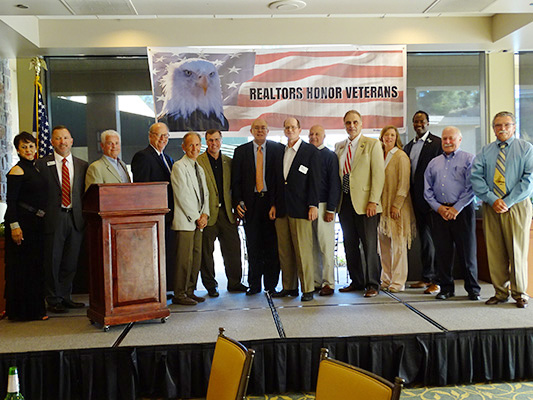
Left to right are Lehua Greenman (Membership Committee Chair), SILVAR President Chris Isaacson, Joe Brown, San Mateo County Supervisor Warren Slocum, Larry Tringali, Steve Trolan, Supervisor Joe Simitian (who served as auctioneer), Tom Gordon, Bill Weseloh, Mike Frangadakis, Kelly Hutter, Derrick Felton, Bill Moody and Frank Limon.

SILVAR members honored the country’s veterans this week, including their own, at the Palo Alto Hills Golf & Country Club. More than 150 members and guests enjoyed delicious hors d’oeuvres, beverages and live music, while bidding on fabulous items at the live and silent auctions on Wednesday night. Thanks to the generous donations from sponsors and members who bid generously, the event grossed over $45,000 for the SILVAR Veterans Scholarship Fund.

The SILVAR Veterans Scholarship Fund is a new component of the Silicon Valley REALTORS® Charitable Foundation’s focus on education. The scholarship fund will support eligible U.S. veterans and eligible dependents of deceased veterans residing in SILVAR’s traditional service area who wish to further their education.

Leading everyone in the Pledge of Allegiance was Bill Weseloh, a longtime SILVAR member and U.S. veteran. Tina Kyriakis, also a SILVAR member, sang “The Star-Spangled Banner.” Serving as masters of ceremonies were Santa Clara County District 5 Supervisor Joe Simitian, who also was the evening’s auctioneer, and Lehua Greenman, Silicon Valley REALTORS® Charitable Foundation trustee and chair of SILVAR’s Membership Committee.

SILVAR President Chris Isaacson and Greenman welcomed guests to the special event. They recognized special guests present, including San Mateo County District 4 Supervisor Warren Slocum, who is also a U.S. veteran, having served in the U.S. Army in Vietnam 1966-67. They noted the country’s veterans have made many sacrifices “so we can live free and with liberty.”

A highlight of the event were the presentations of the Certificate of Special Congressional Recognition “for outstanding and invaluable service to the community” from U.S. Representative Anna Eshoo and a Certificate of Commendation from the County of Santa Clara presented by County Supervisor Joe Simitian to the Silicon Valley Association of REALTORS® and all REALTOR® Veterans.

The presentations were followed by a recognition of all U.S. veterans present at the event, including those who had registered, but were unable to be present that evening. Recognized at the podium were Supervisor Slocum, Bill Weseloh (U.S. Army), Frank Limon (U.S. Army 1965-68, Vietnam 1965-67), Mike Frangadakis (Vietnam 1967-70, currently with the California State Military Reserve); Derrick Felton, (U.S. Army 1988-1992, Persian Gulf), Tom Gordon (U.S. Air Force 1984-1988, Edwards Air Force Base, CA.); Steve Trolan (U.S. Army 1981-85, Fort Shafter, HI 1987-1994, U.S. Army Reserve, 12th Special Forces); Larry Tringali (U.S. Navy Corpsman 1967-69), Kelly Hutter (U.S. Air Force 1985-1993), Bill Moody (U.S. Army, Vietnam 1966-68); John Tripp (Pacific Theater, 1947-1956); and Joe Brown (U.S. Air Force 1969-73, Vietnam 1970-71).

READ MORE HERE

12002861_10153527661242324_7962583769189922055_n

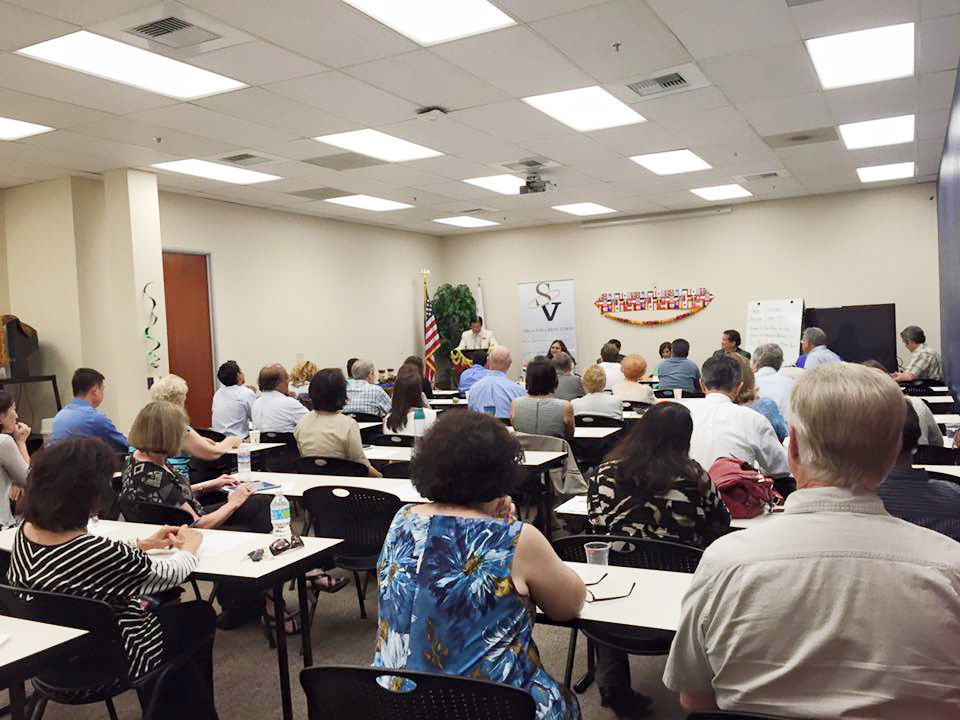
Members of the Silicon Valley Association of REALTORS® packed the training room yesterday to learn more about working with Indian clients. Indians are a close second to Chinese as top foreign buyers of Silicon Valley property. Their cultural nuances, traditions and spiritual beliefs, were discussed by panelists at “Doing Business with Indian Clients,” a program hosted by SILVAR’s Global Business Council.

Sharing the information with members were REALTORS® Sue Bose with Referral Realty – Cupertino, Nomita Shahani with Alain Pinel REALTORS® – Saratoga, Umang Sanchorawala with Alain Pinel REALTORS® – Palo Alto, and supervising loan officer with PNC Mortgage Jimmy Kang. Mark Wong, chair of SILVAR’s Global Business Council, served as moderator.

The REALTORS® presented important information about vastu, the ancient Indian science of architecture. Vastu, which is the counterpart of the Chinese feng shui, can influence Indian buyers in their purchase of a home. According to Bose, the principles of vastu take into account the sun’s rays, earth movement and geomagnetic forces, with fire, water, earth and sky as important elements. Design and construction of buildings are based on vastu so that harmony is created where people who live and work.

Many homes in India are built in the shape of a rectangle or square with a courtyard in the middle, open to the sky, said Bose. Kitchens face southeast with the belief that the gods rule in the east. Winds come from the northeast, so doors and windows should be structured accordingly. Shahani added a pie-shaped lot with the front yard at the tip and the backyard at the larger portion of the lot would be attractive to an Indian buyer because the lot is likened to the shape of a cow, with the tip as its head. The cow is sacred to Indians.

Most Indian buyers “have it all mapped out,” said Bose. They have already done their homework about the home, the neighborhood and the school they want their children to attend. They can also be very aggressive in negotiation, and when their offer is accepted, they think they have overpaid and want to counter or want something more in return.

“It’s just their nature to negotiate,” explained Sanchorawala. “They feel better if they get something more in return.” He said paying for the cleaning or extra work that needs to be done can often appease the buyer.

Be patient with Indian buyers because it is hard to connect with them for the first time. They are not good at returning phone calls. The agent will need to follow up with them multiple times. Sanchorawala said many Indians feel they are important to their job, so they will not interrupt their work day by returning an agent’s phone call.
READ MORE

This is a rendering of the REALTOR® Village to be built in the Philippines. NAR provided seed money to help construct containerized housing in the town of Bogo, Cebu in the Philippines.

This is a rendering of the REALTOR® Village to be built in the Philippines. NAR provided seed money to help construct containerized housing in the town of Bogo, Cebu in the Philippines.

The National Association of REALTORS® (NAR) has partnered with the Chamber of Real Estate & Builders’ Association, Inc. (CREBA) to build a REALTOR® Village in the Philippines. CREBA is the exclusive partner of NAR in the Philippines, one among over 82 real estate organizations delegated with stewardship of the NAR name and programming. SILVAR is NAR’s Ambassador Association to the Philippines and maintains a cooperative relationship with CREBA.

The REALTOR® Village is a project of the Philippine American Society of Arts & Culture in cooperation with NAR and CREBA that will provide containerized housing, the first of its kind, to promote socialized housing in the town of Bogo, which is located in the island of Cebu, Philippines. NAR provided seed money for the project.

Super typhoon Haiyan (Yolanda) that struck the country in November 2013 killed over 6,000 people and disrupted the lives of over a quarter of a million Filipinos, leaving them homeless. The proposed containerized housing can withstand wind of up to 100 miles an hour. The units are considered green buildings. The sustainability plan will consist of equipping recipients with aquaponics and dry hog farming. The recipients will also be planting fruit trees. The target is to build a village of 60 units, including a multipurpose center, health center and library.

A ribbon cutting ceremony attended by NAR Past President Steve Brown and NAR Treasurer Michael McGrew was held a day before the July 27-30 NAR International RELATORS® Conference hosted by CREBA in the Philippines. SILVAR member and past Global Business Council chair Jennifer Tasto, who currently serves as NAR’s President’s Liaison to the Philippines, represented NAR and SILVAR at both events.

SEE VIDEO OF REALTOR® VILLAGE RIBBON CUTTING CEREMONY HERE

After intense pressure from REALTORS® and coalition partners, the Bay Area Air Quality Management District (BAAQMD) has withdrawn a controversial proposal to ban fireplaces at the point of sale.

The ordinance, if adopted by the BAAQMD Board of Directors, would have taken effect November 1, 2016. The original proposal would require anyone selling their home to upgrade all fireplaces to an EPA certified wood burning device, gas or electric, or remove the fireplace entirely. Projects like these can run in the tens of thousands of dollars depending on the nature of the fireplace. Additionally, finding contractors with the skills to do this work could have greatly delayed sales.

Members of the Silicon Valley Association of REALTORS® and staff joined forces with all of the Bay Area REALTOR® Associations, as well as coalition partners, to fight this ordinance. Members spoke out at public hearings; SILVAR President Christopher Isaacson submitted a detailed letter commenting on the onerous nature of the ordinance; and SILVAR members and staff met one-on-one with BAAQMD staff to explain how detrimental this ordinance would be to the housing industry.

BAAQMD recently released a revised proposal which eliminates the point-of-sale requirement. In its place, BAAQMD staff will ask the BAAQMD Board of Directors to approve a mandatory disclosure for all home sales on the dangers of wood-burning smoke. If this disclosure is adopted, it will be incorporated into the PRDS disclosure forms available to members.


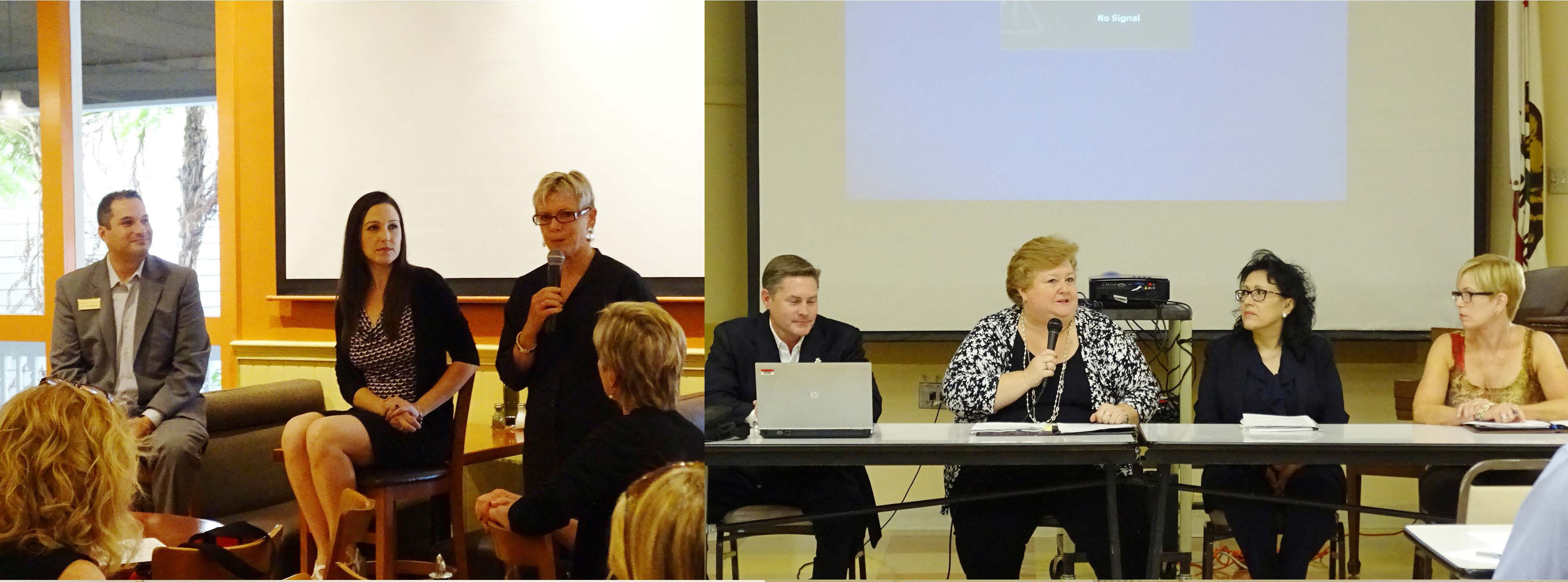
Left, the Los Gatos/Saratoga District panel with Sal Covarrubias, Annie Delgado and Cindy Stanford. Right, the Palo Alto District panel with Eric Trailer, Caroline Wolf, Janine Dietiker and Jackie Griffin.

Left, the Los Gatos/Saratoga District panel with Sal Covarrubias, Annie Delgado and Cindy Stanford. Right, the Palo Alto District panel with Eric Trailer, Caroline Wolf, Janine Dietiker and Jackie Griffin.

Silicon Valley Association of REALTORS® (SILVAR) Districts are educating members on what they need to know about the new disclosure forms, the result of the new Truth in Lending Act and Real Estate Settlement Procedures Act Integrated Disclosure (TRID) rule that goes into effect October 3.

At a July SILVAR Los Gatos/Saratoga District tour meeting, the topic was discussed by a panel with Sal Covarrubias, who is with First American Title Company, and mortgage lenders Annie Delgado and Cindy Stanford, both with Opes Advisors. At the SILVAR Palo Alto August monthly meeting, the panel on TRID included mortgage lenders Eric Trailer, with EverBank and Caroline Wolf, with Princeton Capital, and title company representatives Jackie Griffin, with Old Republic Title Company and Carol Boyden, with Chicago Title Company.

The new rule combines the Good Faith Estimate (GFE) and the initial Truth-in-Lending disclosures into a new form called the Loan Estimate. The new rule also combines HUD-1 and the final Truth-in-Lending disclosures into another new form called the Closing Disclosure.

The good news is it will be easier for buyers to compare the loan estimate with the disclosure, panelists say, but many are concerned that the new rule could delay closings because of timing requirements concerning delivery of the Closing Disclosure. The Closing Disclosure must be delivered and received three days in advance of “consummation” of the loan, which is the day loan documents are signed. If the Closing Disclosure is not received in person, the new rule requires an additional three-day period if it is delivered by mail or electronically. Sunday is not counted; then, add a federal holiday into the mix and the possibility is great that the Closing Disclosure may have to be delivered seven days before consummation.

Also, since compliance with the new rule falls heavily on lenders, it is very likely that lenders will retain tight control over much of the disclosure process. Any last minute changes to the contract, such as seller credits to buyers or removing a loan contingency, could cause the reissuance of a new Closing Disclosure, further delaying the transaction.

The panelists said three changes would definitely require a new 3-day review:

  1. If the APR (annual percentage rate) increases by more than 1/8 of a percent for fixed-rate loans or 1/4 of a percent for adjustable loans. A decrease in APR will not require a new 3-day review if it is based on changes to interest rate or other fees.
  2. If a prepayment penalty is added, making it expensive to refinance or sell.
  3. If the basic loan product changes, such as a switch from fixed rate to adjustable interest rate or to a loan with interest-only payments

Any other changes in the days leading up to closing do not require a new 3-day review, although the lender will still have to provide an updated disclosure.

What can REALTORS® do to avoid pitfalls? Panelists advise:

  1. Be conservative regarding the timeline. Start the process early. Even if signing is a month away, encourage clients to get the required documents and information to the lender early. Avoid the last-minute scramble. It is critical to get the information sooner than later.
  2. There needs to be open communication and transparency among all parties – the client, the REALTOR®, the title officer and the lender. Tell your loan officer everything. There should be no surprises.
  3. Get clients solidified into a loan program as soon as possible. Make sure the financing is in order. Tell the lender about all fees associated with the transaction. Always give updated versions.
  4. Completeness is critical. Make sure all documents are completely filled out and accurate.
  5. Educate your consumers, get a commitment, and take control.

The Consumer Financial Protection Bureau (CFPB) today just released a new online toolkit to help real estate professionals understand the new TILA-RESPA Integrated Disclosure (TRID) rule and how to explain those changes to their clients. As part of the CFPB’s larger mortgage initiative campaign called “Know Before You Owe”, the “Real Estate Professional’s Guide” explains the new changes coming to the home buying process on October 3 and offers tools that real estate professionals can provide their clients about the “Know Before You Owe” campaign. Visit  http://bit.ly/1IQVfgf

Another source about the October 3 changes to the closing forms and procedures in an hour-long webcast entitled, “The New Closing Rules,” with closing expert Phil Schulman and National Association of REALTORS® Senior Counsel Finley Maxson.

REALTORS® can also visit www.car.org/legal and watch the California Association of REALTORS® Legal Live Webinar entitled “RESPA/TILA Integration Overview.”


Veterans_Day_poster_1997-1
On Wednesday, September 23, members of the Silicon Valley Association of REALTORS® (SILVAR) will hold “REALTORS® Honor Veterans,” from 4-8:00 p.m. at the Palo Alto Hills Golf and Country Club, 3000 Alexis Dr, Palo Alto. This event will be an evening of connecting with colleagues, enjoying tasty food, beverages and live music, while bidding on fabulous items at our live and silent auctions. All proceeds from this event will go to the SILVAR Veterans Scholarship Fund

Planning for this event began already in the spring with SILVAR’s Membership Committee, its five Districts and professional Affiliates, the Silicon Valley YPN Chapter and the Charitable Foundation Trust joining together to make this fundraising event a success and an incredibly exciting experience for everyone.

The SILVAR Veterans Scholarship Fund is a new component of the Silicon Valley REALTORS® Charitable Foundation’s focus on education. The scholarship fund will support eligible U.S. veterans and eligible dependents of deceased veterans residing in SILVAR’s traditional service area who wish to further their education. SILVAR’s Charitable Foundation will join in partnership with area schools, like Foothill College, West Valley College, De Anza College, Cañada College and Menlo College.

The scholarship program is SILVAR’s way of supporting our veterans, to thank them for their brave and invaluable service to our country, and to help them be successful. With SILVAR membership support, we will be able to assist our veterans in achieving their education goals.

The Silicon Valley REALTORS® Charitable Foundation focuses on helping others through grants for housing, education and youth. SILVAR members want to make a big difference in people’s lives throughout our SILVAR communities.

For more information about this event and donations for the live and silent auctions and prizes, please contact Lehua Greenman, SILVAR 2015 Membership Chair and Silicon Valley REALTORS® Charitable Foundation Trustee at lgreenman@cbnorcal.com.

REGISTRATION FORM


The Silicon Valley Association of REALTORS® (SILVAR) joins the National Association of REALTORS® (NAR) and California Association of REALTORS® (C.A.R.) in opposing a provision in the highway transportation bill that taxes homebuyers and those looking to refinance by increasing the fees Fannie Mae and Freddie Mac charge on their loans. This bill is now being considered by the U.S. Senate.

Of particular concern to REALTORS® is this tax pays for government needs that are totally unrelated to housing. This extends a 2011 fee increase that NAR opposed. NAR, in coalition with many other groups, urged the Senate not to adopt these fees and treat homeownership as the nation’s piggybank. This tax also will have a disproportionally higher impact on those using FHA loans, first-time home buyers and low and moderate-income buyers.

The National Association of REALTORS® is asking its over one million members to email their representatives in Congress and ask for their help in protecting the real estate industry from patent trolls.

A patent troll is a company that owns a large number of patents, but does not produce any goods or services. The patent troll business model is to sue companies for infringing on the patents it owns, or to license those patents to companies for legal use. These companies are suing REALTORS® and other small businesses for patent infringement based on their use of common business tools like drop-down menus or scan-to-email technologies.

Patent trolls target REALTORS® through letters threatening lawsuits or actually filing lawsuits. These letters demand licensing fees to use common business tools, such as drop down menus or shopping cart features on websites. For many of those targeted, paying for the license is often much less expensive than defending the lawsuit.

Patent trolls hurt the real estate industry. The Innovation Act will close loopholes in our legal system that allow patent trolls to go after businesses like yours.

If you are a REALTOR®, take action now. Just click HERE, or go to your REALTOR® Action Center App on your phone and tell Congress to Vote YES on H.R. 9- The Innovation Act.

Click the link below and tell YOUR member of Congress to STOP Patent Trolls today!

STOP PATENT TROLLS!

The United States Supreme Court recently held that a private or public entity can be sued for discrimination even if there was no intent by that entity to discriminate, upholding the validity of disparate impact claims in fair housing issues.

The ruling touches on the concept of “disparate impact” which, under the Fair Housing Act, states that any policy or practice that creates a disproportionate “adverse impact” on any group based on race, national origin, color, religion, sex, familial status, or disability may be considered discriminatory or illegal. Opponents have maintained there needs to be intent for a discrimination suit to be valid, but all federal courts of appeal have interpreted the law to mean that an entity can get sued for housing discrimination if its actions have a disparate impact on a protected class, regardless of intent.

In its ruling, however, the Court clarified that just because an action has a disparate impact, it does not mean it is discriminatory. The plaintiff must point to a specific policy that the defendant had and show that the policy had a negative impact on the plaintiff’s protected class. The defendant can avoid liability if it can prove that the policy is necessary to achieve a legitimate business interest. The plaintiff also must be able to show there is an alternative business practice with a less discriminatory effect that would equally serve the defendant’s legitimate business interest in order for the plaintiff’s disparate impact claim to be valid.

As an example, a REALTOR® having a policy of only selling homes to members of their religious institution could face a disparate impact claim if a member of a different faith claims that this policy causes members of the another faith to miss the best homes. In the same light, when considering the adoption of any policy, real estate professionals operating as property managers or housing developers should make sure the policy will not have an unintended disparate impact on a protected class.

February 2026
M T W T F S S
 1
2345678
9101112131415
16171819202122
232425262728  

Archives

Enter your email address to subscribe to this blog and receive notifications of new posts by email.

Join 69 other subscribers