
You are currently browsing the category archive for the ‘Silicon Valley’ category.
Dan Lachman, program manager of The Housing Trust of Santa Clara County, wants REALTORS® to inform their clients that The Housing Trust can provide assistance to first-time home buyers.
“We have money to help your first-time home buyers,” Lachman announced at a recent REALTOR® meeting.
The Housing Trust offers three main financial assistance programs for first-time home buyers – the Closing Cost Assistance Program (CCAP), the Mortgage Assistance Program (MAP) and Equity Share Co-Investment (ESCO):
Closing Cost Assistance Program (CCAP)
The Housing Trust will provide up to $6,500 to help pay for closing costs and other transaction expenses associated with purchasing a first home. This program provides a deferred loan of 3 percent of the purchase price up to $15,000 for down payment and/or closing costs. The loan is not repaid until the house is sold or the owner refinances. No interest or principal payments are due during the term of the loan.
Mortgage Assistance Program (MAP)
MAP is a second mortgage of up to $35,000 available to first-time home buyers in Santa Clara County. The Housing Trust MAP loan is a conventional second mortgage, with interest and principal payments due monthly and compatible with most banks and credit unions. It is a 30-year amortizing loan with the interest rate at 1.5 percent above the rate of the first loan.
To qualify for the CCAP and MAP, the income of a single-member household cannot exceed $86,950, or household income for a four-member household cannot exceed $124,200.
Equity Share Co-Investment (ESCO)
The Housing Trust will advance as much as $75,000 to first-time home buyers. The money will be used to match a buyer’s down payment. Payments on the ESCO loan will not be due until 15 years later, or until the house is sold or the borrower refinances. The borrower repays the loan based on the appreciation of the home in equal proportions to the amount of the original down payments. To qualify for the program, the income of a single-member household cannot exceed $103,390, or the household income of a four-member household cannot exceed $147,700.
Since 2001 The Housing Trust has provided 2,100 down payment assistance loans. Also, The Housing Trust’s definition of first-time home buyer is different from the state or federal government’s definition. A person who has not owned a home in Santa Clara County during the last three years is considered a first-time home buyer by The Housing Trust and may apply for assistance, according to Lachman.
Ask your REALTOR® about The Housing Trust of Santa Clara County, or visit www.housingtrustcc.org to learn more about these and other assistance programs.
Member of the Silicon Valley Association of REALTORS® (SILVAR) presented three grants this week, which will help children and, hopefully, make their holiday season brighter.
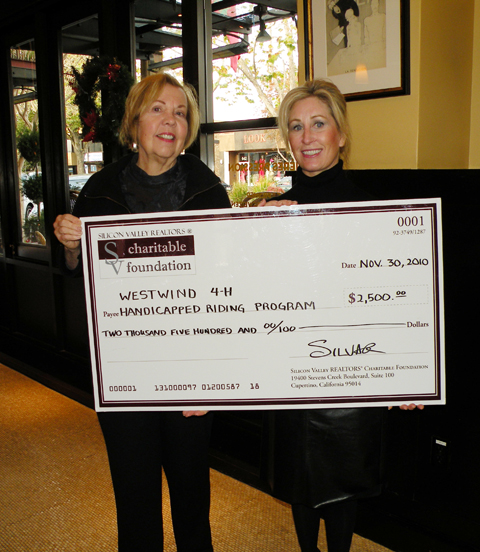
At the Menlo Park/Atherton District meeting on Monday, the Silicon Valley REALTORS® Charitable Foundation Trust presented $2,500 to the Westwind 4-H Riding Program for the Handicapped. Silicon Valley REALTORS® Charitable Foundation President Lisa Keith presented the grant to Judy Lookabill, board member of the Westwind Riding Institute.
Westwind 4-H Riding for the Handicapped has been providing horseback riding instruction for children with physical handicaps since 1978. Westwind Community Barn in Los Altos Hills is the home base of the Westwind 4-H riding program.
- Silicon Valley REALTORS® Charitable Foundation President Lisa Keith and Judy Lookabill, board member of the Westwind Riding Institute, hold the big check.
Lookabill thanked SILVAR members for the donation and continued support of the 4-H program. She said the benefits of horse riding are both psychological and physiological. The program builds confidence and self-esteem; develops coordination and balance; and is one of the few recreational activities, other than swimming, that is truly physically therapeutic, since it requires the involvement of the whole body and utilizes every muscle and joint.
On Wednesday, SILVAR’s Los Gatos/Saratoga District presented a check for $3,990 to EMQ FamiliesFirst in Los Gatos. The donation came from proceeds from the district’s annual pumpkin auction. Los Gatos/Saratoga District Chair Bill Rehbock presented the check to Bettina Kohlbrenner, executive director for fund development for the agency.

Los Gatos/Saratoga District Chair Bill Rehbock is pictured here with Bettina Kohlbrenner, executive director for fund development for the agency.
EMQ (Eastfield Ming Quong) FamiliesFirst helps children in crisis and their families. The agency provides shelter and care to children who are displaced and whose families are unable to care for them, so that they can recover from trauma, abuse and addiction, and rebuild their lives. Kohlbrenner said the agency currently cares for 40 children in the area. She thanked the district for its generous donation.
“Your donation will help make the holidays brighter for these children,” Kohlbrenner told SILVAR members.
At the Thursday Cupertino/Sunnyvale District tour meeting, the Silicon Valley REALTORS® Charitable Foundation presented a check for $1,250 to Child Advocates of Santa Clara and San Mateo. Charitable Foundation trustee Carolyn Miller presented the check to Kathy Williams, CASA board director.
Child Advocates of Santa Clara & San Mateo Counties trains and supports Court Appointed Special Advocate (CASA) volunteers to work one-on-one with abused and neglected children. A CASA volunteer speaks up for a child’s best interests, helping to ensure that he or she will live in a safe and loving environment and has the resources needed to grow up healthy and strong. Williams said the child advocates are “like big brothers and big sisters with teeth,” who serve as champions of the children and look out for their best interest.

Charitable Foundation trustee Carolyn Miller and Kathy Williams, CASA board director, hold the big check.
The Foundation’s grant will help underwrite the cost of recruiting, training and supervising additional volunteer advocates for the over 200 children currently on their list. Williams thanked SILVAR for the donation and noted it comes at a good time, and will provide great help for the children during the holidays.
Child Advocates of Santa Clara & San Mateo Counties trains and supports Court Appointed Special Advocate (CASA) volunteers to work one-on-one with abused and neglected children. A CASA volunteer speaks up for a child’s best interests, helping to ensure that he or she will live in a safe and loving environment and has the resources needed to grow up healthy and strong. Williams said the child advocates are “like big brothers and big sisters with teeth,” who serve as champions of the children and look out for their best interest.
The Foundation’s grant will help underwrite the cost of recruiting, training and supervising additional volunteer advocates for the over 200 children currently on their list. Williams thanked SILVAR for the donation and noted it comes at a good time, and will provide great help for the children during the holidays.
Also, in late November, SILVAR members of the Palo Alto District celebrated the district’s annual Partners in Education(PiE) Campaign and presented a check for $30,740 to the PiE Foundation and Palo Alto Unified School District.
Palo Alto Partners in Education is a nonprofit foundation dedicated to supporting Palo Alto public elementary, middle and high schools by raising money to meet classroom needs otherwise left unfunded. PiE funds support programs in art, home to school translations, math and science.

Palo Alto District PiE Campaign Chair Desiree Docktor is pictured here with PAUSD Superintendent Kevin Skelly.
Thank you to all SILVAR members who generously contribute to the Charitable Foundation and district fundraisers that help individuals and families in need in communities where members live and work!
“Housing affordability has never been better, but the high unemployment rate, slow job growth and difficulty in obtaining credit, especially for high-cost homes, continue to be stumbling blocks to a complete housing recovery,” according to Jeff Bell, president of the Silicon Valley Association of REALTORS®.
Uneven Recovery, but Sales Clearly “Off Bottom”
The National Association of REALTORS® reports today that sales of existing homes in October declined 2.2 percent to a 4.43 million annual rate from 4.53 million in September. The national median existing-home price for all housing types was $170,500, down 0.9 percent from October 2009.
NAR chief economist Lawrence Yun said the recent sales pattern can be expected to continue, but he believes sales will steadily improve to healthier levels of above 5 million by spring of next year. “The housing market is experiencing an uneven recovery, and a temporary foreclosure stoppage in some states is likely to have held back a number of completed sales. Still, sales activity is clearly off the bottom and is attempting to settle into normal sustainable levels,” he said.
Overly tight credit is making it difficult for some creditworthy borrowers to qualify for a mortgage. “A return to common sense loan underwriting standards would go a long way toward achieving responsible, sustainable homeownership,” said NAR President Ron Phipps.
Home Builder Confidence Up, but Obtaining Credit Is a Problem
Home builders are also complaining that tight credit is getting in their way. Nationwide housing starts declined 11.7 percent to an annual rate of 519,000 units in October. Despite the decline, the National Association of Home Builders reports builder confidence is up slightly, as builders are starting to report some improvement in buyer demand and quality of buyer traffic.
“The great concern is that this positive momentum will be stifled due to builders’ inability to obtain financing for new construction at a time when inventories of completed new homes are very thin,” NAHB Chief Economist David Crowe said in a press release.
In addition to tight credit, worry continues about the high unemployment rate, slow job growth and looming shadow inventory. Distressed homes accounted for 34 percent of sales in October, according to NAR. There’s also the threat of foreclosures mounting as a growing amount of homeowners remain out of work and those who have borrowed against their equity default on their mortgage.
GDP Growth Better Than Anticipated
On the upside, the Commerce Department reports the economy grew at a 2.5 percent annual rate in the third quarter, more than previously calculated, due to increased shipments abroad and business spending for equipment and software.
Santa Clara County October Median Up Slightly
Although October home sales fell, Santa Clara County saw a slight year-over-year gain in its October median home price. According to a California Association of REALTORS® report released today, the October median price for a single-family home in Santa Clara County was $637,750, was up 8 percent from the same time a year ago. October sales of single-family detached homes in the county were down 24 percent from October 2009, when the first-time home buyer credits was available.
C.A.R. reports DataQuick statistics, which are based on county records data rather than MLS information, ranked the Silicon Valley cities of Los Altos, Palo Alto, Cupertino and Los Gatos among the top 10 cities with the highest median home prices in California during October 2010. The October median home price in Los Altos was $1,700,000; Palo Alto, $1,050,000; Cupertino, $1,022,500; and Los Gatos, $1,000,000.
In an effort to be in compliance with federal case law and to have an enforceable sign ordinance, the Los Altos City Council unanimously approved two new sign ordinances this week. The ordinances dealing with signs on private and public property will be enforced starting December 30. A final version of the ordinances will be released shortly, but here’s a view of the draft ordinances.
There are changes included in the new ordinances that impact REALTORS®. The biggest change is when it will be permissible to place an open house sign on public property. These amendments were necessary to ensure that the sign rules had reasonable time and place restrictions for open house signs to prevent a legal challenge similar to what occurred in Menlo Park and led to a citywide ban of all signs on public property.
Here is a brief overview of the new rules for real estate and open house signs for Los Altos:
Residential on-site signs:
• One non-illuminated for sale sign allowed per property.
• For sale sign can be no taller than six feet in height and the sign face no larger than four square feet.
• Up to 12 square feet of real estate signage is allowed per property, which allows for both an A-frame open house sign and a for sale sign to be placed on private property at the same time.
• There are no day or time restrictions for real estate signs on private property.
Residential off-site open house signs:
• Size: A-frame signs no larger than four square feet per face, plus two riders, can be no taller than 32 inches.
• Location: Only on sidewalks where it does not obstruct pedestrian or bicycle access, cannot be placed on any medians or on the expressway right-of-way.
• Number per intersection: A single open house can only have one sign per intersection.
• Time restrictions: Signs will only be permitted during the following days and times:
o Friday: 9 AM-1:30 PM
o Saturday, Sunday and Holidays: 11:30 AM – 6 PM
A final version of the ordinance will be distributed to members once it is available.
After providing significant support behind an opposition campaign against Measure Q in Saratoga, SILVAR is pleased the measure proposing a two-story height limit for commercial and office property appears doomed.
The article, written by Joe Rodriguez of the Mercury News, concludes there are still ballots to be counted, but the measure is essentially headed for defeat. Rodriguez questions whether this would mean the Village “could grow taller than the town’s majestic redwood trees, and would development and increased traffic harm the surrounding neighborhoods,” as proponents of the measure fear.
Not so, says Councilman Chuck Page. Page, who won re-election and opposed the measure, says in the article that a previous 35-foot building height remains in effect and would prevent high-rise developments.
“The planning commission isn’t going to let anyone build to the max,” Page said in the article. “We have to do everything smartly and retain the character of the town, which is what everyone wants.”
Measure Q’s defeat is a huge victory for businesses and property owners in Saratoga!
Coldwell Banker Residential Brokerage, the Bay Area’s leading real estate services company, announced today that it has acquired Cashin Company Realtors, one of the Peninsula’s largest and most prestigious local brokerage companies.
According to a press statement released by Coldwell Banker earlier today, the move continues Coldwell Banker Residential Brokerage’s strong trajectory of growth on the Peninsula and in the Bay Area. Founded in 1995 by Emmet J. “Skip” Cashin III, the Cashin Company Realtor’s team of 270 real estate professionals in seven offices throughout San Mateo County accounted for more than $1 billion in annual sales volume in the last 12 months.
The seven-office, 270-agent firm will now operate under the banner of Coldwell Banker Residential Brokerage. With this announcement, Coldwell Banker Residential Brokerage in the San Francisco Bay Area now has more than 60 offices and 3,500 sales associates who accounted for more than $11 billion in sales volume last year.
“Cashin Company has been a highly successful real estate brokerage on the Peninsula for many years,” said Rick Turley, president of Coldwell Banker Residential Brokerage in the San Francisco Bay Area. “They are a perfect fit with Coldwell Banker in terms of our respective cultures, our core values and our strength in the local marketplace, especially in the luxury market.
Cashin said his firm had many suitors in recent years, but decided that Coldwell Banker Residential Brokerage was the right choice in terms of the scale and scope of the nation’s leading brokerage company, agent support, technological tools, networking opportunities, and cultural fit.
“Coldwell Banker shares our culture of service excellence that values customized service for each and every client,” he said. “Additionally, they are the premier real estate brand around the world and offer a robust marketing platform and referral network that will help our sales associates achieve even greater results for their clients.”
Turley and Cashin announced the acquisition this morning in an informal meeting with Cashin Company managers and agents. The press release goes on to state that Turley and other Coldwell Banker Residential Brokerage executives will visit all of the former Cashin Company offices in the coming days to meet individually with agents and hear their ideas for ways the company can better support agent goals and help them grow their businesses.
Many of SILVAR’s REALTOR® members belong to both companies. An article on the acquisition is in the Silicon Valley/San Jose Business Journal.
California Association of REALTORS® Vice President and Chief Economist Leslie Appleton-Young agrees with National Association of REALTORS® Chief Economist and Senior Vice President of Research Dr. Lawrence Yun.
“Absolutely the worst is over, but we will have a slow recovery,” Appleton-Young told SILVAR members at this morning’s Los Gatos/Saratoga District tour meeting.
Here are some positive signs:
- GDP (Gross Domestic Product), which showed a drop of 2.6 percent in 2009 – the largest drop since 1938 – is rising slowly. GDP was up 1.7 percent in 2010 Q2, and up 2 percent in 2010 Q3. There has been positive growth in the economy for the last five quarters. It shows the federal government’s economic stimulus has worked, Appleton-Young said.
- The Consumer Confidence Index in October was at 50.2, up from 48.6 in September.
- Consumer spending was at 1.9 percent in 2010 Q2.
Unfortunately, it’s still not enough to convince businesses that they should expand, she said.
Consumers are downsizing and maintaining the attitude that “less is more.” They are shopping at discount stores like Walmart, so luxury goods are struggling.
“We can’t look to consumers to drive this recovery,” Appleton-Young surmised. “There’s nothing positive on the horizon for consumers right now, and there won’t be until we start to see positive job numbers and this whole labor market starts to turn around.”
Appleton-Young said California is seeing more challenges than the rest of the nation because Sacramento and regional and local governments “are working to make things worse” with their cutbacks and layoffs. Big losers in California are construction, manufacturing, trade and transportation and financial activities. The winners continue to be education, health services, leisure and hospitality.
Appleton-Young said inflation is 18 months to two years away, but she believes a dose of inflation and increase in interest rates would actually be a positive sign that the economy is moving forward.
2011 will be “a lackluster year,” with no significant job growth till late in the year, said Appleton-Young. She doesn’t anticipate that there will be any meaningful reforms next year, as “the government has done all it can to make funds available.”
“As John Maynard Keynes put it, ‘You can’t push on a string,’ you make money available, but if the banks don’t want to spend …,” she commented.
For 2011, the C.A.R. chief economist anticipates a GDP growth of 2.4 percent. For California, a job growth of 1.6 percent; unemployment at 11.4 percent, home sales up by about 2 percent and a slight rise in the median price by about 2 percent.
“We’re still seeing limited inventory of good distressed properties and still very nostalgic upper-end sellers who are not appreciating the market we have today. They are going through a very painful situation,” she said.
According to Appleton-Young, the wild cards for 2011 are:
- Another recession? Some people think there could be a double dip.
- Federal economic policies – there is much uncertainty regarding future tax rates
- Negative equity home owners – there are still many home owners who borrowed excessively against their home equity
- Shadow inventory – distressed sales will continue to factor in the marketplace for four to five more years because there is still a large pool of home owners underwater.

Pictured left to right: SILVAR Executive Officer Paul Cardus, Board Director John Tripp, 2010 President-elect Gene Lentz, C.A.R. Vice President and Chief Economist Leslie Appleton-Young, Los Gatos/Saratoga District Chair Bill Rehbock and 2011 President-elect Suzanne Yost.
At a broker panel held at the Silicon Valley Association of REALTORS® Palo Alto District tour meeting last Friday, Tim Foy, a broker with Midtown Realty, refuted the popular sellers’ notion that spring is the best time to put their house on the market.
“It’s a myth, and it’s especially not true in this market. We need to bust the myth about waiting till spring. Now is an outstanding time to put your house on the market,” claims Foy.
Foy notes MLSListings data shows since September 1, 69 percent of homes have sold in Palo Alto in 14 days or less. “It says we have a lack of supply, which means it’s a great time to be a seller!” according to Foy.
Foy questions why a seller would wait till spring when that’s when competition from other sellers comes into the market. While people say it’s a phenomenal time for buyers, it is also a phenomenal time for sellers. Foy explains right now, competition among sellers is significantly lower. There are buyers out there, but inventory is low. In fact, the brokers report multiple offers are being made on million dollar properties.
In this market, for sellers, as well as buyers, “there is risk in waiting” because you never know how long the record low interest rates will last, according to panelist Michael Dreyfus, a broker with Dreyfus Properties in Palo Alto.
“It’s an outstanding time to buy, but it’s also an outstanding time to sell. Don’t wait for your competition. Don’t wait for interest rates to rise. Get your property out there now,” Foy tells sellers.

- The panel of local brokers included (left to right) Tim Foy of Midtown Realty, Bob Taylor of Taylor Properties, Robert Stelzer of Keller Williams Realty and Michael Dreyfus of Dreyfus Properties.

The panel discussed other important real estate-related issues too. Bob Taylor of Taylor Properties reminds REALTORS® that not all agents do business the same way. He says Silicon Valley agents need to continue to “be diligent in our business, and not casual as in other places.”
Bob Stelzer, a broker with Keller Williams Realty, focused on the importance of the MLS (multiple listing service) and stresses agents who are members of the MLS have a duty to their client to share their listings in the MLS.
Dreyfus says market expectations need to change. Market conditions are not normal today, but they weren’t “normal” a couple of years ago either. In the current market, homes are not going to experience quick, massive appreciation, and the challenge is “how to sell without saying the market is not going to go up by much.”
Dreyfus says the key is in reshaping market expectations away from appreciation and refocusing on the traditonal goals of home ownership – to buy a home because it is a great home, because Palo Alto is a great place to live, and not because you expect the home to appreciate quickly.
By Adam Montgomery, SILVAR Government Affairs Director
Since August, SILVAR has been working to support property owners, businesses and residents in Saratoga, to work against an ill-conceived two-story height limit measure in Saratoga (Measure Q).
Going into the last two days of the campaign, there are almost no new ways to convince voters on an issue, so I would usually save my breath, but an e-mail I received this weekend, while picking out pumpkins with my wife, inspired me to share some thoughts on the current state of affairs in Saratoga.
On Saturday, I was forwarded a chain e-mail that originated as a neighborhood alert, warning residents through an alarming recent account of a robbery at gunpoint that occurred at a Saratoga home. A comment made by a supporter of Measure Q in the chain left me speechless: “Vote YES on Q. Do we really need to draw more attention to Saratoga?” The only way to interpret this comment is that either the campaign has directly contributed to the robbery, or a NO vote would mean more armed robberies.
This comment might make sense if this was a campaign to support public safety funding, but for a ballot box zoning measure to limit commercial, retail and office property to two stories for 30 years, is inflammatory. As I learned back in Constitutional Law 101, defamation is not a protected form of speech, but along with fear and intimidation, this has been a cornerstone for the YES campaign.
This is simply the nastiest campaign I have ever witnessed. Beyond the theft of over 150 legally placed signs in opposition to Q, threats of boycotts against businesses against Q, and unsolicited harassment of residents at street corners or at their home if they openly oppose Q, there have been many lies put out in support of Q.
Lie #1: SILVAR has no representation in Saratoga, with no board members residing there, and they should have no say over the residents of Saratoga. SILVAR does have a board member who lives in Saratoga – his name is Bryan Robertson. SILVAR also has over 300 members living there, representing over one percent of the population. Also, since when do REALTORS® have no say on real estate and land use issues? Last we checked, that is our bread and butter.
Lie #2: Measure Q will bring less attention, preventing armed robberies. The complete opposite may be true. Measure Q’s restrictions will turn businesses away from locating downtown, creating more blight and restricting the tax base used to fund public safety. Remember the broken glass theory – with blight and less foot traffic, come vagrants, loiterers and crime.
Lie #3: Measure Q will prevent overcrowding of Saratoga schools. Saratoga’s enrollment numbers have been declining for years. Downtown is the only area that could allow more than two stories under current height limits, which is not zoned currently for residential development. Also, the Measure Q restrictions will negatively impact commercial property value and tax receipts, reducing school revenues.
Lie #4: Without Measure Q, small businesses will be pushed out of Saratoga. There are no plans under the current rules changed by Measure Q to evict businesses. Business is going really bad in downtown, which has lost 30 businesses so far. Without some significant investment, Saratoga’s downtown will slowly dwindle into a ghost town. Measure Q will kill that investment and wipe out the businesses that have weathered this recent downturn.
Lie #5: Only out-of-towners oppose Q, most of the moneys spent against Q is from Los Angeles. Over 400 residents and businesses have shared their names in opposition to Q, including three council members and four planning commissioners. Our PAC is shared with the California Association of REALTORS®, which is located in Los Angeles, but our Saratoga members have given more money into the REALTOR® Action Fund in this election cycle than has been expended towards the campaign.
What is the moral of this story?
First, voters should not be making complicated land use decisions through the ballot. Voters chose their leaders to listen to their concerns, entrusting them to make the most educated and fair decisions to benefit of the entire community. Land use campaigns always fall victim to emotional and erroneous information. If poorly weighed, these campaigns can handcuff a city’s control over its own jurisdiction.
Second, our association has a duty to conduct our advocacy efforts at the same high ethical levels as our members in their business. We have resisted the temptation to run a tit for tat campaign by not resorting to cheap tricks and questionable behavior; instead, we have focused on educating voters on the facts of the measure. The good news is issue campaigns are usually won or lost on the merits of the arguments used. The more time spent slinging mud at your opposition, instead of the issue, does not typically bear good results.
Tomorrow, voters will go to the polls to decide on several elected offices and ballot measures across the state. To find if you are registered to vote or if your ballot has been received or your polling place location, please visit www.sccvote.org for Santa Clara County voters, or www.shapethefuture.org for San Mateo County voters.
Below you will find SILVAR PAC (Political Action Commitee) and California Association of REALTORS® endorsements, which are based on the best interests of homeowners, business and property rights. Most of the positions are supported by financial contributions and actively supported in part by members’ contributions to the REALTOR® Action Fund.
Measure Q, Saratoga, Two-story Limit for Commercial and Office Properties, Vote NO. If passed, Measure Q will prevent buildings in the commercial and office zoning district to exceed two stories for the next 30 years, and the only way buildings would be able to exceed two stories in the downtown core and other job centers in Saratoga is if this measure goes back to a citywide vote for approval. If approved in November, Measure Q will be devastating for Saratoga’s ability to revitalize the downtown (the Village) and bring new businesses into the city. It will also move future development away from the very place residents want it, which is downtown.
Measure E, Foothill De Anza Community College District, Vote YES. Measure E seeks a $69 per year parcel tax for six years. The revenue from this tax will supplement educational programs at both Foothill and De Anza community colleges, to counteract cuts made by the state. Both community colleges serve as vital assets to the economy, as backbones for the educational strength of northern Santa Clara County. Measure E will ensure Foothill and De Anza remain among the top community colleges in the nation.
Proposition 19, Vote NO. This is the only state proposition on which the California Association of REALTORS® (C.A.R.) has taken a position. If approved by voters, this proposition will legalize and tax marijuana. C.A.R. opposes Prop. 19 because it will give constitutional protections to individuals who smoke, possess and cultivate marijuana in their home, regardless of ownership, with vague and unenforceable exclusions. Specifically, if tenants wish to smoke marijuana in a rental unit, they are required to ask for permission, but there is no language in Prop. 19 to protect the landlord’s ability to refuse, nor does it say that the tenant must be granted permission. C.A.R. believes Prop. 19 is too vague regarding the tenant-landlord relationship, which will lead to many disputes and loss of control of the property owner over writing and enforcing the terms of a lease agreement.
Below is a list of candidates seeking local elected office, whom we feel believe strongly in the value of homeownership and will keep the interests of homeowners and private property rights in mind:
• Santa Clara County Board of Supervisors, District 1: Mike Wasserman
• Santa Clara Valley Water District, Seat 7: Lou Becker
• Atherton Town Council: Bill Widmer and Cary Wiest
• East Palo Alto City Council: Ruben Abrica and David Woods
• Los Altos Town Council: Val Carpenter and Curtis Cole
• Los Altos Hills Town Council: John Radford, Joan Sherlock and Gary Waldeck
• Los Gatos Town Council: Steven Leonardis, Diane McNutt and Joe Pirzynski
• Menlo Park City Council: Chuck Bernstein, Rich Cline and Peter Ohtaki
• Monte Sereno City Council: Don Perry and Toni Yamamoto
• Mountain View City Council: Margaret Abe-Koga and Jac Siegel
• Saratoga City Council: Chuck Page
Remember, Election Day is tomorrow, November 2!


 Silicon Valley Association of REALTORS® says ...