
You are currently browsing the category archive for the ‘Real Estate’ category.
Coldwell Banker Residential Brokerage, the Bay Area’s leading real estate services company, announced today that it has acquired Cashin Company Realtors, one of the Peninsula’s largest and most prestigious local brokerage companies.
According to a press statement released by Coldwell Banker earlier today, the move continues Coldwell Banker Residential Brokerage’s strong trajectory of growth on the Peninsula and in the Bay Area. Founded in 1995 by Emmet J. “Skip” Cashin III, the Cashin Company Realtor’s team of 270 real estate professionals in seven offices throughout San Mateo County accounted for more than $1 billion in annual sales volume in the last 12 months.
The seven-office, 270-agent firm will now operate under the banner of Coldwell Banker Residential Brokerage. With this announcement, Coldwell Banker Residential Brokerage in the San Francisco Bay Area now has more than 60 offices and 3,500 sales associates who accounted for more than $11 billion in sales volume last year.
“Cashin Company has been a highly successful real estate brokerage on the Peninsula for many years,” said Rick Turley, president of Coldwell Banker Residential Brokerage in the San Francisco Bay Area. “They are a perfect fit with Coldwell Banker in terms of our respective cultures, our core values and our strength in the local marketplace, especially in the luxury market.
Cashin said his firm had many suitors in recent years, but decided that Coldwell Banker Residential Brokerage was the right choice in terms of the scale and scope of the nation’s leading brokerage company, agent support, technological tools, networking opportunities, and cultural fit.
“Coldwell Banker shares our culture of service excellence that values customized service for each and every client,” he said. “Additionally, they are the premier real estate brand around the world and offer a robust marketing platform and referral network that will help our sales associates achieve even greater results for their clients.”
Turley and Cashin announced the acquisition this morning in an informal meeting with Cashin Company managers and agents. The press release goes on to state that Turley and other Coldwell Banker Residential Brokerage executives will visit all of the former Cashin Company offices in the coming days to meet individually with agents and hear their ideas for ways the company can better support agent goals and help them grow their businesses.
Many of SILVAR’s REALTOR® members belong to both companies. An article on the acquisition is in the Silicon Valley/San Jose Business Journal.
California Association of REALTORS® Vice President and Chief Economist Leslie Appleton-Young agrees with National Association of REALTORS® Chief Economist and Senior Vice President of Research Dr. Lawrence Yun.
“Absolutely the worst is over, but we will have a slow recovery,” Appleton-Young told SILVAR members at this morning’s Los Gatos/Saratoga District tour meeting.
Here are some positive signs:
- GDP (Gross Domestic Product), which showed a drop of 2.6 percent in 2009 – the largest drop since 1938 – is rising slowly. GDP was up 1.7 percent in 2010 Q2, and up 2 percent in 2010 Q3. There has been positive growth in the economy for the last five quarters. It shows the federal government’s economic stimulus has worked, Appleton-Young said.
- The Consumer Confidence Index in October was at 50.2, up from 48.6 in September.
- Consumer spending was at 1.9 percent in 2010 Q2.
Unfortunately, it’s still not enough to convince businesses that they should expand, she said.
Consumers are downsizing and maintaining the attitude that “less is more.” They are shopping at discount stores like Walmart, so luxury goods are struggling.
“We can’t look to consumers to drive this recovery,” Appleton-Young surmised. “There’s nothing positive on the horizon for consumers right now, and there won’t be until we start to see positive job numbers and this whole labor market starts to turn around.”
Appleton-Young said California is seeing more challenges than the rest of the nation because Sacramento and regional and local governments “are working to make things worse” with their cutbacks and layoffs. Big losers in California are construction, manufacturing, trade and transportation and financial activities. The winners continue to be education, health services, leisure and hospitality.
Appleton-Young said inflation is 18 months to two years away, but she believes a dose of inflation and increase in interest rates would actually be a positive sign that the economy is moving forward.
2011 will be “a lackluster year,” with no significant job growth till late in the year, said Appleton-Young. She doesn’t anticipate that there will be any meaningful reforms next year, as “the government has done all it can to make funds available.”
“As John Maynard Keynes put it, ‘You can’t push on a string,’ you make money available, but if the banks don’t want to spend …,” she commented.
For 2011, the C.A.R. chief economist anticipates a GDP growth of 2.4 percent. For California, a job growth of 1.6 percent; unemployment at 11.4 percent, home sales up by about 2 percent and a slight rise in the median price by about 2 percent.
“We’re still seeing limited inventory of good distressed properties and still very nostalgic upper-end sellers who are not appreciating the market we have today. They are going through a very painful situation,” she said.
According to Appleton-Young, the wild cards for 2011 are:
- Another recession? Some people think there could be a double dip.
- Federal economic policies – there is much uncertainty regarding future tax rates
- Negative equity home owners – there are still many home owners who borrowed excessively against their home equity
- Shadow inventory – distressed sales will continue to factor in the marketplace for four to five more years because there is still a large pool of home owners underwater.
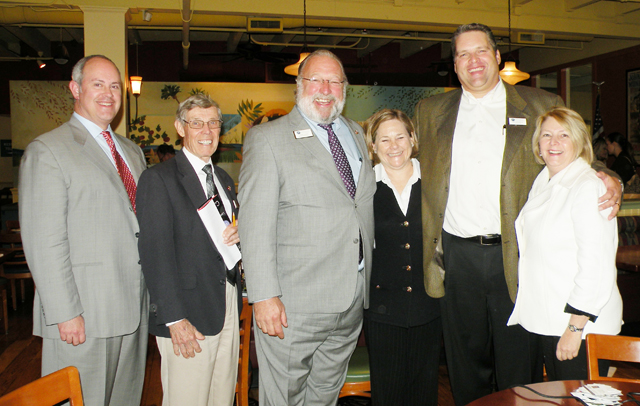
Pictured left to right: SILVAR Executive Officer Paul Cardus, Board Director John Tripp, 2010 President-elect Gene Lentz, C.A.R. Vice President and Chief Economist Leslie Appleton-Young, Los Gatos/Saratoga District Chair Bill Rehbock and 2011 President-elect Suzanne Yost.
At a broker panel held at the Silicon Valley Association of REALTORS® Palo Alto District tour meeting last Friday, Tim Foy, a broker with Midtown Realty, refuted the popular sellers’ notion that spring is the best time to put their house on the market.
“It’s a myth, and it’s especially not true in this market. We need to bust the myth about waiting till spring. Now is an outstanding time to put your house on the market,” claims Foy.
Foy notes MLSListings data shows since September 1, 69 percent of homes have sold in Palo Alto in 14 days or less. “It says we have a lack of supply, which means it’s a great time to be a seller!” according to Foy.
Foy questions why a seller would wait till spring when that’s when competition from other sellers comes into the market. While people say it’s a phenomenal time for buyers, it is also a phenomenal time for sellers. Foy explains right now, competition among sellers is significantly lower. There are buyers out there, but inventory is low. In fact, the brokers report multiple offers are being made on million dollar properties.
In this market, for sellers, as well as buyers, “there is risk in waiting” because you never know how long the record low interest rates will last, according to panelist Michael Dreyfus, a broker with Dreyfus Properties in Palo Alto.
“It’s an outstanding time to buy, but it’s also an outstanding time to sell. Don’t wait for your competition. Don’t wait for interest rates to rise. Get your property out there now,” Foy tells sellers.

- The panel of local brokers included (left to right) Tim Foy of Midtown Realty, Bob Taylor of Taylor Properties, Robert Stelzer of Keller Williams Realty and Michael Dreyfus of Dreyfus Properties.

The panel discussed other important real estate-related issues too. Bob Taylor of Taylor Properties reminds REALTORS® that not all agents do business the same way. He says Silicon Valley agents need to continue to “be diligent in our business, and not casual as in other places.”
Bob Stelzer, a broker with Keller Williams Realty, focused on the importance of the MLS (multiple listing service) and stresses agents who are members of the MLS have a duty to their client to share their listings in the MLS.
Dreyfus says market expectations need to change. Market conditions are not normal today, but they weren’t “normal” a couple of years ago either. In the current market, homes are not going to experience quick, massive appreciation, and the challenge is “how to sell without saying the market is not going to go up by much.”
Dreyfus says the key is in reshaping market expectations away from appreciation and refocusing on the traditonal goals of home ownership – to buy a home because it is a great home, because Palo Alto is a great place to live, and not because you expect the home to appreciate quickly.
This week, voters across the nation went to the ballot box and the electorate’s vote resulted in a clear change in direction for Congress. While the results in California and locally broke the national trend, many of the results will impact our industry.
In Washington, D.C.: Voters ousted roughly 60 Democratic members of the Congress, giving the Republican Party a majority in the U.S. House of Representatives. Although Democrats lost the majority in the House, they were able to maintain control of the U.S. Senate by three votes. Republicans, however, have enough senators to bring any vote to a grinding halt through a filibuster on party-line issues. The National Association of REALTORS® feels confident it will be able to work with the new majority in the House. NAR is one of the most effective lobbying forces on Capitol Hill. Preserving the mortgage interest deduction and getting the housing market back on track will continue to be key priorities for NAR.
In Sacramento: Jerry Brown was soundly elected back as California’s governor and the Democrats still maintain a majority in the state legislature. The California Association of REALTORS® did not have a position on the gubernatorial race, but C.A.R. has a strong relationship with the governor-elect and is confident it will be able to continue that relationship over the next four years. Many key appointments will be made in the near future, including that of DRE commissioner. These appointments will have a direct impact on REALTORS®. C.A.R.-supported Rich Gordon, was also elected to replace termed-out Assembly member Ira Ruskin.
On the proposition front, C.A.R.-opposed Proposition 19 (legalization of marijuana) was defeated. It was the only proposition on which C.A.R. took a position. With its defeat, landlords will continue to have the right to prohibit tenants from smoking, growing and possessing marijuana on their property.
Two other successful propositions, Proposition 25 and Proposition 26, will have a lasting impact at the state and local level. Prop. 25 lowers the legislative voting threshold for approving a budget from two-thirds to a simple majority. This new lower threshold might have resulted in a proliferation of property transfer fees and new withholding requirements for REALTORS®, but Prop. 26 makes that possibility remote. Prop. 26 will prohibit the legislature and local governments from raising or creating fees without a two-thirds vote (for local governments it is a two-thirds vote of the people). Experts believe with the passage of the two propositions, it will be easier to make cuts to services, but harder to raise taxes and fees. Prop. 26 will have a significant impact on local governments, where fees for everything from business licenses to recreational classes will now require citywide votes.
In the Valley: SILVAR PAC saw mixed results in this election, but is confident its interests will still be protected at the local level. SILVAR PAC had endorsed Measure E, a parcel tax for the Foothill De Anza Community College District, and opposed Measure Q in Saratoga, a two-story height limit for commercial and office property. Measure E, which would have insulated the district from many of the budget cuts made by the state and preserve many key educational programs, was defeated.
After providing significant support behind an opposition campaign against Measure Q, the election is still too close to call. The opposition is currently ahead by 39 votes, with over 100,000 ballots still outstanding countywide. If Measure Q is defeated, it will be a huge victory for businesses and property owners in Saratoga.
The candidates endorsed by SILVAR PAC saw both strong victories and disappointing losses. Here is a quick breakdown of those races:
Santa Clara County Board of Supervisors, District 1: SILVAR PAC-endorsed Mike Wasserman was successful in his election bid, and will now replace termed-out Supervisor Don Gage on the board.
Santa Clara Valley Water District, Seat 7: SILVAR PAC-endorsed Lou Becker was defeated by environmental lobbyist Brian Schmit.
Atherton Town Council: SILVAR PAC-endorsed Bill Widmer received the most votes in the election, and will be a fresh new voice in a town council that has seen much contention in recent years.
East Palo Alto City Council: Both SILVAR PAC-endorsed candidates Ruben Abrica and David Woods were re-elected.
Los Altos Town Council: SILVAR PAC-endorsed incumbent Val Carpenter, was successful in her re-election bid and council newcomer Jarrett Fishpaw was successful waging an upset against former council member Curtis Cole. Fishpaw was financially supported by SILVAR PAC, and will bring fresh ideas and perspective to the council.
Los Altos Hills Town Council: SILVAR PAC-endorsed John Radford and Gary Waldeck were both successful in their election bids to serve on the council for the first time.
Los Gatos Town Council: All three SILVAR PAC-endorsed candidates, including incumbents Diane McNutt and Joe Pirzynski and REALTOR® Steve Leonardis, were elected to the council.
Menlo Park City Council: SILVAR PAC-endorsed Rich Cline and newcomer Peter Ohtaki were both elected to the council, with non-endorsed incumbent Heyward Robinson failing to win re-election.
Monte Sereno City Council: In the most heartbreaking result in the election, SILVAR PAC-endorsed mayor and REALTOR® Don Perry was denied a second term on the council by voters. His advocacy for the rights of homeowners will be missed on the council.
Mountain View City Council: Both SILVAR PAC-endorsed incumbents Margaret Abe-Koga and Jac Siegel were re-elected.
Saratoga City Council: In a very close election, the sole SILVAR PAC-endorsed candidate Chuck Page was re-elected to the council, earning more votes than any other candidate.
Most of the positions taken by SILVAR PAC were supported by member contributions to the REALTOR® Action Fund. Our success could not be possible without your generous support!
By Adam Montgomery, SILVAR Government Affairs Director
Since August, SILVAR has been working to support property owners, businesses and residents in Saratoga, to work against an ill-conceived two-story height limit measure in Saratoga (Measure Q).
Going into the last two days of the campaign, there are almost no new ways to convince voters on an issue, so I would usually save my breath, but an e-mail I received this weekend, while picking out pumpkins with my wife, inspired me to share some thoughts on the current state of affairs in Saratoga.
On Saturday, I was forwarded a chain e-mail that originated as a neighborhood alert, warning residents through an alarming recent account of a robbery at gunpoint that occurred at a Saratoga home. A comment made by a supporter of Measure Q in the chain left me speechless: “Vote YES on Q. Do we really need to draw more attention to Saratoga?” The only way to interpret this comment is that either the campaign has directly contributed to the robbery, or a NO vote would mean more armed robberies.
This comment might make sense if this was a campaign to support public safety funding, but for a ballot box zoning measure to limit commercial, retail and office property to two stories for 30 years, is inflammatory. As I learned back in Constitutional Law 101, defamation is not a protected form of speech, but along with fear and intimidation, this has been a cornerstone for the YES campaign.
This is simply the nastiest campaign I have ever witnessed. Beyond the theft of over 150 legally placed signs in opposition to Q, threats of boycotts against businesses against Q, and unsolicited harassment of residents at street corners or at their home if they openly oppose Q, there have been many lies put out in support of Q.
Lie #1: SILVAR has no representation in Saratoga, with no board members residing there, and they should have no say over the residents of Saratoga. SILVAR does have a board member who lives in Saratoga – his name is Bryan Robertson. SILVAR also has over 300 members living there, representing over one percent of the population. Also, since when do REALTORS® have no say on real estate and land use issues? Last we checked, that is our bread and butter.
Lie #2: Measure Q will bring less attention, preventing armed robberies. The complete opposite may be true. Measure Q’s restrictions will turn businesses away from locating downtown, creating more blight and restricting the tax base used to fund public safety. Remember the broken glass theory – with blight and less foot traffic, come vagrants, loiterers and crime.
Lie #3: Measure Q will prevent overcrowding of Saratoga schools. Saratoga’s enrollment numbers have been declining for years. Downtown is the only area that could allow more than two stories under current height limits, which is not zoned currently for residential development. Also, the Measure Q restrictions will negatively impact commercial property value and tax receipts, reducing school revenues.
Lie #4: Without Measure Q, small businesses will be pushed out of Saratoga. There are no plans under the current rules changed by Measure Q to evict businesses. Business is going really bad in downtown, which has lost 30 businesses so far. Without some significant investment, Saratoga’s downtown will slowly dwindle into a ghost town. Measure Q will kill that investment and wipe out the businesses that have weathered this recent downturn.
Lie #5: Only out-of-towners oppose Q, most of the moneys spent against Q is from Los Angeles. Over 400 residents and businesses have shared their names in opposition to Q, including three council members and four planning commissioners. Our PAC is shared with the California Association of REALTORS®, which is located in Los Angeles, but our Saratoga members have given more money into the REALTOR® Action Fund in this election cycle than has been expended towards the campaign.
What is the moral of this story?
First, voters should not be making complicated land use decisions through the ballot. Voters chose their leaders to listen to their concerns, entrusting them to make the most educated and fair decisions to benefit of the entire community. Land use campaigns always fall victim to emotional and erroneous information. If poorly weighed, these campaigns can handcuff a city’s control over its own jurisdiction.
Second, our association has a duty to conduct our advocacy efforts at the same high ethical levels as our members in their business. We have resisted the temptation to run a tit for tat campaign by not resorting to cheap tricks and questionable behavior; instead, we have focused on educating voters on the facts of the measure. The good news is issue campaigns are usually won or lost on the merits of the arguments used. The more time spent slinging mud at your opposition, instead of the issue, does not typically bear good results.
Tomorrow, voters will go to the polls to decide on several elected offices and ballot measures across the state. To find if you are registered to vote or if your ballot has been received or your polling place location, please visit www.sccvote.org for Santa Clara County voters, or www.shapethefuture.org for San Mateo County voters.
Below you will find SILVAR PAC (Political Action Commitee) and California Association of REALTORS® endorsements, which are based on the best interests of homeowners, business and property rights. Most of the positions are supported by financial contributions and actively supported in part by members’ contributions to the REALTOR® Action Fund.
Measure Q, Saratoga, Two-story Limit for Commercial and Office Properties, Vote NO. If passed, Measure Q will prevent buildings in the commercial and office zoning district to exceed two stories for the next 30 years, and the only way buildings would be able to exceed two stories in the downtown core and other job centers in Saratoga is if this measure goes back to a citywide vote for approval. If approved in November, Measure Q will be devastating for Saratoga’s ability to revitalize the downtown (the Village) and bring new businesses into the city. It will also move future development away from the very place residents want it, which is downtown.
Measure E, Foothill De Anza Community College District, Vote YES. Measure E seeks a $69 per year parcel tax for six years. The revenue from this tax will supplement educational programs at both Foothill and De Anza community colleges, to counteract cuts made by the state. Both community colleges serve as vital assets to the economy, as backbones for the educational strength of northern Santa Clara County. Measure E will ensure Foothill and De Anza remain among the top community colleges in the nation.
Proposition 19, Vote NO. This is the only state proposition on which the California Association of REALTORS® (C.A.R.) has taken a position. If approved by voters, this proposition will legalize and tax marijuana. C.A.R. opposes Prop. 19 because it will give constitutional protections to individuals who smoke, possess and cultivate marijuana in their home, regardless of ownership, with vague and unenforceable exclusions. Specifically, if tenants wish to smoke marijuana in a rental unit, they are required to ask for permission, but there is no language in Prop. 19 to protect the landlord’s ability to refuse, nor does it say that the tenant must be granted permission. C.A.R. believes Prop. 19 is too vague regarding the tenant-landlord relationship, which will lead to many disputes and loss of control of the property owner over writing and enforcing the terms of a lease agreement.
Below is a list of candidates seeking local elected office, whom we feel believe strongly in the value of homeownership and will keep the interests of homeowners and private property rights in mind:
• Santa Clara County Board of Supervisors, District 1: Mike Wasserman
• Santa Clara Valley Water District, Seat 7: Lou Becker
• Atherton Town Council: Bill Widmer and Cary Wiest
• East Palo Alto City Council: Ruben Abrica and David Woods
• Los Altos Town Council: Val Carpenter and Curtis Cole
• Los Altos Hills Town Council: John Radford, Joan Sherlock and Gary Waldeck
• Los Gatos Town Council: Steven Leonardis, Diane McNutt and Joe Pirzynski
• Menlo Park City Council: Chuck Bernstein, Rich Cline and Peter Ohtaki
• Monte Sereno City Council: Don Perry and Toni Yamamoto
• Mountain View City Council: Margaret Abe-Koga and Jac Siegel
• Saratoga City Council: Chuck Page
Remember, Election Day is tomorrow, November 2!
PRDS Forms is an extensive line of paper and online forms used in the buying and selling of residential real estate. These forms are available online for free as a member benefit to all REALTOR® members of SILVAR and SAMCAR (San Mateo County Association of REALTORS®).
What makes these forms special?
These forms are created by REALTORS® for REALTORS®, and are trademarks of Advanced Real Estate Solutions, Inc., a subsidiary of the Silicon Valley Association of REALTORS®. These forms are highly acclaimed, and have been heavily used for over 25 years by listing agents from leading offices in Silicon Valley and the San Francisco Peninsula. In fact, some listing agents will entertain only offers presented on those forms.
PRDS forms are unique to the Santa Clara County and San Mateo County markets. While the California Association of REALTORS® also has a list of forms that are standard use for all the contracts, PRDS forms have a different template and verbiage, which is more unique to these regions. PRDS forms are designed with a litigation avoidance/risk management focus – every form is backed by liability insurance. These forms are also responsive to mandated legal changes, regional issues and current market conditions because the Standard Forms Committee, composed of 25 members from SILVAR and SAMCAR, meets every other week and works very hard to make sure all forms are current and reflect local practice.
“We continually update these forms and add new forms to make them compatible with different areas, as laws and market conditions change in each city,” said Mark Burns, president of the PRDS Board of Drectors. “We make REALTORS® aware of these changes and look out for our members.”
Depending on the city in which a residence is located, forms explaining the local option for airport noise, water heater and smoke detector compliance, disclosure regarding safety improvement projects, certain inclusions with regard to inspections and disclosures, may be incorporated in the PRDS forms packet. Attorneys on the committee assist committee members in continually updating the forms when needed.
PRDS forms contain all the other common forms that pertain to agency disclosure, including TDS (Transfer Disclosure Statements), a Supplemental Seller’s Checklist, etc. They are also less expensive to members when compared to other forms. The paper form may be purchased at each association’s store, but SILVAR and SAMCAR REALTOR®) members may obtain the forms online for free.
For a broker, providing agents paper forms might not seem like a big cost, but it can be. Every set of PRDS forms costs from $1 to $1.50 each. The cost adds up when agents use thousands of forms a year. If agents used the form electronically, there is no cost to the broker. Mistakes can easily be fixed online so the forms look professional, give buyers an edge, and ultimately help agents achieve their goal – a successful sale.
Replying to a question on Trulia.com, SILVAR member Aaron Wheeler, president of Oakville Properties & Oakville Capital, wrote “I like to use these forms as they are very pro-buyer, and there is less opportunity for error (look at all of the different checkboxes on the CAR contract, I see too many agents make mistakes). They also incorporate “as-is” language into the contract very nicely.”
Sebastian Wong, REALTOR® with Asante Real Estate Group and a SILVAR member, explains it well in his blog. He writes, “I personally think that PRDS gives more protection for the buyer because I think the verbiage is better. … For all you buyers and sellers out there, this may be a question you want to ask your agent. What association are you with? … While the forms aren’t such a big deal for all, if you are buying in Cupertino, most houses here are done with PRDS. If your agent is a C.A.R. user, they might have no experience using the PRDS forms and might overlook something. Just something to look out for!”
There are more good things about these forms. This summer, Instanet Solutions and Advanced Real Estate Solutions, a wholly owned subsidiary of SILVAR, provided SILVAR REALTOR® members with access to PRDS Forms via InstanetForms, as a member benefit. This means PRDS users are now able to access their forms ANYWHERE and ANYTIME, from virtually any Internet-connected PC or Mac.
Also, PRDS will soon be coming out with a new advisory for use in San Mateo and Santa Clara counties that will be “faster, better, easier for REALTORS®,” Burns said. The new PRDS advisory is for the counties of San Mateo and Santa Clara, replaces C.A.R.’s SBSA, and encompasses a wide variety of regional and proprietary advisories and disclosures. Best of all, Burns said the PRDS advisory in draft form is just 16 pages long.
Stay tune for this new PRDS advisory!
In a span of one week, two top officials have told Silicon Valley REALTORS® that, at least for the Bay Area, particularly the Silicon Valley region, the worst for home sales is over, that there are better days ahead. However both of these officials said a full recovery will take time.
At a general membership meeting of the Silicon Valley Association of REALTORS®, National Association of REALTORS® Chief Economist and Senior Vice President of Research Dr. Lawrence Yun told REALTORS® “the worst in (home) sales is clearly over. … Even in the worst market, the bleeding has stopped.”
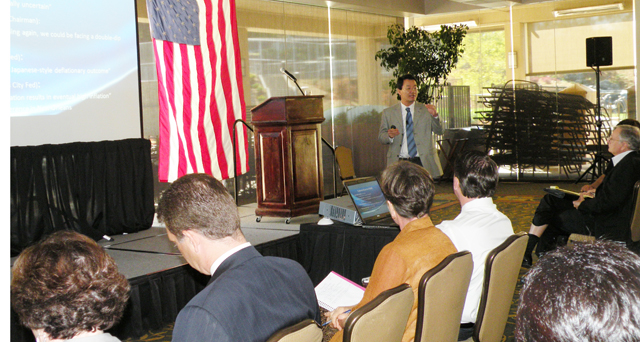
Dr. Yun at the SILVAR general membership meeting.
Yun said, particularly in the San Francisco –San Jose area, the bottom has already occurred and prices are beginning to firm up.
California’s housing market recovery started even before the home buyer tax credit, according to the national economist. “California’s housing market correction was short, sharp and fast,” Yun said.
The key test will be this winter. “If this winter’s sales match up with other winter home sales, I would say that would be a very positive sign,” Yun said. “Let’s give it time.”
In the meantime, Yun said those with strong credit who can buy, should buy, while mortgage interest rates are still at a 50-year low.
“I don’t expect rates to remain low. They may increase next year,” Yun said. “If you’re willing to stay well within a budget and are comfortable with it, at a 4.4 mortgage interest rate you’re protected under inflation.”
Check out Yun’s PowerPoint presentation here.
****
California Department of Real Estate Commissioner Jeff Davi spoke at a SILVAR District tour meeting in Los Gatos last week and said much of the same thing. He told REALTORS® that “there are better days ahead.”
Davi marveled at the vast improvement in housing affordability and historically low interest rates. “I promise you this, rates are not going to stay at 3 or 3.5 percent fixed. The affordability index is fabulous. Buyers are now better off. They have great opportunities in this market,” Davi said.
****
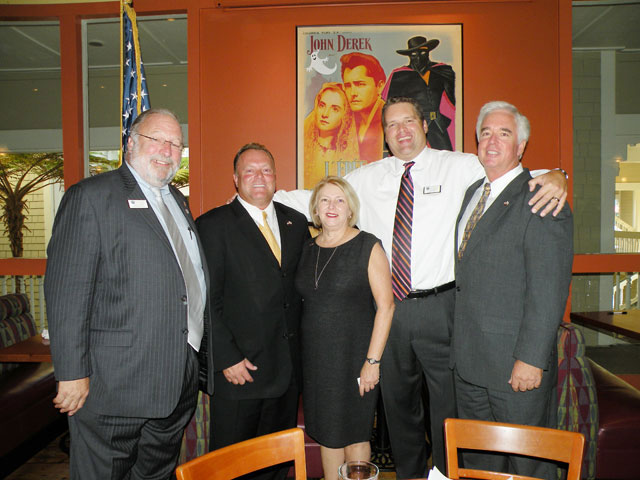
Left to right: SILVAR President-elect Gene Lentz, DRE Commissioner Jeff Davi, Board Director Suzanne Yost, Los Gatos/Saratoga District Chair Bill Rehbock and C.A.R. Past President Jim Hamilton.
So, what’s holding back a full recovery?
Yun said the unemployment rate has stopped rising dramatically, but it is still high, and while we are seeing some job creation, it’s not coming quick enough and not large in numbers. Corporate profits are rising, but business spending is down. Businesses continue to hesitate because they’re uncertain about how they will be impacted by health care legislation, the recently passed financial regulatory bill and potential taxes. Right now, they realize they can still make a profit with fewer employees.
“We need job creation. If business spending increases, the economy would be more robust,” Yun said.
Pay attention to foreclosure numbers, as these numbers will signal what’s ahead, Davi said. In 2006, there were 12,000 foreclosures. In 2008, there were 240,000 foreclosures. Last year, the number of foreclosures slightly fell to 200,000 – still a lot, but a good sign, nevertheless. Foreclosures need to get back to the 2006 level, Davi said.

 Silicon Valley Association of REALTORS® says ...