
You are currently browsing the category archive for the ‘California Housing Market’ category.
In an effort to be in compliance with federal case law and to have an enforceable sign ordinance, the Los Altos City Council unanimously approved two new sign ordinances this week. The ordinances dealing with signs on private and public property will be enforced starting December 30. A final version of the ordinances will be released shortly, but here’s a view of the draft ordinances.
There are changes included in the new ordinances that impact REALTORS®. The biggest change is when it will be permissible to place an open house sign on public property. These amendments were necessary to ensure that the sign rules had reasonable time and place restrictions for open house signs to prevent a legal challenge similar to what occurred in Menlo Park and led to a citywide ban of all signs on public property.
Here is a brief overview of the new rules for real estate and open house signs for Los Altos:
Residential on-site signs:
• One non-illuminated for sale sign allowed per property.
• For sale sign can be no taller than six feet in height and the sign face no larger than four square feet.
• Up to 12 square feet of real estate signage is allowed per property, which allows for both an A-frame open house sign and a for sale sign to be placed on private property at the same time.
• There are no day or time restrictions for real estate signs on private property.
Residential off-site open house signs:
• Size: A-frame signs no larger than four square feet per face, plus two riders, can be no taller than 32 inches.
• Location: Only on sidewalks where it does not obstruct pedestrian or bicycle access, cannot be placed on any medians or on the expressway right-of-way.
• Number per intersection: A single open house can only have one sign per intersection.
• Time restrictions: Signs will only be permitted during the following days and times:
o Friday: 9 AM-1:30 PM
o Saturday, Sunday and Holidays: 11:30 AM – 6 PM
A final version of the ordinance will be distributed to members once it is available.
After providing significant support behind an opposition campaign against Measure Q in Saratoga, SILVAR is pleased the measure proposing a two-story height limit for commercial and office property appears doomed.
The article, written by Joe Rodriguez of the Mercury News, concludes there are still ballots to be counted, but the measure is essentially headed for defeat. Rodriguez questions whether this would mean the Village “could grow taller than the town’s majestic redwood trees, and would development and increased traffic harm the surrounding neighborhoods,” as proponents of the measure fear.
Not so, says Councilman Chuck Page. Page, who won re-election and opposed the measure, says in the article that a previous 35-foot building height remains in effect and would prevent high-rise developments.
“The planning commission isn’t going to let anyone build to the max,” Page said in the article. “We have to do everything smartly and retain the character of the town, which is what everyone wants.”
Measure Q’s defeat is a huge victory for businesses and property owners in Saratoga!
Coldwell Banker Residential Brokerage, the Bay Area’s leading real estate services company, announced today that it has acquired Cashin Company Realtors, one of the Peninsula’s largest and most prestigious local brokerage companies.
According to a press statement released by Coldwell Banker earlier today, the move continues Coldwell Banker Residential Brokerage’s strong trajectory of growth on the Peninsula and in the Bay Area. Founded in 1995 by Emmet J. “Skip” Cashin III, the Cashin Company Realtor’s team of 270 real estate professionals in seven offices throughout San Mateo County accounted for more than $1 billion in annual sales volume in the last 12 months.
The seven-office, 270-agent firm will now operate under the banner of Coldwell Banker Residential Brokerage. With this announcement, Coldwell Banker Residential Brokerage in the San Francisco Bay Area now has more than 60 offices and 3,500 sales associates who accounted for more than $11 billion in sales volume last year.
“Cashin Company has been a highly successful real estate brokerage on the Peninsula for many years,” said Rick Turley, president of Coldwell Banker Residential Brokerage in the San Francisco Bay Area. “They are a perfect fit with Coldwell Banker in terms of our respective cultures, our core values and our strength in the local marketplace, especially in the luxury market.
Cashin said his firm had many suitors in recent years, but decided that Coldwell Banker Residential Brokerage was the right choice in terms of the scale and scope of the nation’s leading brokerage company, agent support, technological tools, networking opportunities, and cultural fit.
“Coldwell Banker shares our culture of service excellence that values customized service for each and every client,” he said. “Additionally, they are the premier real estate brand around the world and offer a robust marketing platform and referral network that will help our sales associates achieve even greater results for their clients.”
Turley and Cashin announced the acquisition this morning in an informal meeting with Cashin Company managers and agents. The press release goes on to state that Turley and other Coldwell Banker Residential Brokerage executives will visit all of the former Cashin Company offices in the coming days to meet individually with agents and hear their ideas for ways the company can better support agent goals and help them grow their businesses.
Many of SILVAR’s REALTOR® members belong to both companies. An article on the acquisition is in the Silicon Valley/San Jose Business Journal.
California Association of REALTORS® Vice President and Chief Economist Leslie Appleton-Young agrees with National Association of REALTORS® Chief Economist and Senior Vice President of Research Dr. Lawrence Yun.
“Absolutely the worst is over, but we will have a slow recovery,” Appleton-Young told SILVAR members at this morning’s Los Gatos/Saratoga District tour meeting.
Here are some positive signs:
- GDP (Gross Domestic Product), which showed a drop of 2.6 percent in 2009 – the largest drop since 1938 – is rising slowly. GDP was up 1.7 percent in 2010 Q2, and up 2 percent in 2010 Q3. There has been positive growth in the economy for the last five quarters. It shows the federal government’s economic stimulus has worked, Appleton-Young said.
- The Consumer Confidence Index in October was at 50.2, up from 48.6 in September.
- Consumer spending was at 1.9 percent in 2010 Q2.
Unfortunately, it’s still not enough to convince businesses that they should expand, she said.
Consumers are downsizing and maintaining the attitude that “less is more.” They are shopping at discount stores like Walmart, so luxury goods are struggling.
“We can’t look to consumers to drive this recovery,” Appleton-Young surmised. “There’s nothing positive on the horizon for consumers right now, and there won’t be until we start to see positive job numbers and this whole labor market starts to turn around.”
Appleton-Young said California is seeing more challenges than the rest of the nation because Sacramento and regional and local governments “are working to make things worse” with their cutbacks and layoffs. Big losers in California are construction, manufacturing, trade and transportation and financial activities. The winners continue to be education, health services, leisure and hospitality.
Appleton-Young said inflation is 18 months to two years away, but she believes a dose of inflation and increase in interest rates would actually be a positive sign that the economy is moving forward.
2011 will be “a lackluster year,” with no significant job growth till late in the year, said Appleton-Young. She doesn’t anticipate that there will be any meaningful reforms next year, as “the government has done all it can to make funds available.”
“As John Maynard Keynes put it, ‘You can’t push on a string,’ you make money available, but if the banks don’t want to spend …,” she commented.
For 2011, the C.A.R. chief economist anticipates a GDP growth of 2.4 percent. For California, a job growth of 1.6 percent; unemployment at 11.4 percent, home sales up by about 2 percent and a slight rise in the median price by about 2 percent.
“We’re still seeing limited inventory of good distressed properties and still very nostalgic upper-end sellers who are not appreciating the market we have today. They are going through a very painful situation,” she said.
According to Appleton-Young, the wild cards for 2011 are:
- Another recession? Some people think there could be a double dip.
- Federal economic policies – there is much uncertainty regarding future tax rates
- Negative equity home owners – there are still many home owners who borrowed excessively against their home equity
- Shadow inventory – distressed sales will continue to factor in the marketplace for four to five more years because there is still a large pool of home owners underwater.
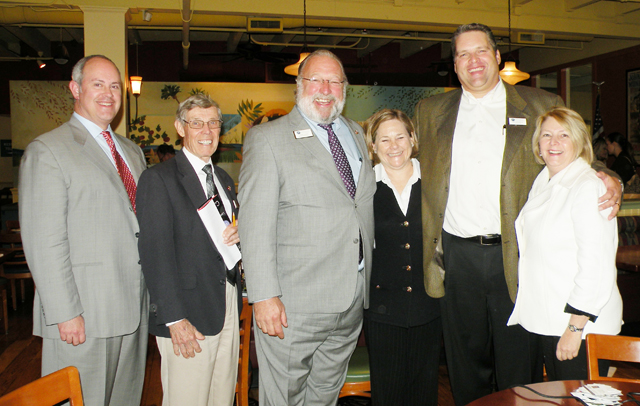
Pictured left to right: SILVAR Executive Officer Paul Cardus, Board Director John Tripp, 2010 President-elect Gene Lentz, C.A.R. Vice President and Chief Economist Leslie Appleton-Young, Los Gatos/Saratoga District Chair Bill Rehbock and 2011 President-elect Suzanne Yost.
At a broker panel held at the Silicon Valley Association of REALTORS® Palo Alto District tour meeting last Friday, Tim Foy, a broker with Midtown Realty, refuted the popular sellers’ notion that spring is the best time to put their house on the market.
“It’s a myth, and it’s especially not true in this market. We need to bust the myth about waiting till spring. Now is an outstanding time to put your house on the market,” claims Foy.
Foy notes MLSListings data shows since September 1, 69 percent of homes have sold in Palo Alto in 14 days or less. “It says we have a lack of supply, which means it’s a great time to be a seller!” according to Foy.
Foy questions why a seller would wait till spring when that’s when competition from other sellers comes into the market. While people say it’s a phenomenal time for buyers, it is also a phenomenal time for sellers. Foy explains right now, competition among sellers is significantly lower. There are buyers out there, but inventory is low. In fact, the brokers report multiple offers are being made on million dollar properties.
In this market, for sellers, as well as buyers, “there is risk in waiting” because you never know how long the record low interest rates will last, according to panelist Michael Dreyfus, a broker with Dreyfus Properties in Palo Alto.
“It’s an outstanding time to buy, but it’s also an outstanding time to sell. Don’t wait for your competition. Don’t wait for interest rates to rise. Get your property out there now,” Foy tells sellers.

- The panel of local brokers included (left to right) Tim Foy of Midtown Realty, Bob Taylor of Taylor Properties, Robert Stelzer of Keller Williams Realty and Michael Dreyfus of Dreyfus Properties.

The panel discussed other important real estate-related issues too. Bob Taylor of Taylor Properties reminds REALTORS® that not all agents do business the same way. He says Silicon Valley agents need to continue to “be diligent in our business, and not casual as in other places.”
Bob Stelzer, a broker with Keller Williams Realty, focused on the importance of the MLS (multiple listing service) and stresses agents who are members of the MLS have a duty to their client to share their listings in the MLS.
Dreyfus says market expectations need to change. Market conditions are not normal today, but they weren’t “normal” a couple of years ago either. In the current market, homes are not going to experience quick, massive appreciation, and the challenge is “how to sell without saying the market is not going to go up by much.”
Dreyfus says the key is in reshaping market expectations away from appreciation and refocusing on the traditonal goals of home ownership – to buy a home because it is a great home, because Palo Alto is a great place to live, and not because you expect the home to appreciate quickly.
In a span of one week, two top officials have told Silicon Valley REALTORS® that, at least for the Bay Area, particularly the Silicon Valley region, the worst for home sales is over, that there are better days ahead. However both of these officials said a full recovery will take time.
At a general membership meeting of the Silicon Valley Association of REALTORS®, National Association of REALTORS® Chief Economist and Senior Vice President of Research Dr. Lawrence Yun told REALTORS® “the worst in (home) sales is clearly over. … Even in the worst market, the bleeding has stopped.”
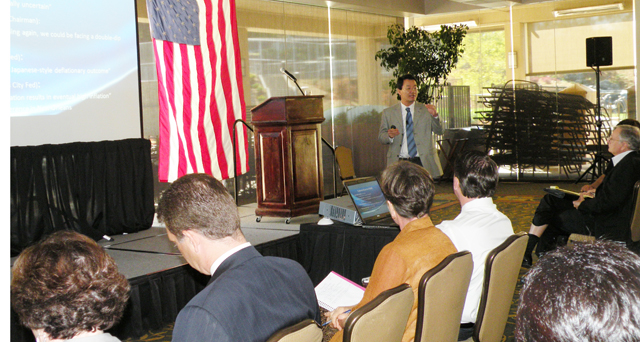
Dr. Yun at the SILVAR general membership meeting.
Yun said, particularly in the San Francisco –San Jose area, the bottom has already occurred and prices are beginning to firm up.
California’s housing market recovery started even before the home buyer tax credit, according to the national economist. “California’s housing market correction was short, sharp and fast,” Yun said.
The key test will be this winter. “If this winter’s sales match up with other winter home sales, I would say that would be a very positive sign,” Yun said. “Let’s give it time.”
In the meantime, Yun said those with strong credit who can buy, should buy, while mortgage interest rates are still at a 50-year low.
“I don’t expect rates to remain low. They may increase next year,” Yun said. “If you’re willing to stay well within a budget and are comfortable with it, at a 4.4 mortgage interest rate you’re protected under inflation.”
Check out Yun’s PowerPoint presentation here.
****
California Department of Real Estate Commissioner Jeff Davi spoke at a SILVAR District tour meeting in Los Gatos last week and said much of the same thing. He told REALTORS® that “there are better days ahead.”
Davi marveled at the vast improvement in housing affordability and historically low interest rates. “I promise you this, rates are not going to stay at 3 or 3.5 percent fixed. The affordability index is fabulous. Buyers are now better off. They have great opportunities in this market,” Davi said.
****
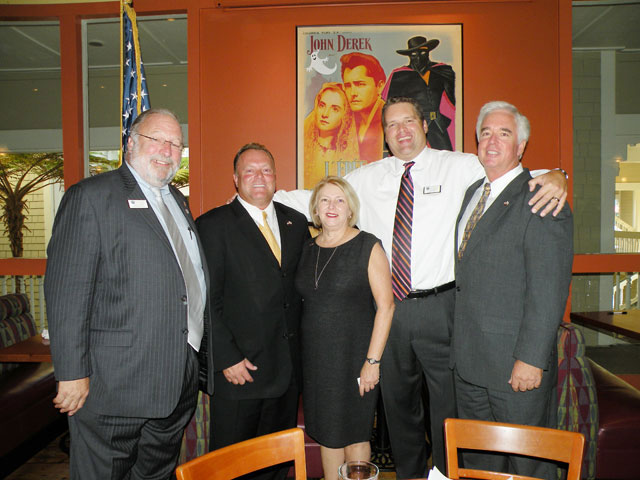
Left to right: SILVAR President-elect Gene Lentz, DRE Commissioner Jeff Davi, Board Director Suzanne Yost, Los Gatos/Saratoga District Chair Bill Rehbock and C.A.R. Past President Jim Hamilton.
So, what’s holding back a full recovery?
Yun said the unemployment rate has stopped rising dramatically, but it is still high, and while we are seeing some job creation, it’s not coming quick enough and not large in numbers. Corporate profits are rising, but business spending is down. Businesses continue to hesitate because they’re uncertain about how they will be impacted by health care legislation, the recently passed financial regulatory bill and potential taxes. Right now, they realize they can still make a profit with fewer employees.
“We need job creation. If business spending increases, the economy would be more robust,” Yun said.
Pay attention to foreclosure numbers, as these numbers will signal what’s ahead, Davi said. In 2006, there were 12,000 foreclosures. In 2008, there were 240,000 foreclosures. Last year, the number of foreclosures slightly fell to 200,000 – still a lot, but a good sign, nevertheless. Foreclosures need to get back to the 2006 level, Davi said.

 Silicon Valley Association of REALTORS® says ...