
You are currently browsing the tag archive for the ‘Qualified Residential Mortgage (QRM)’ tag.
Last Thursday, the Consumer Financial Protection Bureau (CFPB) released the “qualified mortgage” rule setting guidelines to ensure that home loans will be given only to qualified borrowers who can repay them, thus protecting consumers from predatory lending. Lenders who follow these rules in making a loan will be protected from liability.
While the QRM (qualified residential mortgage) overseen by the Federal Reserve has not yet been announced, the National Association of REALTORS® applauds the CFPB for creating a broadly defined Qualified Mortgage rule that establishes strong consumer protections while ensuring continued access to safe, affordable mortgage credit.
Under the new guidelines, which take effect on January 2014, lenders must obtain and verify an applicant’s financial information, including employment status, income, assets, debts, and credit history. Borrowers must have enough income or assets to repay the loans. Interest-only and undocumented income mortgages, including loans in excess of 30 years or in which the principal increases over time, will no longer be allowed.
Under the “ability to repay” rule set by the new guidelines, lenders will be required to look at a borrower’s ability to repay over the long term by looking at a borrower’s current income and assets, employment status, credit history, the mortgage monthly payment, other payments like property taxes and other debt obligations. A borrower’s total debt obligations, including the mortgage and other loan obligations is limited to 43 percent of the borrower’s monthly income.
There is no minimum down payment requirement for qualified mortgages. Earlier proposals of a down payment of as much as 20 percent in order to qualify for a mortgage raised concerns that such a requirement would disqualify potential borrowers from owning a home.
Banks are not required to follow either the QM or QRM rules; however, they probably will. By following the QM guidelines, lenders get a measure of protection from litigation. By following the QRM guidelines not yet announced, banks will be able to sell their loans to Fannie Mae and Freddie Mac.
NAR urges regulators to mirror the forthcoming Qualified Residential Mortgage rule after the QM rule to ensure affordable credit remains available to qualified borrowers.
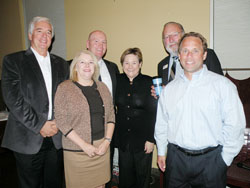
Pictured left to right are past C.A.R. President Jim Hamilton, SILVAR President-elect Suzanne Yost, Los Gatos/Saratoga District Chair Doug Evans, C.A.R. Vice President and Chief Economist Leslie Appleton-Young, SILVAR President Gene Lentz, and Los Gatos/Saratoga District Co-chair Chris Rasmussen.
California Association of REALTORS® Vice President and Chief Economist Leslie Appleton-Young told SILVAR members at last Wednesday’s Los Gatos/Saratoga District tour meeting that while the worst is over, the market continues to struggle with not much relief in sight.
“The tide has turned for housing, but now it’s stuck,” said Appleton-Young.
C.A.R.’s chief economist explained that the economy started to gain a bit of traction and seemed to be moving forward at the beginning of this year, but things happened one after another – Japan’s earthquake and tsunami, oil price spikes, uprisings in the Middle East, stock market volatility, the U.S. debt and the debt crisis in the euro zone. As a result, the housing market that appeared to be recovering is now stalled.
Lenders aren’t lending and consumer and entrepreneurial confidence continue to be low. As long as the jobs problem continues, she doesn’t expect consumer spending to improve by much. Mortgage rates have experienced a historical drop, “but you can’t push on a string. You can’t make people borrow; you can’t make lenders lend,” she said.
The good news is Santa Clara County is doing better than most parts of the state with just a 9.6 unemployment rate. In Santa Clara County, 35 percent of homes that closed escrow in September were distressed, but this is a far cry from places like Solano County, where in September 73 percent of homes that closed escrow in September were distressed sales.
The Bay Area has the best economy in California, in terms of income and job growth. “Companies in this valley are in the cutting edge, leading growth in the economy,” said Appleton-Young.
September single-family home sales were at 487,940 units. Absent more wild cards that could upset the economy, C.A.R. expects 491,000 unit sales by year-end and 496,000 unit sales in 2012, just a 1 percent increase from this year. California’s median price was $287,440 in September, down 8.3 percent from September 2010, but way above from when it bottomed in February 2009 at $245,230. C.A.R. expects the median price to hit $291,000 by the end of 2011 and to increase 1.7 percent to $296,000 in 2012.
Troubles are ahead because all levels of government will have to wrestle with issues of pensions and cost of health and other benefits for public employees. Appleton-Young said ultimately, everyone will have to answer for the deficit.
“It’s hard to do when in some places, the coffers are empty. You can’t spend more than you take in, even if you are the U.S. government. Everyone is going to have to give up something in the end,” she said.
Appleton-Young said in 2012, REALTORS® will need to watch the following federal issues closely – the future of Fannie Mae and Freddie Mac, changes in the tax treatment of real estate, including the definition of the QRM (Qualified Residential Mortgage), which could mean purchasing a home will be even more difficult and costly for consumers.


 Silicon Valley Association of REALTORS® says ...