
You are currently browsing the tag archive for the ‘California Association of REALTORS’ tag.
SILVAR REALTORS® received an upbeat message about the housing market from California Association of REALTORS® Vice President and Chief Economist Leslie Appleton-Young at Wednesday’s Los Gatos/Saratoga District tour meeting. Appleton-Young told REALTORS® the housing market is “the bright spot of the economy” and the fundamentals are sound.
“Yours is the strongest regional economy by far,” she told SILVAR REALTORS®.
Consumer confidence, though uneven, is getting better. Unemployment is heading down. The state, which lost 1.3 million jobs during the recession, has added 485,000 jobs since January 2010.
There is a shortage of inventory for various reasons. Homeowners with equity are still unwilling to sell at today’s prices. Others may want to sell but do not have enough equity in their homes for a down payment and closing costs for their next home. Then there are those who are stuck and cannot sell their home because they are underwater on their mortgage.
Appleton-Young said 29 percent of California borrowers are underwater and 4.4 percent are within 5 percent of being in negative equity. These performing loans may not be sustainable for the long-term. Despite this, Appleton-Young said it is an urban legend that lenders will flood the market with foreclosures after the election.
Mortgage rates are still at 50-year lows and the Federal Reserve has promised they will remain this way until 2015. Fifty percent of people living in the state can afford to buy a home, however many buyers can’t buy because investors are outbidding them; they are “living in the gray” due to a recent short sale, foreclosure or bankruptcy; or their credit scores are low and can’t meet lending requirements because banks continue to practice “defensive lending.”
Due to an improving economy and shortage of inventory, California home prices are snapping back slowly, said Appleton-Young. The California median home price increased 15.5 percent from August 2011 to $343,820. The statewide median home price is forecast to increase a moderate 5.7 percent to $335,000 in 2013. For this year, C.A.R. projects the California median home price will climb 10.9 percent to $317,000.
Strong demand is reflected in August 2012 home sales, which shot up 6.5 percent from August 2011. Appleton-Young said it has been a strong year without tax credits, government programs or stimulus. Of total sales of existing single-family homes in August, 62 percent of sales were traditional equity sales, 14.4 percent REOs and 23 percent short sales.
Appleton-Young projects home sales in 2012 will increase 5.1 percent from the 497,900 existing, single-family homes sold in 2011. The C.A.R. forecast sees sales in 2013 gaining 1.3 percent from this year’s sales.
“The market is working itself through,” said Appleton-Young.
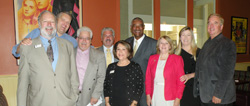
Left to right: SILVAR Past President Gene Lentz, Board Director Bill Rehbock, Affiliate Chair Richard Miller, Board Director David Tonna, President-elect Carolyn Miller, C.A.R. President LeFrancis Arnold, President Suzanne Yost, Los Gatos/Saratoga Chair Cassie Maas, and C.A.R. Past President Jim Hamilton
SILVAR members from the Menlo Park/Atherton and Los Gatos/Saratoga districts had the opportunity to meet and listen to California Association of REALTORS® President LeFrancis Arnold at their meetings this week. Meeting California REALTORS® across the country is part of his duty as president of the state REALTOR® association, said Arnold.
Arnold said SILVAR REALTORS® are very fortunate to be working and living in Silicon Valley because compared to other parts of the state, the region was not hit as hard by the housing downturn. He has observed the growing interest in residential real estate here and in the state from foreign buyers.
“The housing industry is one of the most important assets in California,” said Arnold. Proof of this is in the billions of dollars of residential real estate purchased by international investors. Arnold noted the top foreign buyers come from Canada, China, Mexico and Great Britain, and they are looking at properties in California.
“No immigrant comes to America with a desire to be a tenant. They dream of homeownership,” said Arnold.
Global real estate is growing in importance, said Arnold. Foreign investors and immigrants create opportunities and bring diversity not only in housing, but also in the election process. It is important that everyone, regardless of race, is given the opportunity for homeownership. Arnold said another part of his duty as C.A.R. president is to meet with legislators and deliver this message. It is what C.A.R., SILVAR and the National Association of REALTORS® do at the state, local and national levels.
Arnold underlined the importance of political advocacy. REALTORS® at the local, state and federal level fight legislation that will negatively affect homeownership and allow REALTORS® to be political activists. He stressed advocacy for homeownership needs to continue because the threats are very real, particularly proposals to impose transfer taxes and continuing discussions on eliminating or reducing the mortgage interest deduction (MID).

Left to right: SILVAR President Suzanne Yost, Menlo Park/Atherton Chair Chris Isaacson, C.A.R. President LeFrancis Arnold and SILVAR Past President Gene Lentz
Arnold said REALTORS® at the local, state and national level will continue to work as a team and fight legislation that hurts the American Dream of homeownership.
“Each of us has a role to play,” said Arnold. “We have to continue to fight for homeownership rights.”
In another move to protect struggling California homeowners, the California Association of REALTORS® (C.A.R.) is sponsoring a bill so homeowners who face losing their home and have negotiated a short sale in good faith with their lender or servicer are not forced to go through foreclosure.
Assembly Bill 1745 (Torres, D-Pomona) prevents lenders or servicers that have agreed to a “short sale” from foreclosing on a home. For any number of reasons (e.g., sickness, job loss, etc.), a homeowner may be unable to continue making his or her monthly mortgage payment. Rather than go through a lengthy and stressful foreclosure process, the homeowner will attempt to negotiate a “short” sale with the lender in which the lender agrees to accept less than the amount owed by the homeowner.
Foreclosures and short sales are usually handled by two different departments within banks. Unfortunately, these two departments often do not communicate with each other, which can frequently result in a homeowner being foreclosed upon, despite having previously negotiated a short sale with the same bank.
AB 1745 will likely result in banks implementing a dual tracking system to prevent foreclosing upon homeowners with whom they have already negotiated a short sale. The measure is scheduled for hearing on Monday, April 30 by the Assembly Banking and Finance Committee.
 Legislative Day is the day when REALTORS® from all over California travel to Sacramento and meet with their elected officials to discuss critical legislation that can affect REALTORS®, homeowners and private property rights. This year Legislative Day is on Wednesday, May 2.
Once REALTORS® arrive in Sacramento they will receive a special briefing from California Association of REALTORS® leadership and honorable guests, including California Governor Jerry Brown, who has confirmed that he will be speaking at the Morning Briefing.
A luncheon will follow the briefing. Dr. Tony Quinn, co-editor of California Target Book and non- partisan analyst of California’s legislative and congressional elections, will be the guest speaker at the luncheon with members of the Silicon Valley Association of REALTORS®. Dr. Quinn has 40 years experience with California state government. Currently, he is engaged in writing and elections analysis. During his career he has headed several public relations firms, directed the Office of Economic Research in the California Department of Commerce, served as Chief Consultant for Elections and Reapportionment and Policy Director of the Assembly Republican Caucus. He also served as a member of California Fair Political Practices Commission and assistant to the California Attorney General.
After lunch Silicon Valley REALTORS® will meet with their legislators, including Senators Elaine Alquist, Sam Blakeslee and Joe Simitian, and Assembly members Jim Beall, Paul Fong, and Rich Gordon. At these meetings REALTORS® will have the opportunity to discuss important real estate issues, such as private property rights, legal reforms and housing opportunity policies.
California REALTORS® are encouraged to attend Legislative Day. REALTORS® make up one of the largest groups that hit Sacramento every year.
The California Association of REALTORS® is OPPOSING SB 1220 (DeSaulnier), which imposes a transfer tax to generate funds for affordable housing.
C.A.R. is opposing SB 1220 because it will add to the cost of buying a home at a time when the housing market is struggling to recover. While C.A.R. is an aggressive advocate for affordable housing, the association believes it sets bad precedent to fund affordable housing by making housing less affordable.
Stay tuned for more information and a potential Red Alert!
The Carbon Monoxide Poisoning Prevention Act of 2010 became effective on July 1 and requires every existing single-family residence having a fossil fuel burning heater or appliance, fireplace, or an attached garage to install or plug in a carbon monoxide device. Other existing dwelling units will need to have the devices installed by January 1, 2013.
A carbon monoxide detector is a relatively inexpensive device, similar to a smoke detector that signals detection of carbon monoxide in the air. It can be battery powered or a plug-in device with battery backup. The following FAQs on what homeowners should know about the new carbon monoxide law are provided by the Silicon Valley Association of REALTORS® from information from the California Association of REALTORS®, in accordance with the California Health and Safety Code.
How many devices and where do I place them in the home?
It is recommended that for minimum security, a CO alarm should be centrally located outside of each separate sleeping area in the immediate vicinity of the bedrooms, at least six inches from all exterior walls and at least three feet from supply or return vents.
For new one-to-two family dwellings and townhouses not more than three stories and where work requiring a permit for alterations, repairs or additions exceeding $1,000 in existing dwellings units, a CO detector must be installed outside of each separate sleeping area in the immediate vicinity of the bedroom(s) and on every level, including basements within which fuel-fired appliances are installed and in dwelling units that have attached garages.
Are there any penalties for noncompliance with this law?
A violation is an infraction punishable by a maximum fine of $200 for each offense. However, a property owner must receive a 30-day notice to correct first. If an owner who receives such a notice fails to correct the problem within the 30-day period, then the owner may be assessed the fine.
Can a buyer rescind the sale if the dwelling doesn’t have the necessary carbon monoxide detectors?
While the Real Estate Transfer Disclosure Statement (TDS) has been amended to incorporate the seller’s certification that, by close of escrow, the seller will be in compliance with existing requirements for CO detector, smoke detector and water heater bracing, the TDS specifically states installation of a CO detector, among other appliances and devices, is not a precondition of sale or transfer of the dwelling.
Does a seller have any special carbon monoxide disclosure obligations?
Disclosure obligations are satisfied when providing a buyer with the TDS. If the seller is exempt from giving a TDS, the law doesn’t require any specific disclosures regarding CO detector devices.
Do landlords have any special obligations regarding carbon monoxide detectors?
All landlords of dwelling units must install carbon monoxide detectors. The CO device must be operable at the time that a tenant takes possession. However, the tenant has the responsibility of notifying the owner or owner’s agent if the tenant becomes aware of an inoperable or deficient CO device. The landlord is not in violation of the law for a deficient or inoperable CO device if he or she has not received notice of the problem from the tenant.
If the California Building Standards Commission adopts or updates building standards relating to carbon monoxide devices in the future, is the owner required to install the newer device?
Yes, when the owner makes an application for a permit for alterations, repairs, or additions to that dwelling unit with the cost exceeding $1,000.


 Silicon Valley Association of REALTORS® says ...