
You are currently browsing the tag archive for the ‘California Association of REALTORS’ tag.
The National Association of REALTORS® is asking its over one million members to email their representatives in Congress and ask for their help in protecting the real estate industry from patent trolls.
A patent troll is a company that owns a large number of patents, but does not produce any goods or services. The patent troll business model is to sue companies for infringing on the patents it owns, or to license those patents to companies for legal use. These companies are suing REALTORS® and other small businesses for patent infringement based on their use of common business tools like drop-down menus or scan-to-email technologies.
Patent trolls target REALTORS® through letters threatening lawsuits or actually filing lawsuits. These letters demand licensing fees to use common business tools, such as drop down menus or shopping cart features on websites. For many of those targeted, paying for the license is often much less expensive than defending the lawsuit.
Patent trolls hurt the real estate industry. The Innovation Act will close loopholes in our legal system that allow patent trolls to go after businesses like yours.
If you are a REALTOR®, take action now. Just click HERE, or go to your REALTOR® Action Center App on your phone and tell Congress to Vote YES on H.R. 9- The Innovation Act.
Click the link below and tell YOUR member of Congress to STOP Patent Trolls today!

Take advantage of SILVAR’s early bird special price and complete all classroom requirements needed to earn the National Association of REALTORS® (NAR) designation. The courses will be offered at SILVAR on September 30, October 1, 2, 5 and 6.
SILVAR is offering an early bird special for members and nonmembers through June 1 – $500 for the paper version, which includes a manual for each of the five courses offered, and $450 for the paperless option. After June 1, regular cost of the entire CIPS Institute is $600 for the paper option and $550 for paperless. Cost for an individual course is $175 for hard copy and $150 for paperless. Members may enroll online at ims.silvar.org. Non-members may register by contacting SILVAR Public Affairs & Communications Director Rose Meily at rmeily@silvar.org, or call (408) 200-0109.
The CIPS Institute provides training in international business issues, including currency conversion, cultural awareness, legal and tax requirements, ownership and transaction principles of international real estate, and specifics about the real estate markets in Europe, the Americas, and Asia. The week-long CIPS Institute includes two required core courses and three elective courses. Students must pass a multiple-choice exam at the end of each course.
David Wyant, 2012 and 2009 NAR International Instructor of the Year, will be returning to SILVAR to teach the CIPS Institute. Wyant has taught three previous CIPS Institutes at SILVAR and received excellent reviews.
Upon completing the required five courses and fulfilling other necessary requirements, applicants receive their CIPS designation and will have the opportunity to be recognized at the November 13-16, 2015 NAR REALTORS® Conference and Expo in San Diego.
Limited sponsorships for the CIPS Institute are available. Each sponsor is given the opportunity to speak for 20 minutes about their product or service on an assigned day. For more information, contact SILVAR Public Affairs & Communications Director Rose Meily at rmeily@silvar.org, or call (408) 200-0109.

A new survey from the National Association of REALTORS® (NAR) found while 96 percent of REALTORS® have never been a victim of crime, more than two-thirds (40 percent) have found themselves in situations where they have feared for their safety or the safety of their personal information. Some of the most common circumstances that resulted in fearful situations were open houses, showing vacant and model homes, working with properties that were unlocked or unsecured and showing homes in remote areas.
The survey asked members how safe they feel while on the job and nearly 3,000 Realtors from across the country answered questions about their personal experiences, and the safety procedures and materials provided by their brokerage. The survey found one-third of members surveyed carry a self-defense weapon. Female REALTORS® are more likely to carry pepper spray, while male REALTORS® more commonly carry a firearm. Thirty-eight percent have participated in self-defense classes as a proactive safety measure, and 13 percent use a smart phone safety application to track their whereabouts or alert colleagues of an emergency. Also, before showing a property, the typical Realtor meets about half of their prospective buyers whom they haven’t previously met, in a real estate office or other neutral location.
Awareness, prevention and defense tactics are key to staying safe, according to Karen Trolan, president-elect of the Silicon Valley Association of REALTORS®. This is why this month, the local trade association is sponsoring “REALTORS® Training Realtors,” a free safety and self-defense training class that will teach agents risk awareness, safety tips, and how to protect yourself and survive in a hostile situation.
“Safety is so important for agents. Because they interface with the public all the time, both female and male agents should know how to protect themselves,” said Trolan. “REALTORS® Training REALTORS®” will be held on Friday, March 27, 11:30 a.m. to 1:30 p.m. at Pacific Coast Academy, 14170 Blossom Hill Road, Los Gatos. Taught by REALTORS® Laura Welch (Century 21 M&M), Carla Bunch (Marbella Properties) and Trolan (Alain Pinel Realtors), the class is FREE, but space is limited to 45 participants. Register online at ims.silvar.org, or call (408) 200-0100.
Trolan added that awareness of potentially dangerous situations is just as important as the self-defense. “The training will focus on three important aspects of safety – awareness, prevention and self-defense,” said Trolan.
The National Association of REALTORS®, the California Association of REALTORS®, and local REALTOR® groups like the Silicon Valley Association of REALTORS®, make safety resources and materials available to their members throughout the year. Additionally, the REALTOR® associations dedicate the entire month of September to bringing more awareness to REALTOR® safety among members.
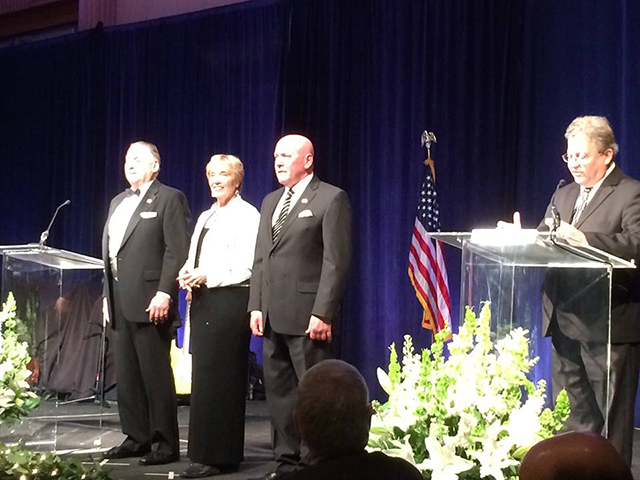
Phyllis Carmichael, longtime member and 2015 treasurer of the Silicon Valley Association of REALTORS®, was among three California REALTORS® honored over the weekend at the California Association of REALTORS® (C.A.R.) Winter Business Meetings, having received the prestigious C.A.R. Director for Life award.
The C.A.R. Director for Life award is bestow on a member for years of outstanding performance and dedicated service to the association, including a minimum of 10 years of active service to C.A.R. and at least five years as a C.A.R. director.
Carmichael has worked in real estate for over 40 years. She is an associate broker with Coldwell Banker in Los Altos.
Carmichael was president of the Los Altos Board of REALTORS® in 1988 and is a recipient the board’s Lifetime Achievement Award. She was also named 1990 REALTOR® of the Year. Carmichael served as SILVAR President in 1996. She also has served as Region 9 Chair and C.A.R. Director.
Call Your Senator TODAY!
The California Association of REALTORS® (C.A.R.) is OPPOSING AB 2416 (Stone), a bill that creates a new kind of lien for wage claim disputes. C.A.R. opposes AB 2416 because it denies due process to the owner of the property, and unnecessarily clouds title. The bill was just passed by the Senate Appropriation Committee and could make it to the Senate floor by Monday, August 18. Ask your Senator to vote NO on AB 2416.
Under existing law, trades people and others who have conducted work to improve a property have the right to record a mechanics lien against the property for payment for that work. This bill is not like a mechanics’ lien. If an employee has a wage dispute with their employer there are multiple legal remedies available to them to seek fair compensation. This is a new and different remedy.
AB 2416 seeks to create a new wage lien, without the procedural protections of the mechanics lien so that an employee may record a lien against any property owned by the employer, even property that has NO connection to the dispute. The new rule purports to exempt principal residences, but the bill invites “shotgun” recordings that will hit all properties.
There are already existing legal remedies for wage disputes. Between arbitration, grievance processes, and lawsuits, employees already have sufficient legal options at their disposal to address wage disputes without chilling the availability of mortgage finance and unnecessarily clouding title.
The Silicon Valley Association of REALTORS® has learned that Assembly Bill 2136, signed into law by California Governor Jerry Brown in July and effective January 1, 2015, helps clarify a REALTOR®’s record retention obligations when it comes to electronic communications.
The California Association of REALTORS® (C.A.R.) sponsored legislation to provide guidance in this new and rapidly changing area of interpersonal communications. AB 2136 amends both Business and Professions Code Section 10148 (broker record retention requirements) and Civil Code Section 1624 (the Statute of Frauds – controlling which contracts must be in writing to be enforceable). Added to Section 1624 is a provision that “an electronic message of an ephemeral nature that is not designed to be retained or create a permanent record, including, but not limited to a text or instant message . . . is insufficient to constitute a contract to convey real property. . .” If the principals do send texts or tweets that they intend to be part of a real estate contract, there are additional steps that need to be taken under Section 1624. See C.A.R. Q&A at http://www.car.org/legal/broker-practice-folder/calbRRRR/
Added to Section 10148 is a provision that “[t]his subdivision shall not be construed to require a licensed real estate broker to retain electronic messages of an ephemeral nature, as described in subdivision (d) of Section 1624 of the Civil Code.”
AB 2136 will give some welcome relief from the possibility of having to save all “ephemeral” electronic communications, such as tweets and texts. Emails, however, are not mentioned in Section 1624. C.A.R. advises REALTORS® who are not already saving emails with clients that are material to a transaction and relate to licensed activity to create a system to store them.
CalBRE Commissioner Wayne Bell has informed C.A.R. that in light of the new law, CalBRE will not be requiring retention of “ephemeral” records referred to in the bill, effective now, even though the law does not technically come into effect until January 1, 2015.
Fannie Mae and Freddie Mac will not be reducing loan limits, the new director of the Federal Housing Finance Agency (FHFA) announced last week. FHFA Director Mel Watt’s decision not to direct the government-sponsored enterprises (GSEs) to lower the limits for home loans that they back is a major shift in direction of his predecessor, who favored winding down their role in mortgage finance.
The conforming loan limit will remain at $417,000 in most areas and at $625,500 in high-cost areas like Santa Clara and San Mateo counties. Watt also said the agency was taking steps to loosen mortgage credit by easing standards on when banks could be forced to buy back some loans sold to Fannie and Freddie.
A conforming loan limit is the maximum size for loans that can be purchased by government-sponsored enterprises Fannie Mae or Freddie Mac. Mortgages purchased by Fannie Mae and Freddie Mac are generally less expensive than the larger jumbo loans because the government absorbs the cost of default.
Watt’s announcement is good news, especially for California home buyers, said David Tonna, president of the Silicon Valley Association of REALTORS®. “If the FHFA were to lower the loan limits, it would force home buyers to pay more for their mortgages and undermine home ownership affordability. High-cost areas like Silicon Valley are already experiencing shrinking housing affordability,” said Tonna.
The California Association of REALTORS® (C.A.R.) immediately commended the new FHFA director’s announcement. “C.A.R. commends FHFA Director Melvin Watt for his announcement that the FHFA will not reduce loan limits on loans eligible for purchase by Fannie Mae and Freddie Mac,” said C.A.R. President Kevin Brown. “Lower loan limits would have had an adverse effect in many parts of the country, but especially here in California where rebounding home prices and decreasing home affordability would hamper mortgage activity and impact the housing recovery.”
The economy has made a remarkable comeback from the Great Recession, according to a California Association of REALTORS® (C.A.R.) real estate analyst. The nation’s GDP is at 2.4 percent, up from 1.9 percent in the beginning of 2013. Personal consumption, the biggest component of GDP, hinges on consumer confidence, which has also rebounded, with its index climbing to 82.3 in March, the highest reading since January 2008.
“Right now, the economy is charging along and moving forward. There is positive economic growth,” Sara Sutachan told members of the Silicon Valley Association of REALTORS® during her visit to the area last month. Sutachan is manager of Broker and Real Estate Finance Outreach for C.A.R.
It’s even better in the Bay Area, especially in the San Jose metro area, which has experienced a 3.4 percent job growth, adding 110,000 in the area. Silicon Valley is charting a stronger course compared to other parts of the state.
“You are in a world of your own and going gangbusters,” Sutachan told the REALTORS®.
Sutachan then gave REALTORS® a heads-up on what to expect this year.
* Interest rates have begun tapering off, so consumers should expect to see rates hover around the 5 percent range. This will place a damper on housing affordability for many buyers, especially first-time home buyers.
* Financial reforms stemming from the Dodd-Frank Act are reining in lenders to ensure that they make a good faith effort to verify a borrower’s ability to repay their mortgage. Stiff penalties are imposed if they do not. Mortgage applications are required to comply with the Qualified Mortgage (QM) rule, which includes full documentation of income, assets and employment, a maximum of 3 percent for points and fees, a cap of 43 percent on the back-end debt-to-income ratio, among other requirements.
* Talk of dissolving Fannie Mae and Freddie Mac threatens home ownership since these government-sponsored enterprises are the cornerstone of housing. The GSEs and Ginnie Mae (Government National Mortgage Association) are responsible for 90 percent of mortgage originations and 99 percent of mortgage securitizations.
* The proposed draft legislation on federal tax reform could significantly impact home ownership because it proposes to lower the cap on the mortgage interest deduction, place tighter requirements on the capital gains exclusion, repeal the deduction for property taxes paid in connection with an owner-occupied home, along with all other deductions for state and local income taxes.
Sutachan forecasts statewide home sales could decline about 3 percent this year. She expects the median price to rise about 8.2 percent from last year. She said sales have stalled due to tight inventory since there has been little new construction for the past five years; sellers are reluctant to put houses their house on the market because they don’t have anywhere to go; because of the high appreciation, investors are renting instead of flipping their properties; there are fewer distressed sales in the market; off-market listings are growing.
California Association of REALTORS® President Kevin Brown announced this morning the successful outcome of C.A.R.’s work with U.S. Senator Barbara Boxer (D-CA) to protect distressed homeowners from debt relief income tax associated with a short sale in California. As part of this effort, Senator Boxer requested the Internal Revenue Service (IRS) to provide guidance on whether mortgage debt forgiveness in a lender-approved short sale would be taxable income under federal law, given California’s recent non-recourse laws for short sales, which were hard fought victories by C.A.R.
The IRS has clarified in a letter that California’s troubled homeowners who sell their homes in a short sale are not subject to federal income tax liability on “phantom income” they never received. The IRS recognizes that the debt written off in a short sale does not constitute recourse debt under California law, and thus does not create so-called “cancellation of debt” income to the underwater home seller for federal income tax purposes. This clarification rescues tens of thousands of distressed home sellers from personal liability upon expiration of the Mortgage Forgiveness Debt Relief Act of 2007 on December 31, 2013.
C.A.R. is seeking a similar ruling from the California Franchise Tax Board (FTB), which has been awaiting the IRS action. C.A.R. anticipates the FTB will act promptly. Short sales may raise other tax issues and, as always, homeowners should speak with their tax professional regarding the tax consequences of a short sale.


 Silicon Valley Association of REALTORS® says ...