
Environmental sustainability is a hot topic today and REALTOR® studies show more buyers are looking for environmental upgrades when searching for a home.

A National Association of REALTORS® (NAR) survey found 68 percent of buyers thought energy efficient appliances were somewhat or very important and 67 percent of homebuyers thought energy efficient lighting was somewhat or very important. According to the California Association of REALTOR®S (C.A.R.), 94 percent of buyers were looking for Energy Star rated appliances; 91 percent wanted an Energy Star rating for the whole home; and 89 percent responded they wanted to see Energy Star rated windows. Energy Star is a standard for energy efficient consumer products created by the Environmental Protection Agency and the Department of Energy.

Green homes sell for more and save the owner money. A study conducted by economists at the University of California Berkeley and UCLA found certified green homes sold for 9 percent more than comparable, non-labeled homes.

According to the California Homebuilding Foundation, landscaping accounts for 57 percent of the water usage for an average home. If a home has a low water yard, the dramatic difference in water usage between that yard and a traditional lawn.

Energy upgrades help the resale value of a home. Homeowners will see the financial savings from the beginning. Well-designed, energy efficient landscaping can pay for itself in eight years. An energy efficient washing machine uses 35 percent less water and energy than a regular one. Replacing five light fixtures with high efficiency models can save up to $75 per year on lighting. An Energy Star heat pump water heater can save a family up to $670 annually. A homeowner who goes through the process of sealing the gaps at vents, ducts, and electrical wires can save on average $200 per year. A home with significant environmental upgrades can see utility bill savings of 20 percent or more. On larger homes, this can add up to hundreds of dollars per year.

There are also a variety of government programs to help pay for the upgrades. Below is a list of government programs available in this area to help homeowners green their homes:
FHA – FHA’s Energy Efficient Mortgage program helps homebuyers or homeowners save money on utility bills by enabling them to finance the cost of adding energy efficient features to new or existing houses as part of their FHA insured home purchase or refinancing mortgage.

Energy Upgrade California – Provides up to $4,500 in rebates for energy-efficient heating and air-conditioning, energy efficient windows, sealing and insulation, and solar or tank-less water heaters.

PG&E – Offers rebates for energy efficiency and free energy efficient upgrades to income-qualified homeowners and renters.

Bay Area Water Supply and Conservation Agency – BAWSCA offers rebates to individuals who replace their lawns with water-efficient landscaping, as well as rebates for replacing toilets and washing machines with water efficient models.

Menlo Park – A $300 rebate for energy assessments is available, and if the homeowner completes the improvements, the City will rebate the full cost of the assessment.

Palo Alto – Palo Alto has a variety of programs. Residents can participate in PaloAltoGreen, where all of their energy will come from sustainable sources. Residents can receive $4 per square foot of removed lawn. The City also provides rebates for purchasing energy efficient appliances.

Los Altos Hills – The Town promotes a High Energy Homes program, where residents can get an online assessment of their home energy use through High Energy Analytics, Inc., a Los Altos Hills based company.

Mountain View – Mountain View offers residents no-cost home energy assessments and monthly energy usage alerts. Available for check out at the city library are devices that measure energy usage of small appliances.

Cupertino – The City provides grants for making energy upgrades as well as a free tree to any interested resident.

Sunnyvale – In Sunnyvale, matching funds are available to qualified low-income residents to do energy efficient upgrades.

Santa Clara County – Acterra Green@Home provides additional energy saving programs to residents of Santa Clara County.

Santa Clara Valley Water District – Has a variety of rebate programs including financial incentives to replace lawns, replace energy inefficient clothes washers, and more.
Cybercrime is an unfortunate reality these days and has become a potential threat in real estate transactions. The Silicon Valley Association of REALTORS® is alerting members and other real estate agents to a recent scheme involving the wiring of funds directly to escrow.

Potential buyers have received emails allegedly from a title company or attorney providing wire information for use by the buyer to transmit earnest money for an upcoming transaction. The messages were actually emails that were intercepted by hackers who then altered the account information in the emails so the buyer’s funds were instead sent to the hacker’s own account. The emails appear genuine and contain the title company’s email information and/or logo, etc. When the buyer transferred their funds pursuant to the altered instructions, their money was stolen.

It is apparent in this type of scam that the hackers monitored the email traffic of either the title company or the customer and were aware of the timing of upcoming transactions. While in the reported instances a customer was induced to misdirect their own funds, an altered email could conceivably be used to cause misdirection of funds by any party in the transaction, including the title company themselves.

Although wiring funds directly to escrow is still viewed by the real estate industry as a better practice than having real estate agents physically transporting buyers’ deposit checks, the danger of hackers who are able to monitor Internet traffic and intercept emails from escrow officers to buyers and alter the wiring instructions to misdirect the buyer’s funds into the hacker’s own account is grave cause for concern. In such a wire fraud scam, if buyers transferred their funds pursuant to the altered wiring instructions, their money would be stolen with little or no chance that the money would ever be returned. Conversely, if sellers are to receive their sales proceeds by wire transfer from the escrow holder to their bank, this same type of fraudulent activity could occur.

To protect your funds and to avoid identity theft, members are encouraged to take immediate steps to secure their computer systems and email accounts to safeguard against this type of scam. Buyers and sellers should confirm all email wiring instructions directly with the escrow officer by calling the escrow officer on the telephone. In that conversation the correct account number information should be repeated verbally before taking any steps to have the funds transferred.

If there is any indication that buyers, sellers or anyone else has received questionable wiring instructions, your client should promptly notify their bank; you, as their real estate agent; and the escrow holder.

Here is a partial of online sources that can provide tips to protect your systems against cybercrime:
Federal Bureau of Investigation: http://www.fbi.gov
Internet Crime Complaint Center: http://www.ic3.gov
National White Collar Crime Center: http://www.nw3c.org
On Guard Online: http://www.onguardonline.gov

The Silicon Valley REALTORS® Charitable Foundation, the charitable arm of the Silicon Valley Association of REALTORS®, presented scholarship awards to 18 graduating seniors from public high schools in Silicon Valley at the end of the 2013-2014 school year. Scholarship recipients each receive $1,000 and are selected from the high schools in communities served by SILVAR members.

Now on its 15th year, the REALTOR® scholarship program recognizes students who have exemplified outstanding achievements in academics, extracurricular/employment activities and community involvement. The selection committee includes representatives from the local business community, area high schools, area colleges and SILVAR.

Students receiving the Charitable Foundation scholarships, the schools from which they graduated, and the colleges and universities they will be attending this fall are: John Kevin Ong Dayao, Cupertino High School, (UC Davis); Mason Peter McCloskey, Fremont High School, (Cal Poly-San Luis Obispo); Wonji Park, Gunn High School (Cal Poly-Pomona); Min Kyu Park, Homestead High School (UCLA); Claire Henderson, Leigh High School (UCLA); Elizabeth Ashley Bishop, Los Altos High School (Tufts University); Alexandra Wong, Los Gatos High School (Brown University); Barbara Julia Jackson, Lynbrook High School (University of Pittsburgh); Sarah Hagadone, Menlo-Atherton High School (UC Berkeley); Marisa Yang, Monta Vista High School (UC Berkeley); Kiley Anne Rucker, Mountain View High School (Cal Poly-San Luis Obispo); Lena Cuevas, Palo Alto High School (Colorado State University); Nicholas Kikuchi, Prospect High School (Santa Clara University); Julie Chen, Santa Clara High School (UC Berkeley); Manini Desai, Saratoga High School (Barnard College); Hanna Zemene Abuhay, Westmont High School (UC Santa Cruz); Jesus Covarrubias Robles, Wilcox High School (Princeton University); Florence Ortiz, Woodside High School (UC Santa Cruz).

“We are happy we have been able to assist our youth for the past 15 years. The seniors selected this year are very deserving of recognition,” said Scholarship Program Chair Nina Yamaguchi.

SILVAR members who presented the scholarships to the recipients at their respective senior awards ceremonies included Chris Alston (Keller Williams), Carolyn Miller (Re/Max Real Estate Services), Michael Hall (Alain Pinel Realtors), Nina Daruwalla (Coldwell Banker), Mary Pope-Handy (Sereno Group), Susan Sweeley (Alain Pinel Realtors), Suzanne Yost (Alain Pinel Realtors), Mark Burns (Referral Realty), Mary Tan (Coldwell Banker), Jimmy Kang (Wells Fargo Home Mortgage), Robert Reid (Keller Williams Realty), Sue Bose (Referral Realty), David Tonna (Alain Pinel Realtors), Niki Maroko (Re/Max Real Estate Service) and Nancy Domich (Old Republic Title Company).

“Our scholarship program is one way REALTORS® are able to give back to our communities and to our youth, who are the future of our communities,” added John Tripp, 2014 president of the Silicon Valley REALTORS® Charitable Foundation.

The scholarship awards presented by the Charitable Foundation are made possible by donations from SILVAR REALTOR® and affiliate members. Since its creation, the scholarship program has provided $270,000 in scholarships to high school seniors in Silicon Valley. The Charitable Foundation would like to thank SILVAR members for their generous support!

SEE PHOTOS

Members of the Silicon Valley Association of REALTORS® (SILVAR) are disappointed that the State Senate passed a bill yesterday that will dramatically weaken the Ellis Act in San Francisco, and could serve as a precedent for weakening the law statewide. The California Association of REALTORS® (C.A.R.) strongly opposed SB 1439 (Leno) and SILVAR members lobbied against the measure on Legislative Day this year.

The Senate rejected SB 1439 by a slim margin on Wednesday. Leno then agreed to draft an amendment that would differentiate between small family holdings and speculators. This amendment garnered the votes necessary for the bill to pass yesterday.

C.A.R. sponsored the Ellis Act in 1985. The law allows property owners to evict tenants in order to leave the rental business. SB 1439 would require a landlord to own a building for at least five years before evicting a tenant under the Ellis Act. It would include corporate landlords and apply to all owners of the corporation. Once a property owner submits a request to Ellis Act evict, the law would prohibit them from conducting Ellis Act evictions on any property subsequently purchased.

SB 1439 only applies to the city and county of San Francisco. AB 2405, a companion bill that would have applied statewide, failed to clear the Assembly Judiciary Committee on April 29.

SILVAR members raised multiple concerns about SB 1439 with local legislators on Legislative Day. “REALTORS® explained how this bill would discourage investment in property ownership and could impact selling prices. It would also encourage owners to evict all tenants prior to putting a property up for sale because an empty property becomes more valuable. said David Tonna, president of the SILVAR. “San Francisco already has some of the most protective and expensive eviction rules in the state.”

The bill is scheduled to go before the State Assembly for deliberation this summer.

Fannie Mae and Freddie Mac will not be reducing loan limits, the new director of the Federal Housing Finance Agency (FHFA) announced last week. FHFA Director Mel Watt’s decision not to direct the government-sponsored enterprises (GSEs) to lower the limits for home loans that they back is a major shift in direction of his predecessor, who favored winding down their role in mortgage finance.

The conforming loan limit will remain at $417,000 in most areas and at $625,500 in high-cost areas like Santa Clara and San Mateo counties. Watt also said the agency was taking steps to loosen mortgage credit by easing standards on when banks could be forced to buy back some loans sold to Fannie and Freddie.

A conforming loan limit is the maximum size for loans that can be purchased by government-sponsored enterprises Fannie Mae or Freddie Mac. Mortgages purchased by Fannie Mae and Freddie Mac are generally less expensive than the larger jumbo loans because the government absorbs the cost of default.

Watt’s announcement is good news, especially for California home buyers, said David Tonna, president of the Silicon Valley Association of REALTORS®. “If the FHFA were to lower the loan limits, it would force home buyers to pay more for their mortgages and undermine home ownership affordability. High-cost areas like Silicon Valley are already experiencing shrinking housing affordability,” said Tonna.

The California Association of REALTORS® (C.A.R.) immediately commended the new FHFA director’s announcement. “C.A.R. commends FHFA Director Melvin Watt for his announcement that the FHFA will not reduce loan limits on loans eligible for purchase by Fannie Mae and Freddie Mac,” said C.A.R. President Kevin Brown. “Lower loan limits would have had an adverse effect in many parts of the country, but especially here in California where rebounding home prices and decreasing home affordability would hamper mortgage activity and impact the housing recovery.”

Members of the Silicon Valley Association of REALTORS® (SILVAR) were in Washington, D.C. this week attending the National Association of REALTORS®’ (NAR) REALTOR® Party Convention & Trade Expo, with nearly 8,500 other REALTORS® from across the country, advocating policies that impact the residential and commercial real estate markets. REALTORS® met with legislators, congressional and regulatory staff, as well as top industry executives.

This year’s convention focused on critical real estate issues such as preserving the mission and accessibility of the Federal Housing Administration’s loan programs, protecting real estate-related tax policies, and reforming the secondary mortgage market.

“This week is important, not only because REALTORS® want to ensure their points-of-view on important real estate issues are heard, but also to remind our country’s leaders of the vital role that real estate plays in both the long- and short-term health of this nation,” said NAR President Steve Brown.

SILVAR members attended U.S. Senator Dianne Feinstein’s weekly constituent breakfast and met with staff of U.S. Representatives Anna Eshoo, Jackie Speier and Mike Honda. During meetings on Capitol Hill, SILVAR REALTORS® urged support for legislation to reinstate the Mortgage Forgiveness Debt Relief Act, which expired at the end of 2013; preservation of the mortgage interest deduction and the property tax deduction; and not to pass legislation that will weaken and ultimately eliminate Fannie Mae, Freddie Mac, and FHA.

SILVAR members also participated in a number of NAR meetings. David Barca, California Association of REALTORS® Federal Committee chair, briefed California NAR Directors on legislative issues. SILVAR Executive Officer Paul Cardus shared information on SILVAR’s global program with other REALTOR® associations at the State and Local Forum on Global Business.

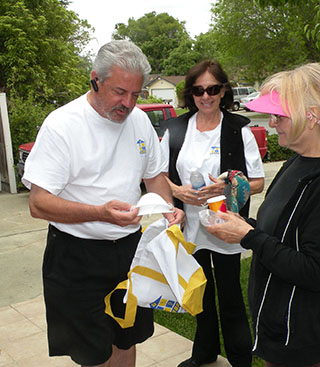
SILVAR President David Tonna and Diane Chandler hand a senior homeowner a complimentary RSVP (REALTOR® Service Volunteer Program) bag, which includes batteries, face mask to protect them from harsh chemicals, and a vial of life, so they can have their complete medical information ready in their home for emergency personnel to reference during an emergency.

SILVAR President David Tonna and Diane Chandler hand a senior homeowner a complimentary RSVP (REALTOR® Service Volunteer Program) bag, which includes batteries, face mask to protect them from harsh chemicals, and a vial of life, so they can have their complete medical information ready in their home for emergency personnel to reference during an emergency.

SILVAR members washed hundreds of windows, trimmed a multitude of bushes, replaced numerous smoke detectors and furnace filters and did other household tasks in over 120 senior homes this week as part of the association’s annual REALTOR® Service Volunteer Program (RSVP).

Every year in May, SILVAR members visit the homes of seniors who are physically and financially challenged. Members help the elderly with simple household tasks, like replacing light bulbs, changing furnace filters, washing windows, turning over mattresses, changing smoke detector batteries and light yard work.

RSVP is a community outreach project launched by SILVAR in 2001 to assist seniors and the homebound in communities within the Association’s five districts of Menlo Park/Atherton, Palo Alto, Los Altos/Mountain View, Cupertino/Sunnyvale and Los Gatos/Saratoga. The program has expanded on the Peninsula and in the South Bay, with volunteers from neighboring REALTOR® associations helping seniors in their respective communities.

While the SILVAR RSVP volunteers trimmed bushes and weeded her yard, a Los Altos senior homeowner laughingly described herself as being “94 years old and experienced,” and still able to play poker. She expressed her gratitude for the assistance. With only a son living in San Diego, she has no help. She said she has been availing of the REALTOR® service program for the past two years.

“Oh, lordy, I think the program is just wonderful! It’s very fantastic,” she exclaimed.

In Mountain View, an 80-year-old senior resident who lives alone and has no children, said she has requested help from SILVAR REALTORS® for the past five years.

“It’s wonderful that they give up their time to help us. I used to do everything, but it’s the high things I can’t reach,” she said, as RSVP volunteers Jamie Carmichael dusted her home and cleaned her bathroom mirrors, and Stanley Ku trimmed her bushes.

One Saratoga senior homeowner who is riddled with arthritis said she was a volunteer in the community for many years. “Now I am getting it back,” she smiled.

READ MORE HERE

Members of the Silicon Valley Association of REALTORS®, the trade organization representing over 4,000 REALTORS® and affiliate members engaged in the real estate business on the Peninsula and in the South Bay, joined 2,100 California REALTORS® in Sacramento on Wednesday for Legislative Day, where they discuss critical issues that impact home ownership and private property rights with Silicon Valley’s legislators.

At the morning briefing, California Association of REALTORS® (C.A.R.) President Kevin Brown and the C.A.R. leadership welcomed California REALTORS® and thanked them to making the trip to Sacramento. He said, Legislative Day is an opportunity for REALTORS® “to demonstrate the size and power of organized real estate and represent our clients who are not here.”

California Governor Jerry Brown, a special guest at the morning briefing, also thanked REALTORS® for coming to Sacramento. He said it’s been a good year, the budget is balanced and stabilized, but the state still faces issues. Brown said diversity, which is one of California’s great assets, is also its biggest challenge and complicates issues.

“We are working out issues that the whole world has to deal with, but with enough openness, with enough skill, and enough harmony our state is going in the right direction … Wherever we look, California is leading the way,” said Gov. Brown.

“You’re in the right business,” Gov. Brown told REALTORS®. “You sell the California dream and it’s very much alive. Let’s keep it that way. So far, so good. Keep coming back every year.”

Read more here

The National Association of REALTORS® (NAR) is asking members of the Silicon Valley Association of REALTORS® and other members of the national trade association to tweet their Senators to support patent reform. This is NAR’s first ever Twitter Call for Action.

“Patent trolls” are companies that own a large quantity of patents. Often, they do not produce any goods. The business model is to just own patents and sue or threaten to sue anyone who potentially violates the patent. As small business owners, REALTORS® are exposed to these threats of litigation, often for using basic business technology, like drop-down website menus, mapping features, and online checkout carts.

Many small business owners who receive one of these threatening letters will settle the case because that is less expensive than going to court. A number of multiple listing services have been required to pay millions of dollars in licensing fees due to a patent troll suit. Patent trolls sue more non-tech companies than tech companies, and have cost the U.S. economy $80 billion in litigation costs in 2012.

If you are a REALTOR® go to Twitter Call for Action for complete details on connecting to your Senators on Twitter.

For more information about Patent Litigation Reform and why NAR supports this bill, please visit NAR’s Patent Reform Litigation Reform page.

Former Santa Clara County principal planner Don Weden told members of SILVAR’s Cupertino/Sunnyvale District this week that California is experiencing a number of structural changes and will be facing bigger challenges than in the past due to population growth, household changes, and an aging population.

The California Department of Finance projects Santa Clara County’s current population of 1.8 million will grow by 140,000 people in 15 years. As population grows, so will households, but their makeup will change.

“The future looks gray,” said Weden.

Currently in Santa Clara County, one in 10 persons is age 65 and older. By 2030, one in five persons or one-fourth of the adult population will be over 65.

Weden said development plans anchored on the drivable suburban model are no longer suitable. One in five Americans over 65 do not drive – because of rising gas prices, because they can’t, and some prefer not to.

“Neighborhoods we thought were fun to grow up in may be problematic to grow old in,” said Weden.

Weden indicated the rate of home ownership among the 25-34 year old group has dropped from 40 percent in 2007 to 31 percent in 2010. Millennials, the generation born between 1980 and 2000, now number 80 million, more than the baby boomers, and projected to soon comprise majority of the U.S. workforce. This generation has never known the world without the Internet. Weden said Millennials are the most educated generation in history, but also saddled with much student debt. They are mostly renters not only due to economic necessity, but because they want to be mobile, free to move from job to job without having to worry about selling their home every time they move.

“They are also less confident in the economics of the American dream,” said Weden.

Also important is this generation does not like driving. Eighty-eight percent want to live in an urban setting that is walkable. This is why it is critical for cities to focus on planning walkable urban neighborhoods instead of drivable suburban communities, said Weden. Baby boomers would also prefer it, especially once they can no longer drive.

Weden said the evolution from the predominantly drivable suburban neighborhoods to walkable urban neighborhoods is gradually taking place in Bay Area cities. He said REALTORS® need to get involved in planning these neighborhoods. The neighborhoods need not be exotic, but should be complete, offering residents of all ages an active lifestyle, with services and shops, including grocery stores and other amenities.

March 2026
M T W T F S S
 1
2345678
9101112131415
16171819202122
23242526272829
3031  

Archives

Enter your email address to subscribe to this blog and receive notifications of new posts by email.

Join 69 other subscribers