
You are currently browsing the category archive for the ‘Silicon Valley’ category.
Helpful, cheerful, professional, efficient, friendly, courteous, respectful – these are just some of the many words senior homeowners used to describe this year’s RSVP (REALTOR® Service Volunteer Program) volunteers. They were also called “angels” and “little elves” by some of the scores of seniors who sent in their feedback and wrote lengthy comments expressing their deep appreciation for the helping hands they received during RSVP Week in May.
“I’m 85 with COPD (chronic obstructive pulmonary disease) breathing problems, so I can do less at this time. It is so nice to have four happy people come and do chores that are hard for you. Thank you,” wrote a Mountain View senior homeowner.
One Saratoga senior wrote, “I am delighted! It was lots of fun to be visited by such an outstanding and friendly team and to have such expert help with chores that I have been unable to do. Many thanks! This is a wonderful gift for you to give. I appreciate you!”
Another senior wrote, “Your volunteers were truly dedicated to helping people. In my case, two cataract operations left me without glasses and I really needed their kind help. Thank you so much.”
“We were very pleased with the work. The woman and man who came were very nice and professional. Thank you all so much. We really appreciate your help!” wrote a Los Gatos couple.
A Palo Alto senior wrote, “It’s such a treat to have met these lovely people and to bask in the luxury of the great things they did for me. I am so impressed and pleased.”
Another Palo Alto resident wrote, “Year after year they have helped a ‘loner.’” “I have nothing but high praises for the three young people that filled our request to the fullest,” wrote a senior from Sunnyvale.
Still another homeowner wrote, “I like this program and talking with young people. It gives me the feeling of being cared for and about.”
“It’s wonderful to know that there are caring people out there. Thanks so much for your kindness,” a Los Altos senior conveyed his thanks.
A Menlo Park senior citzen’s thank you card read, “The yard looks so much better – hope my daughter will now be able to keep it under control. Many thanks!”
A big thank you to the 247 volunteers from SILVAR who helped 146 senior households this year, RSVP Chair David Barca, SILVAR RSVP Chair Eileen Giorgi, and RSVP District Chairs Chris Isaacson (Menlo Park/Atherton District), Jeff Beltramo (Palo Alto District), David Kim and Suzanne O’Brien (Los Altos/Mountain View District), Sue Bose (Cupertino/Sunnyvale District) and Rick White (Los Gatos/Saratoga District).
“It takes so little to make our seniors happy. They are so appreciative and grateful to our volunteers,” said Giorgi. “I want to personally thank all the volunteers who took the time to help them this year. Thanks, too, to our RSVP district chairs who worked long hours to make sure the program ran smoothly in their district.”
The Silicon Valley REALTORS® Charitable Foundation, the charitable arm of the Silicon Valley Association of REALTORS®, is presenting scholarship awards to 18 graduating seniors from public high schools in Silicon Valley at the end of the 2010-2011 school year. Each student will receive a $1,000 scholarship.
Now in its 12th year, the REALTOR® scholarship program recognizes students who have exemplified outstanding achievements in academics, extracurricular/employment activities and community involvement. The selection committee included representatives from the local business community, area high schools, area colleges and the Silicon Valley Association of REALTORS®.
Students who received scholarships from the Foundation, the schools from which they graduated, and the colleges and universities they will be attending are:
Jaime Garvey, Cupertino High School (University of San Francisco); Angel Luis Roa, Fremont High School (University of Southern California); Madelaine Bustos, Gunn High School (Boston University); Evelyn May Siu, Homestead High School (Princeton University); Christopher Hyde, Leigh High School (UC San Diego); Ian Gregory Glasner, Los Altos High School (Carnegie Mellon University); Se Eun Park, Los Gatos High School (Duke University); Alex Zhu, Lynbrook High School (Boston University); Emily Johnson, Menlo-Atherton High School (Occidental College); Stella Ziegler, Monta Vista High School (Reed College); Gillie Agmon, Mountain View High School (UC San Diego); Julia Howard, Palo Alto High School (University of Puget Sound); Nicholas Cotter, Prospect High School (UC Berkeley); Cyrus Shannon Sinai, Santa Clara High School (UCLA); Shannon Galvin, Saratoga High School (Georgetown University); Karli Willenborg, Westmont High School (UC Santa Cruz); Sidney Nguyen, Wilcox High School (UC San Diego); and Keneisha Perry, Woodside High School (CSU Chico).
“As we mark the 12th year of the Silicon Valley REALTORS® Scholarship Program, we are very happy we are able to continue assisting the deserving winners as they embark on their college careers,” said SILVAR Scholarship Chair Nina Yamaguchi. “The seniors selected for the SILVAR Scholarship Program are among the cream of the crop. We believe through our scholarship program we can help our local youth achieve their dreams.”
“We feel fortunate to be able to give back to the community and to our youth through our scholarship program,” said Eileen Giorgi, president of the Silicon Valley REALTORS® Charitable Foundation. “We also thank the teachers and staff in each high school for their help and participation in making this program the success that it is.”
SILVAR members attending the senior awards ceremonies at the selected high schools and presenting the scholarships to the recipients include Carole Feldstein (Coldwell Banker), Maryann Simas (Coldwell Banker), Robert Reid (Keller Williams Realty), Carolyn Miller (Re/Max Real Estate Services), Vivian Wang (Coldwell Banker), Dale Anne Collings (Coldwell Banker), Joanne Fraser (Coldwell Banker), Mark Burns (Coldwell Banker), Mary Tan (Coldwell Banker), Jimmy Kang (Bank of America), Shawn Carroll (Coldwell Banker), Sue Bose (Referral Realty), Bill Gorman (Coldwell Banker), Lydia Kou (Alain Pinel Realtors), Russell Morris (Coldwell Banker) and Theresa Loya (Coldwell Banker).
The scholarship program is a partnership effort between the Silicon Valley REALTORS® Charitable Foundation and educators in SILVAR’s service areas. Scholarship recipients are selected from the high schools in the communities served by the over 4,000 members of the Silicon Valley Association of REALTORS®.
 Every year in May, as part of the REALTOR® Service Volunteer Program (RSVP), SILVAR REALTORS® and affiliates assist seniors and the homebound with household tasks they can no longer perform on their own. The program, which was started by members in 2001 and launched by SILVAR as an official community outreach project in 2002, has expanded to include volunteers from the San Mateo County Association of REALTORS®, the Fresno Association of REALTORS®, and Santa Clara County Association of REALTORS® and Santa Cruz County Association of REALTORS®.
RSVP is now on its 10th year, and this week – May 16-20, volunteers helped seniors in SILVAR’s five districts with simple chores like washing windows, installing smoke detector batteries, flipping mattresses, light vacuuming, dusting, replacing light bulbs, changing furnace filters and trimming bushes. Many seniors expressed their gratitude for the work done by the RSVP volunteers.
Gloria from Los Altos, who is 81 years old and lives alone, was especially thrilled. It was the first time she availed of the free service and she was nearly in tears as a couple of RSVP volunteers proceeded to dust her furniture and vacuum and sweep her floors, while the other volunteers washed her windows and trimmed the bushes outside her home.
“Thank you, thank you,” a 91-year-old Sunnyvale senior resident repeatedly told the RSVP volunteers after they had flipped her mattress and washed her windows.
Peggy, 63, is a Mountain View resident who is homebound and confined to wheelchair. She has poliomyelitis (post polio syndrome) and other complications. After surgery, she learned new living skills at Valley Medical Center and was eager to manage on her own. Her closest relative is a sister who lives out of state. The REALTORS® moved furniture and boxes away from all passageways so she could maneuver her wheelchair around her home and function independently.
“I can’t thank them enough for doing this. This has been my family’s home since 1959. I live alone, but I can’t think of any other place where I would rather live. This is my home,” Peggy exclaimed.
In Los Gatos, 73-year-old Barbara, who is bedridden, was grateful that volunteers cleaned her refrigerator and stove, dusted and vacuumed her floors. “I think it’s wonderful that there are people like you that can help people like us who cannot move around anymore,” she exclaimed.
Palo Alto resident Chris, who is 80, just had hip surgery. So she welcomed the help from the REALTORS® who washed windows, fixed a door knob, picked up the clutter and moved items she didn’t need to her garage. Dave, another Palo Alto resident in his 80s, still talks about how much he appreciated the REALTORS® who went out of their way to install a hand rail in his shower stall a couple of years ago. “I am so grateful to them. I used to do a lot of things, but it’s all too much for me now,” he remarked.
An elderly Saratoga couple in their late 80s lamented that all their kids lived out of state. They manage, but welcomed help washing their windows and flipping their mattress. “It’s a wonderful thing that you do for the community. It’s very necessary for us,” they said.
At the end of the week, SILVAR members felt it was all worthwhile. For many volunteers it’s an eye-opening experience and “humbling.” They’re glad they can help out and make a difference in the lives of the seniors and the homebound in their community.
This week REALTORS® from across the nation convened in our nation’s capitol for the National Association of REALTORS® Mid-year Business meetings and visits with members of Congress. SILVAR members joined their fellow REALTORS® in Washington, D.C. to take part in NAR business meetings and personally meet with their representatives in Congress.
Along with members from the San Mateo, Santa Clara, Santa Cruz County Associations of REALTORS®, SILVAR members met with both U.S. Representatives Anna Eshoo and Mike Honda during the meetings. The SILVAR delegation included SILVAR President Gene Lentz, President-elect Suzanne Yost, Region 13 Caucus Chair Jim Hamilton, NAR Directors David Barca, Jeff Barnett, Judy Ellis, Susan Tilling, C.A.R. Directors John Tripp, Aaron Wheeler, and Federal Political Coordinator and SILVAR PAC Trustee Carole Feldstein.
In meetings with members of Congress, REALTORS® focused on five core issues important to homeowners and the housing industry. Below are the issues that were brought to the attention of our legislators.
The Future of the Secondary Mortgage Market
The GSEs, though they have been in conservatorship for almost three years, remain critical to ensuring mortgage market liquidity. Currently, estimates of GSE loan volume range as high as two-thirds of mortgage loans. There is currently a push in Congress to eliminate the GSEs. Without a viable replacement for their secondary mortgage market mission, it will mean severely restricted mortgage capital and higher costs for qualified, creditworthy borrowers. The reduction in mortgage liquidity will exacerbate downward pressure on home prices ultimately reducing the home values for existing homeowners.
REALTORS® urged that the federal government must have a continued key role in the secondary mortgage market in order to ensure that there is capital for mortgage lending in all mortgage markets under all market conditions. California’s jumbo market over the last four years has demonstrated that a purely private market is incapable of meeting all the needs of home buyers and supplying a stable flow of capital. Reform of the secondary mortgage market, in particular Fannie Mae and Freddie Mac, should be comprehensive and undertaken methodically.
Access to Affordable Mortgage Products
The current loan limits for high-cost areas are set to expire on September 30, 2011. Reverting to the statutory limits will create a decline in liquidity and hurt our nation’s economic recovery. Many argue that the loan limit increases help only higher cost areas, but this is not the case. Reverting to the statutory limits will reduce limits in 619 counties and 41 states and the District of Columbia. The average decline in loan limits will be more than $58,000.
The Dodd-Frank Act requires mortgage securitizers to retain 5 percent of the risk unless the mortgage is a qualified residential mortgage (QRM). The proposed rule issued by six federal regulators would require families to make a 20 percent down payment and meet other stringent requirements. The QRM definition is extraordinarily important because it will determine the types of mortgages that will generally be available for borrowers for the foreseeable future. Weak underwriting and toxic mortgages are the main cause of mortgage defaults, not well-underwritten mortgages with affordable down payments.
REALTORS® urged their members of Congress to oppose any decrease to FHA and GSE loan limits. Maintaining the conforming loan limit calculation and caps in high-cost areas would allow the local economic climate of each high-cost state to dictate the necessity of an increase in its conforming loan limit. Maintaining the current conforming loan limits in high-cost areas would also give everyone equal access to the secondary market.
REALTORS® also asked that members of Congress submit comments to the six regulators during the comment period and voice concern that the proposed Qualified Residential Mortgage (QRM) rule would deny otherwise creditworthy Americans affordable financing while further concentrating the lending industry in the mega-banks that are already “too big to fail.”
Preserving Home Ownership Tax Benefits
In December 2010, the President’s National Commission on Fiscal Responsibility and Reform (best known as the Deficit Commission) issued a report identifying tax and spending changes designed to significantly reduce the deficit over the next decade. That Commission recommended different tax options. At least three different approaches were included:
- Eliminate all “tax expenditures” (deductions, exclusions, credits).
- Eliminate the mortgage interest deduction (MID) for second homes and reduce the amount of allowable mortgage debt from $1 million to $500,000.
- Convert the deduction to a 12 percent tax credit.
Since the report was issued, REALTORS® have aggressively reminded Congress that any change to the tax rules that apply to home ownership would disrupt the market and cause home values to further decline. Both Rep. Eshoo and Rep. Honda were thanked for co-sponsoring H.Res. 25, which supports the existing the mortgage interest deduction.
REALTORS® expressed any change to the MID or other home ownership provisions will slow the housing recovery. Tax rates have a way of creeping up over time. Since 1986, when the rate was 28 percent, the top rate has been as high as 39.6 percent and is presently 35 percent. Reducing, eliminating or otherwise changing the value of the mortgage interest deduction will cause the value of housing to drop even more, perhaps by as much as 15 percent in some markets. This decline would be in addition to the 30 percent decline that some markets have experienced.
Short Sales
Too often, short sales are still a story of delay and unrealistic lender views of current home values, resulting in the potential buyer canceling the contract and the property going into foreclosure. Even if successful, the process usually takes many months and countless hours and often requires re-marketing because buyers lose patience and terminate the contract. Streamlining short sales will reduce the amount of time it takes to sell the property, improve the likelihood the transaction will close, and reduce the number of foreclosures. This will benefit lenders, sellers, buyers, and communities.
REALTORS® support H.R. 1498 to require servicers to decide whether to approve a short sale within 45 days of completion of the short sale request. A hearing on H.R.1498 will shine a light on the short sales issue and identify ways to make short sales work better. Delays in approving requests for a short sale remain a significant impediment to this foreclosure avoidance option. Banks are losing more than they have to because they lose much more when selling homes after foreclosure than they would if they approved reasonable short sales.
Affordable and Available Property Insurance
Floods claimed more lives and property than any other natural disaster in the U.S. over the last century. Unable to ignore the rising cost to taxpayers of disaster payments for uninsured properties or the lack of a private market for flood insurance, Congress created the NFIP in 1968. Today, 5.6 million property owners rely on the program in 21,000 communities where flood insurance is required for federally related mortgages. Since September 2008, Congress has approved nine NFIP extensions and allowed five lapses. During the June 2010 lapse, 47,000 home sales were delayed or cancelled, according to NAR survey data. Real estate markets require certainty to make the long-term investments that are vital to the U.S. economic recovery.
REALTORS® urged Congress to reauthorize the National Flood Insurance Program (NFIP) for at least five years and end the uncertainty of extensions and shutdowns. NAR supports provisions of H.R.1300 (Biggert, R-IL) to reauthorize NFIP through 2016 but oppose its privatization pilot program which would reduce the program’s risk pool and long-term viability. NAR opposed H.R. 435 (Miller, R-MI) to sunset the NFIP by 2013 and authorize interstate compacts.
In recognition of Fair Housing Month in April, REALTORS® continue to reaffirm their commitment to equal access to housing and home ownership. Signed into law in 1968 and amended in 1988, the Fair Housing Act prohibits housing discrimination on the basis of race, color, religion, sex, disability, familial status and national origin.
“Fair housing is not an option; it’s the law,” said Gene Lentz, president of the Silicon Valley Association of REALTORS® . “REALTORS® are on the ‘front lines,’ working with buyers and sellers to see that they enjoy the benefits of a housing market free from discrimination.”
To mark Fair Housing Month, SILVAR on April 8 offered the National Association of REALTORS® ’ At Home with Diversity certification course for all REALTORS® and affiliates. The course teaches real estate professionals how to increase their sensitivity and adaptability to future market trends and how to transact business across cultures, generations and other differences. More than 25,000 REALTORS® have completed the program.
“People have a right to live wherever they can afford to live,” Lentz said. “Fair housing means opening those doors for everyone in this country whose goal it is to own a home.”
Lentz indicated Santa Clara County is among the most diverse counties in the U.S. The 2010 U.S. Census figures show the county grew by nearly 6 percent in the past decade. Much of the growth in population is attributed to a gain of about 140,000 Asians and 76,000 Latinos, yet minority home ownership comprises a very low percentage of the population.
“Diverse neighborhoods and schools strengthen communities, and minority population growth is vital to sustaining housing markets,” said Lentz.
Lentz said the home seller, the prospective home buyer and the real estate professional all have rights and responsibilities under the law.
A home seller or landlord is required under the law not to discriminate in the sale, rental and financing of property on the basis of race, color, religion, sex, handicap, familial status, or national origin. They cannot instruct their agent to convey any limitations in the sale or rental because the real estate professional is also bound by law not to discriminate.
Buyers or renters have the right to expect that housing will be available without discrimination, including the right to expect housing in their price range made available without discrimination; equal professional service; the opportunity to consider a broad range of housing choices; no discriminatory limitations on communities or locations of housing; no discrimination in the financing, appraising, or insuring of housing; reasonable accommodations in rules, practices and procedures for persons with disabilities; non-discriminatory terms and conditions for the sale, rental, financing, or insuring of a dwelling; and freedom from harassment or intimidation for exercising their fair housing rights.
People who believe they have experienced discrimination may file a complaint with the Department of Fair Employment and Housing (DFEH). Complaints must be filed within one year of the alleged discrimination.
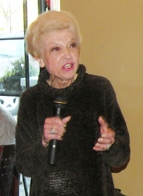
Carole Rodoni
Real estate consultant Carole Rodoni didn’t mince words when she talked to Silicon Valley REALTORS® at SILVAR’s Palo Alto District this morning. She is appalled at how lawmakers have handled the budget, the deficit, short sales and foreclosures, and even the war in Libya, but with regard to Silicon Valley real estate, Rodoni is upbeat.
The former president of Fox & Carskadon Realtors, former COO of Cornish and Carey Real Estate and Alain Pinel Realtors, and now president of Bamboo Consulting Inc. says the media can talk about a slump in the housing market, but the San Francisco Bay Area is an “oasis in the desert.” This region is the gateway to the Pacific Rim, with the best universities, diversity of culture and education.
“People aspire to live here and there is no more land here. Land is valuable and land here will keep its value,” says Rodoni. “At the end of the day, how can anyone say Silicon Valley isn’t alive and well?”
What should REALTORS® tell buyers? “Tell them they are getting a free gift right now,” Rodoni says.
Prices have come down a bit, interest rates have edged up from 3 percent to about 4 percent, but they are still low. She predicts rates will rise even more by the end of this year, possibly to 5 percent or more, and perhaps 6 and 7 percent in three years because of inflation. “The stars have aligned here,” according to Rodoni. “Where do you find this affordability?”
Rodoni says buyers should “buy it, hold it – don’t spin it, and keep it for at least five years.” Also, while buyers should pay attention to interest rates, she says they should also watch out for lending fees because she is sure they will increase.
“Loans will be 5 to 8 percent more expensive than last year,” Rodoni says. “At the end of the day interest counts, but understand that everything is going up because of loan fees. If you are a buyer, while it’s good to look at price, look also at loan fees. Match interest rate to the loan product.”
She says buyers should ask themselves these questions: Is it the right price? Is it the right place? Examine where you are looking. Will it appraise for that price? Is the lender going to like it? Then she cautions: Do not attempt to low ball when you’re facing a multiple offer situation. How high are you going to go? Especially in this region, you cannot sit with terms and conditions.
“It would be like playing football in a baseball diamond,” she says. “Investors know there is value here and they will continue to come in. Silicon Valley is the bread and butter market. They see the sweet spot and will fight to get it.”
By SILVAR Government Affairs
The Mortgage Interest Deduction (MID) may be under attack again. As the 112th Congress struggles to finalize a budget plan for this year, everything is back on the table. House Speaker John Boehner (R-OH) recently stated that MID for second homes is becoming harder and harder to justify in these difficult times. So might be the MID for homes greater than $500,000.
If these rollbacks to the deduction are put into law, it will be devastating for Silicon Valley homeowners and the overall housing market. But how will it impact you? As part of the National Association of REALTORS® (NAR) Home Ownership Matters campaign, NAR has released an APP that calculates how homeowners do and will benefit for the preservation of the mortgage interest deduction.
The MID Calculator allows homeowners to estimate the tax savings value of the mortgage interest rate deduction. Use the buying power calculator to see how your housing dollars are optimized by the tax savings. This APP is compatible with iPhone, iPod touch, and iPad.
As budget talks heat up, homeowners and REALTORS® should be prepared in the coming weeks to contact their member of Congress to voice their support for preserving the mortgage interest deduction. More information regarding legislative proposals and the deduction can be found at NAR’s MID site.
More than 130 members of the Silicon Valley Association of REALTORS® attended SILVAR’s Los Gatos/Saratoga District tour meeting a few weeks ago and listened as Jacquie Berry, owner of Community Association Data Source, emphasized the greatest mistake any seller can make is an incomplete disclosure.
When dealing with homeowner associations (HOAs), it gets especially complicated because the law requires more disclosures from common interest developments (CIDs), in addition to the normal disclosures required in the sale of single-family homes. Common interest developments are condominiums and planned developments that are governed by a homeowner association which administers the property and is responsible for repairing, replacing, or maintaining the common areas. The homeowner association places restrictions on the use of the property and the common areas.
Berry shared the following statistics: There are over 48,000 homeowner associations in California; CIDs make up a quarter of all housing in the state of California; 49 percent of CIDs are self-managed and less than 25 percent are 100 percent funded in their reserves.
Berry said lenders are asking more questions about the financial health of HOAs so buyers won’t be caught by surprise by undisclosed defects in the common areas and underfunded reserve accounts, which result in special assessments. Agents and prospective buyers should review state laws, documents that HOAs are required to provide, and ask questions. She noted forms change, and homeowner associations rarely provide a complete or updated set of disclosure documents.
Also, HOAs may state they have adequate reserves to maintain deferred maintenance, but they do not specify a timeline for which these reserves are adequate. HOAs must prepare a reserves budget every year, providing a current estimate of the costs of repairing and replacing major common area components over the long-term. Ideally, reserve funds should be able to cover all major repair and replacement costs when needed.
“The value of the property is directly related to reserves,” stressed Berry.
Berry said it’s very important that these disclosures be obtained and reviewed by the appropriate professional so the buyer can make an intelligent decision as to whether or not to purchase the property.
“It’s all about disclosure,” Berry said. “It’s not about anything else but disclosure.”
Real estate brokers and salespersons who earn more than $100,000 in gross receipts from business operations per calendar year may now be required to register as a “qualified purchaser,” report and pay use tax directly to the California Board of Equalization by April 15 for the previous calendar year. This new requirement was promulgated by AB x4-18(2009). There is no fee for registration, but qualified purchasers will now have to pay the state’s use tax for out-of-state purchases directly with the BOE starting with the 2010 tax year.
REALTORS® began receiving notices and registration applications in the mail this week from the State. Completing the registration and making the use tax payment to the BOE for 2010 purchases prior to April 15 will prevent fees and penalties from being assessed.
The use tax applies to most purchases from sellers who are not required to collect sales tax. That is often the case with Californians’ purchases from out-of-state or online retailers. The use tax was created as a companion to the sales tax in 1935 in order to protect California businesses that must regularly collect sales tax and would otherwise be at a competitive disadvantage to out-of-state vendors.
Use tax is administered by the Board of Equalization, but legislation enacted in 2003 provided individuals the option to report use tax on their state income tax return instead of filing a use tax return with the BOE. In general, consumers must pay California use tax if they purchase an item from an out-of-state seller and the seller does not collect California sales or use tax, and the consumer uses, gives away, stores, or consumes the item in this state.
While sales tax is owed to the BOE by the seller, the purchaser is generally responsible for paying the use tax. The use tax rate is the same as one’s local sales tax rate.
For more information on other taxes and fees in California, visit www.taxes.ca.gov
Not being able to get a home insured can stall, if not kill, a transaction. At this morning’s SILVAR Cupertino/Sunnyvale District tour meeting, an affiliate panel shared information on how to avoid such a dilemma. The panel, moderated by Kyle Chuang (Farmers Insurance), included Walt Rowley (Liberty Mutual Group), Linda Bentson (Old Republic Title), Laura Roseblade and Pauline McDonald (both from State Farm Insurance).
Here are some of many tips the panel shared:
• Each insurance company is different and has its own limitations of coverage, so it’s important to shop around and make sure you are dealing with a true insurance professional who knows the business.
• While there are lenders who may insist that insurance should cover the amount of the loan, insurance companies will only cover the value of the home. The amount an insurance company will cover differs from the appraised value because the appraised value includes land, while home insurance just covers the structure.
• The condition of a house affects insurance coverage more than the age of a house. The following may affect coverage:
– Roof condition – Some companies may deny coverage if an additional layer is placed on top of the original layer.
– Trees and brush in close proximity to the house
– Distance of a fire hydrant or fire station to the house – Some insurance companies will not insure a home if it is more than three miles away from a fire station
– Certain pets
• You have to think in terms of risk. Would you take a risk on a condition that you have observed? Inform you client about a potential problem so it can be fixed right away.
• In the case of condominiums, work closely with the lender. It’s important to know the insurance company that handles the master policy, what the HOA master policy entails, and get a copy of the certification of insurance for the master policy.
• Once you have all insurance documents, get them to your escrow officer as soon a possible.

 Silicon Valley Association of REALTORS® says ...