
You are currently browsing the category archive for the ‘Silicon Valley’ category.
Borrowers who are current on their home loans may be able to refinance for lower interest rates, even if they are seriously upside down. The Federal Housing Finance Agency (FHFA) announced on Monday that it will broaden the scope of the Home Affordable Refinance Program (HARP) by removing the current 125 percent loan-to-value cap for fixed-rate mortgages backed by Fannie Mae and Freddie Mac. Other program enhancements include, among other things, reducing certain fees, eliminating the need for a new property appraisal if the FHFA has a reliable automated valuation model (AVM) estimate, and extending HARP until the end of 2013. New federal guidelines for the HARP changes should be released to mortgage lenders and servicers by November 15.
The basic eligibility requirements for an enhanced HARP loan are as follows:
• Existing mortgage loan must be owned or guaranteed by Fannie Mae or Freddie Mac. Check here here to see whether a borrower has a Fannie Mae or Freddie Mac loan.
• Existing mortgage loan must have been sold to Fannie Mae or Freddie Mac before June 1, 2009.
• Existing mortgage loan cannot have been refinanced under HARP previously (except for Fannie Mae loans refinanced between March and May 2009).
• Current loan-to-value (LTV) ratio must be more than 80 percent.
• Existing mortgage loan must be current, with no late payments in the past six months, and no more than one late payment in the past 12 months.
Late Thursday evening, the Senate voted 60-38 to pass an amendment introduced by Senators Robert Menendez (D-NJ) and Johnny Isakson (R-GA). The amendment would restore the FHA and GSE Loan Limits to the levels prior to September 30.
The amendment is included in the Treasury, Housing and Urban Development Appropriations bill that also passed the Senate. While this is a victory for REALTORS®, this amendment has a long way to go to be approved in the House or during a conference between the House and Senate.
REALTOR® and affiliate members of the Silicon Valley Association of REALTORS® will hold their annual Economic Seminar and General Membership Meeting on Thursday, Nov. 3, from 2 to 5 p.m. at the Computer History Museum, 1401 North Shoreline Blvd. in Mountain View. Dr. Robert Kleinhenz, California Association of REALTORS® Deputy Chief Economist, will be the guest speaker and give members information on “What’s Ahead for Our Real Estate Market.”
Dr. Kleinhenz manages C.A.R.’s research and economics department, which gathers and publishes information on the California housing market, and conducts survey research of consumers and C.A.R. members. He has a Doctorate in Economics from the University of Southern California and regularly speaks to local, state and national audiences.
Silicon Valley REALTORS® are looking forward to having Dr. Kleinhenz highlight national, statewide and local real estate issues that are shaping our market environment today. This is a member only event.

District Chair Doug Evans is pictured here with Debbie Burkholder, assistant director of the Lucile Packard Foundation Children’s Fund.
SILVAR’s Los Gatos/Saratoga District presented $2,000 to the Lucile Packard Foundation for Children’s Health at the district’s tour meeting on Wednesday. District Chair Doug Evans presented the donation to Debbie Burkholder, assistant director of the Lucile Packard Foundation Children’s Fund.
The Lucile Packard Foundation for Children’s Health works in alignment with Lucile Packard Children’s Hospital and the child health programs of Stanford University. The donation from the district is earmarked to support research in Ewing sarcoma, a malignant bone tumor that affects children.
Ewing sarcoma as a devastating cancer that can occur any time during childhood and young adulthood, but usually develops during puberty, when bones are growing rapidly. This type of cancer usually strikes between the ages of 10 and 20, and occurs more frequently among male teen-agers.
The donation is part of the proceeds from the Los Gatos/Saratoga District Charity Golf Tournament, held in July at the Cinnabar Hills Golf Club in San Jose. The event raised $7,000 for charity. The remainder of the proceeds will be presented by the district to the following local non-profit groups at its upcoming tour meetings: Los Gatos Education Foundation, $2,000; Los Gatos Community Foundation, $1,500; Los Gatos Public Library, $1,000; and Operation Reindeer, $500.

Team 408 included REALTORS® from the Cupertino/Sunnyvale and Los Gatos/Saratoga districts. They are pictured here with their Affiliates, who cheered them on.
A co-ed softball game pitting Team 650 (REALTOR® members of SILVAR’s Menlo Park/Atherton, Palo Alto and Los Altos/Mountain View districts) against Team 408 (REALTOR® members of SILVAR’s Cupertino/Sunnyvale and Los Gatos/Saratoga districts) turned out to be competitive, but fun, and successfully raised over $3,200 for the Silicon Valley REALTORS® Charitable Foundation.
More than 100 players and spectators gathered at the softball field in the New Portola Valley Town Center on Thursday afternoon for the event, which also featured music and a bar-b-que dinner. The event was hosted this year by the Menlo Park/Atherton District.
The event began with the national anthem sang by Lisa Nunes of First American Title and her daughter Taylor Nunes. SILVAR President Gene Lentz threw the first pitch. Then, the two REALTOR® teams played ball as Affiliates of the respective teams, wearing color coordinated t-shirts (blue for Team 408 and red for Team 650), and the crowd, cheered them on. With a final score of 5 to 1 in the bottom of the seventh inning, Team 408 won the game and the trophy!
SILVAR would like to convey a very special thank you to the following generous sponsors:
BBQ Sponsor: Opes Advisors
Home Base Sponsor: Coldwell Banker
Base Sponsors: Alain Pinel Realtors (Los Altos); Alain Pinel Realtors (Menlo Park); and Princeton Capital
Supporters: A & R Termite Control, Inc.; Cupertino/Sunnyvale District; and Moise Nahouraii-Referral Realty (Cupertino)

Team 650 included REALTORS® from the Menlo Park/Atherton, Palo Alto and Los Altos/Mountain View districts.
“I’m very happy that the Menlo-Atherton District could host an event that could bring the entire SILVAR association together,” said Day On the Diamond Committee Chair Lehua Greenman. “I thank all those who participated, and also the continued support of our generous sponsors and affiliates. We look forward to another great Day On the Diamond between Teams 650 and 408 in 2012!”
The real winner of the event was the Silicon Valley REALTORS® Charitable Foundation. “I want to thank everyone for supporting our Charitable Foundation by participating in this event, by sponsoring, playing, coaching, umpiring, hosting, cheering and being part of a great crowd,” added Greenman.
 California REALTORS® have a new way to differentiate themselves and show consumers they maintain a high level of knowledge of the home buying and selling process and are bound by a strict code of ethics by using the REALTOR® Badge, a new, free California Association of REALTORS® member benefit introduced by C.A.R.’s subsidiary, Real Estate Business Services® Inc. (REBS®).
The REALTOR® Badge is a personalized widget that verifies a REALTOR®’s license status and displays your REALTOR® information, including office, specialization, and designation information. REALTORS® can display the REALTOR® Badge on their website, blog, and property listing pages.
The REALTOR® Badge is an easy way to add value to your reputation and online presence. Placing the badge on your website gives your current and prospective clients the assurance that you are more than a real estate agent; you are a REALTOR® who subscribes to a strict code of ethics.
“Consumers who are making one of the most important financial decisions in their lives want to know they are working with someone who is knowledgeable about the real estate industry and who follows a strict code of ethics,” said REBS Chairman Robert Bailey. “The REALTOR® Badge instantly identifies a REALTOR® as belonging to an elite group of real estate professionals that consumers can trust. I’ve even included the REALTOR® Badge on my website because I want my clients and prospective clients to be assured they are working with a REALTOR® and to understand what that means,” said Bailey.
The REALTOR® Badge also includes a REALTOR®’s area of expertise, market specialties, and any additional languages the REALTOR® may speak or read. With a link directly to the California Department of Real Estate (DRE), a consumer can verify a REALTOR®’s license status.
Get your REALTOR® Badge at www.realtorbadge.com

Karen Izzo, Nancy Cole, and Diana Crawford shared with members their experiences selling property in the Los Gatos Mountains at a September Los Gatos/Saratoga District tour meeting.
It takes certain types of buyers and agents to take an interest in mountain property. Nancy Cole (Coldwell Banker), Karen Izzo (Sereno Group) and Diana Crawford (Intero Real Estate) are agents who specialize in Los Gatos Mountains property. They wouldn’t have it any other way, they told SILVAR members at a September Los Gatos/Saratoga District tour meeting this month.
The agents discussed the benefits of living in the Los Gatos Mountains, as well as the intricacies of purchasing property there. As mountain residents themselves, Cole, Izzo and Crawford were quick to list the many benefits of mountain living – fresh clean air, open spaces, larger properties, with proximity to the city and excellent schools.
A longtime Los Gatos Mountains resident, Cole said she continues to be intrigued by the incredible beauty of her surroundings, but she and the other agents noted it takes a certain type of person to gravitate to the surroundings and lifestyle. Cole described the typical mountain property buyer as being more independent, more self-reliant, more entrepreneurial, highly educated and high functioning.
Mountain property buyers want a different lifestyle from that offered in the city. They want to escape the high density of the city and like the solitude, mellower lifestyle in the mountains, said Izzo.
Crawford described mountain residents as more environmentally sensitive than most. They appreciate the supportive, positive subculture that mountain living offers, she said.
There is a demand for mountain property, and these days the market is offering better values and good buys, said Cole. Buyers come from the valley, the San Francisco Bay area; some are transfers from the East Coast, which has many similar properties.
Mountain living does not come without its unique issues. The agents noted real estate transactions involving mountain property are more complicated than typical residential transactions for homes in the city or suburbs. Buyers have to contend with more complicated title reports, plat maps and easements. Then there is the issue of water – private wells, springs, septic tanks, and of course, road maintenance agreements and/or private roads, and homeowner associations (HOAs) in some communities.
It’s worth it, said Crawford, a Los Gatos Mountains resident for more than 25 years. She said she has the best of both worlds and likened it to “going on a retreat every day.”
There’s good news and bad news. First the good news …
On Monday, September 26, the U.S. Senate passed the Continuing Appropriations Act (H.R. 2608), which also includes a provision extending the National Flood Insurance Program (NFIP) until November 18, 2011. Next week, the House is expected to approve this extension and has ensured that there will be no lapse in NFIP authority in the interim.
The National Association of REALTORS® is urging Congress to finish its work on the 5-year reauthorization bill (H.R. 1309) before this latest extension ends, in order to provide certainty and avoid further disruption to real estate markets.
And the bad news …
After an unsuccessful attempt to include an extension of the existing loan limit in the continuing resolution to keep the federal government running, Congress failed to extend the FHA (Federal Housing Administration) and GSE (Government-sponsored Enterprise) mortgage loan limits.
On Oct. 1, the conforming loan limits will decline in 669 counties in 42 states, including San Mateo and Santa Clara counties. The new limits will be equal to 115 percent of the local area median home price (down from 125 percent). The high cost cap will fall from $729,750 to $625,500.
The National Association of REALTORS® will continue to work with Congress to attempt to restore the higher limits as quickly as possible.
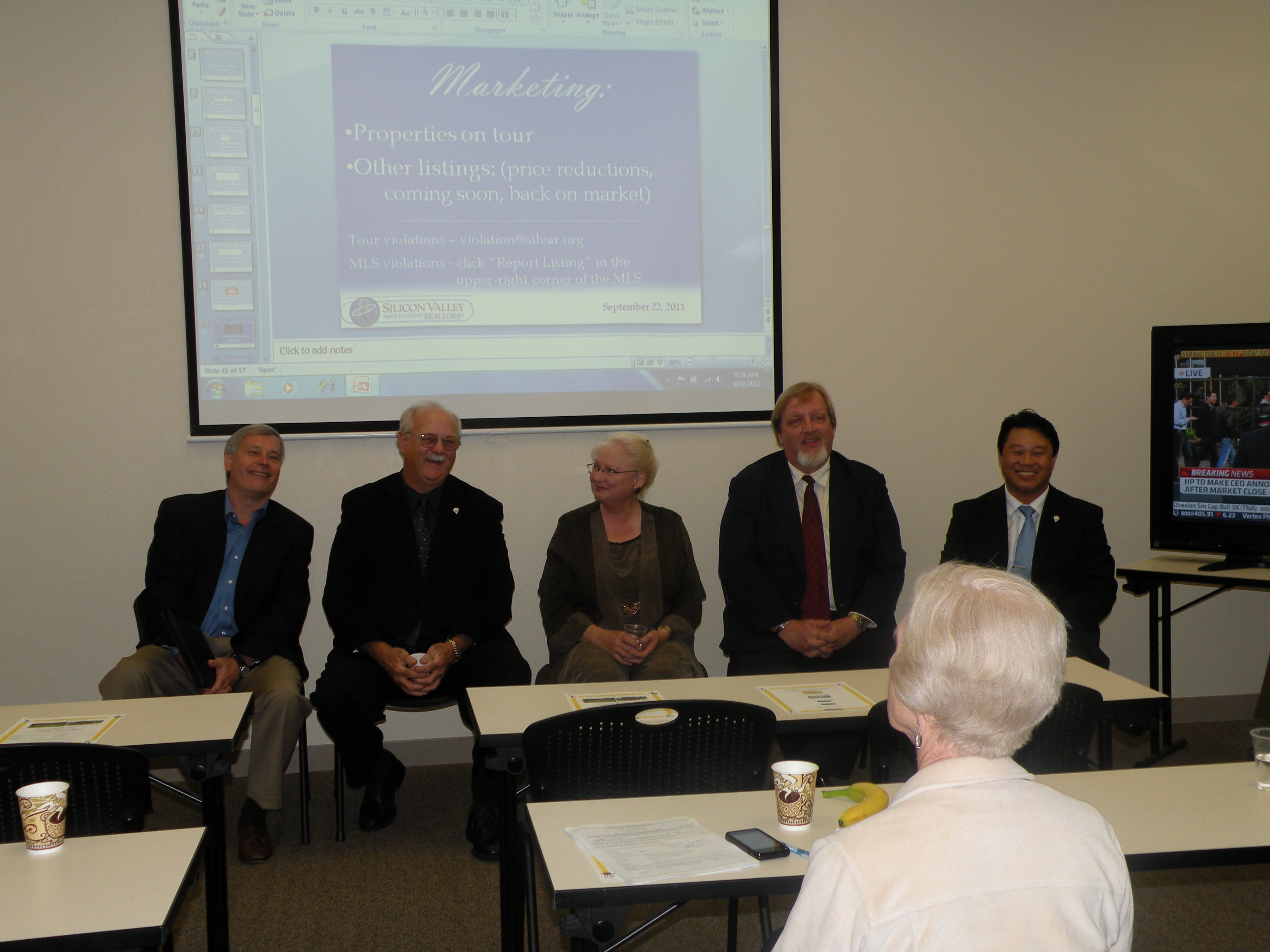
Left to right: Jack Walker, Jim Davis, Tara Martin-Milius, Fred Fowler and Bo Chang.
Five of nine candidates vying for seats in the Sunnyvale City Council shared their positions on taxes, housing, energy retrofitting and rent control at yesterday’s Cupertino/Sunnyvale District’s tour meeting. Council seats 4, 5, 6, and 7 will be decided in the November 8 election.
Overall issues that concerned the candidates were the city’s budget, and the planning and development of the downtown area, which they see as a key source of revenue for the city. All of these candidates stated they are against rent control and imposing energy retrofitting at point of sale.
Bo Chang, who is vying for Seat 5, is a REALTOR® and SILVAR member. Having served on the planning commission for the past four years, Chang said bringing downtown to completion is the cornerstone to raising the city’s sales tax revenue. He said raising taxes and imposing fees would be a last resort because this will discourage entrepreneurship. He identified three areas which can economically benefit the city. They include working on fixing the downtown so it can quickly generate sales tax; and the El Camino corridor and Moffett Park, both of which are doing well. Chang would like to see sustainable housing in the center of employment, along transportation corridors and retail services, in order to accommodate residents without transportation. He is for smart growth because smart development is necessary to accommodate residents so they live close to work, which will mitigate the transportation issues. The city also needs to facilitate communication and work with other cities regarding the issue. A longtime resident and having served on the planning commission for the past four years, Chang said he has invested much in the city and would like to continue serving at the council level.
Jim Davis, a recently retired Sunnyvale law enforcement officer, is seeking Seat 6. He is concerned about the city’s finances, especially since it used $13 million of its reserves to balance the budget last year. He said the city did a good job in the past by bringing in businesses, but due to the economic downturn, things changed. The city has not done enough since to bring businesses back. He doesn’t think the city has done much to encourage commercial property owners to improve their property to make the city attractive for businesses. The city needs to invigorate its resources and bring jobs into the community. He said places like Perry Park need redevelopment dollars. He said it depresses him how long the downtown development has been stalled. He believes the city has done a good job keeping the balance but it needs to be aware of where to put new housing. He said it will be a challenge to keep up with the housing balance. He said his 36 years in law enforcement have given him experience dealing in conflict resolution and listening intently. He has followed the city council meetings closely, so if elected, he can hit the ground running.
Jack Walker is also vying for Seat 6. A former Sunnyvale mayor, current board officer of the Sunnyvale Chamber of Commerce and active resident, Walker said the city’s budget and planning issues need to be addressed and he believes he can help. He said the sales tax structure has been primarily retail based. While Moffett Park has been well developed, a drawback is businesses there are service oriented. He is concerned planning decisions are discouraging manufacturing. Walker is against housing in El Camino and said it needs to stay commercial and retail. He believes Sunnyvale is rapidly reaching a turning point where there is no available land for housing. He is concerned about infilling the industrial areas with housing, but some open spaces on the edges of the industrial areas make sense. The city needs to be cautious and make sure density does not compromise existing neighborhoods. He said housing, jobs, revenue, density are all related and intertwined and he feels his past experience as mayor has given him perspective on these issues.
Seeking Seat 7 is Fred Fowler, also a past Sunnyvale mayor, a volunteer with the Sunnyvale Department of Public Safety, and commissioner on the Sunnyvale Housing and Human Services Commission. Since retiring from office, Fowler said he has seen changes in the way the city works and does not feel it is working efficiently. He likes the way Sunnyvale used to be and wants to bring back the best of past practices. Fowler said the city’s revenues are limited and the best thing is to get the downtown working. He said the city’s current tax structure doesn’t make sense because it doesn’t grow with inflation the way the city’s expenses do. He doesn’t believe the city can survive with a sales tax on goods only and would like to explore taxes on the services sector, but lowering rates overall. Fowler believes Sunnyvale needs more housing of all types, especially rental housing. He sees opportunities for more housing in the old ITR zoning areas and would consider rezoning areas with old office buildings and convert them to housing. He said he has the experience, skills and talents available for the city and is ready to get to work.
Tara Martin-Milius is also seeking Seat 7. She has a business in communications and management consulting, chaired the San Miguel Neighbors Association for many years and is a member of the Sunnyvale Arts Commission. Martin-Milius said she wants to represent residents and be their voice in the council. She said the city’s budget has to be fixed. She would love to see the downtown up and going again to enhance the city’s revenue stream. Her priority is to get businesses into Sunnyvale. She said right now property taxes are the biggest line item for city revenue and should not be. She would like to see businesses help feed the city’s income stream. Martin-Milius wants to keep the balance between residential and commercial. She said residents have complained about transition areas to high density. She would like to see mixed use development on transportation corridors like El Camino, but would make sure transition areas work well. The city can’t support itself as a bedroom community; it needs industrial development, she said. With her experience with residents and teaching career, Martin-Milius said she would be able to facilitate council meetings and bring balance to what goes on in the city council.
This week, four of six candidates vying for two seats in the Cupertino City Council shared their views on housing, taxes, rent control and green building standards with members of SILVAR’s Cupertino/Sunnyvale District. There appeared to be no stark difference in each candidate’s stance on these issues.

Left to right: Rod Sinks, Donna Austin, Marty Miller and Gilbert Wong.
Donna Austin, a staunch supporter of mixed-use development, believes the city needs to step up and provide more housing and retail. She would support higher density and height along the transit corridor. She described herself as “fiscally very conservative,” not too keen on Measure C, but said it’s a tax that will not hurt residents. Measure C, which is on the November 8 ballot, proposes to raise the city’s transient occupancy tax (TOT) paid by hotel guests from 10 percent to 12 percent. There are other ways to obtain revenue, she said. She is for more housing, especially since Apple is expanding. Austin is against rent control because she does not believe renters or landlords would be motivated to renovate. She believes the city is already one of the greenest communities in the region and residents should be free to follow green practices that best suit them. A former San Jose teacher and an active community volunteer, Austin has served on the city’s planning commission and was honored by the Cupertino Chamber of Commerce as this year’s citizen of the year. She believes with her teaching skills, she would bring a different perspective to the council and benefit the city.
Marty Miller, who is a REALTOR® and SILVAR member, wants the city to be more friendly toward businesses. He is in general opposed to all taxes. He believes Californians are overtaxed and that the state tax system is badly in need of reform. By raising the cost for travelers to stay in Cupertino, Miller said the passage of Measure C will ultimately hurt businesses and the city. More housing is needed in Cupertino and there should be a better balance of jobs and housing, he said. If more people lived closer to where they worked, there would be even less traffic, he noted. Miller is opposed to rent control and called it “misguided government policy.” He is also against imposing green building standards on the community. Incentives are the way to go; not mandates. There are two things that kill jobs and growth, said Miller – taxes and excessive regulation, so government should leave the market alone. A REALTOR®, who has been on the planning commission for the past nine years, Miller said the “real power is in the city council.” It is why he is a candidate. He said he would be an appropriate representative of the business community, especially REALTOR®s.
Rod Sinks is frustrated at city projects that have stalled, especially Vallco Shopping Mall, and he is running because he wants to push them through. The city needs to create things that cater to the people. More housing and development are keys to making Cupertino a destination place, so people will shop here and dine here, he said. Sinks said he worked as a volunteer to pass the parcel tax because he saw it as a strengthening measure to improve property values, but he is not a supporter of other taxes. He, too, said California needs to reform its tax system, which he feels inhibits mobility. He is opposed to rent control because it creates a disincentive. As co-founder of Bay Area for Clean Environment (formerly No Toxic Air), a grassroots environmental organization, Sinks said he is very excited about greening the community, but does not believe it should be mandated. Having launched successful high-tech start-up companies, Sinks believes he has the vision and the skills to bring a team together and make the council function more efficiently, especially at its meetings.
Gilbert Wong, who currently serves as mayor of Cupertino and is the lone incumbent in the race, said he would like to continue his work on the council. Born and raised in Cupertino, Wong served five years on the planning commission, prior to his election to the city council in 2007. He said the city has a great future with its excellent public schools. There are more things to come and he would like to see the development projects continued. Wong believes taxes should be the last resort and placing Measure C on the November ballot was just that. He explained Hewlett Packard’s departure left a $1 million dollar hole in the city’s finances. The TOT could raise $450,000 additional revenue for the city. He said he would support anything to protect Cupertino’s schools as long as it is reasonable, such as a school parcel tax. Wong noted, as a property manager, he too does not support rent control. He believes Cupertino’s green building standards should not raise the cost for builders, especially during these hard economic times. The city should stick to the minimum standards currently in place and review them next year, Wong said.

 Silicon Valley Association of REALTORS® says ...