
You are currently browsing the category archive for the ‘Silicon Valley’ category.
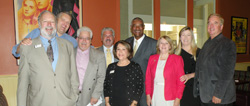
Left to right: SILVAR Past President Gene Lentz, Board Director Bill Rehbock, Affiliate Chair Richard Miller, Board Director David Tonna, President-elect Carolyn Miller, C.A.R. President LeFrancis Arnold, President Suzanne Yost, Los Gatos/Saratoga Chair Cassie Maas, and C.A.R. Past President Jim Hamilton
SILVAR members from the Menlo Park/Atherton and Los Gatos/Saratoga districts had the opportunity to meet and listen to California Association of REALTORS® President LeFrancis Arnold at their meetings this week. Meeting California REALTORS® across the country is part of his duty as president of the state REALTOR® association, said Arnold.
Arnold said SILVAR REALTORS® are very fortunate to be working and living in Silicon Valley because compared to other parts of the state, the region was not hit as hard by the housing downturn. He has observed the growing interest in residential real estate here and in the state from foreign buyers.
“The housing industry is one of the most important assets in California,” said Arnold. Proof of this is in the billions of dollars of residential real estate purchased by international investors. Arnold noted the top foreign buyers come from Canada, China, Mexico and Great Britain, and they are looking at properties in California.
“No immigrant comes to America with a desire to be a tenant. They dream of homeownership,” said Arnold.
Global real estate is growing in importance, said Arnold. Foreign investors and immigrants create opportunities and bring diversity not only in housing, but also in the election process. It is important that everyone, regardless of race, is given the opportunity for homeownership. Arnold said another part of his duty as C.A.R. president is to meet with legislators and deliver this message. It is what C.A.R., SILVAR and the National Association of REALTORS® do at the state, local and national levels.
Arnold underlined the importance of political advocacy. REALTORS® at the local, state and federal level fight legislation that will negatively affect homeownership and allow REALTORS® to be political activists. He stressed advocacy for homeownership needs to continue because the threats are very real, particularly proposals to impose transfer taxes and continuing discussions on eliminating or reducing the mortgage interest deduction (MID).

Left to right: SILVAR President Suzanne Yost, Menlo Park/Atherton Chair Chris Isaacson, C.A.R. President LeFrancis Arnold and SILVAR Past President Gene Lentz
Arnold said REALTORS® at the local, state and national level will continue to work as a team and fight legislation that hurts the American Dream of homeownership.
“Each of us has a role to play,” said Arnold. “We have to continue to fight for homeownership rights.”
MLSListings Inc. reports market activity “slowed to a crawl for nearly all indicators” in the month of June for Santa Clara County and four other neighboring counties. The severe shortage of homes is impacting home sales, sparking multiple offers and slightly higher home prices in a number of communities.
The Silicon Valley Association of Realtors’ multiple listing service provider reports Santa Clara County had 1,093 closed sales of single-family homes, virtually unchanged from 1,097 in June 2011. Santa Clara County’s June’s inventory took a dive of 38 percent from last year. The county’s inventory of 2,589 homes was down 42.2 percent from inventory in June 2003 and down 57.4 percent from 6,071 homes on inventory in June 2008.
According to the MLSListings report, Santa Clara County saw its June 2012 median price of $695,000 jump 9.4 percent over the previous year. The June median for a single-family home in Santa Clara County is 26.2 percent higher than the median of $550,500 in June 2009, when home prices resumed their upward trend.
Unless inventory opens up, home buyers will continue to be squeezed in this tight market, says Suzanne Yost, president of the Silicon Valley Association of REALTORS®. “Many families are already having a difficult time finding a place to live. We will continue to see first-time home buyers facing strong competition from investors with cash. For motivated sellers, pricing is a key factor,” said Yost.
California Governor Jerry Brown signed the Homeowner Bill of Rights into law this week to help struggling Californians keep their homes. This law aims to avoid foreclosure where possible to help stabilize California’s housing market and prevent the other negative effects of foreclosures on families, communities, and the economy.
The new law will generally prohibit lenders from engaging in dual tracking; require a single point of contact for borrowers seeking foreclosure prevention alternatives; provide borrowers with certain safeguards during the foreclosure process; and allow borrowers the right to sue lenders for material violations of this law. The full text of this law, also known as Assembly Bill 278 and Senate Bill 900, is available at www.leginfo.ca.gov.
Last week, the California State Legislature passed a Conference Report that was a key element of the California Attorney General’s package of bills making up a “Homeowners Bill of Rights.”
The legislation is intended to codify the national negotiated settlement between the state’s Attorney General and major banks. The California Association of REALTORS® (C.A.R.) had opposed the legislation because it felt, while well-meaning, the legislation would encourage the filing of frivolous lawsuits that would delay the foreclosure process and further discourage lending.
While C.A.R. is disappointed in the final outcome, the bill passed by lawmakers is a much improved version of the package of bills initially sponsored by the Attorney General. The original bill would have halted all foreclosures, drying up both REO inventory and even short sales.
“The good news is what has passed is an improved version of the package of bills initially sponsored by the Attorney General. During Legislative Day in May, REALTORS® from across the state traveled to Sacramento and spoke with their legislators against these complicated and harmful provisions. The Conference Committee ultimately did not include them in the final report,” said Suzanne Yost, president of the Silicon Valley Association of REALTORS®.
The Silicon Valley Association of REALTORS® (SILVAR) praises Congress for finally passing one of the real estate industry’s key legislative priorities, a 5-year reauthorization of the National Flood Insurance Program (NFIP), also known as the “Biggers-Waters Flood Insurance Reform and Modernization Act of 2012.” President Barack Obama is expected to sign it into law.
According to the National Association of REALTORS®, the 5-year reauthorization will bring certainty to real estate transactions in more than 21,000 communities nationwide where flood insurance is required for a mortgage. The bill ensures the program will continue long-term for more than 5.6 million business- and home owners who rely on it.
The passage of the flood insurance bill is the culmination of a successful multi-year REALTOR® campaign and a final push at the National Association of REALTORS® (NAR) Midyear Legislative Meetings & Trade Expo in May 2012. During their meetings SILVAR members joined thousands of REALTORS® nationwide and met with their members of Congress in Washington, D.C. and urged action on the National Flood Insurance Program (NFIP) and several other priority issues.
Since 2008, Congress had been extending the NFIP a few months at a time. Twice this led to shutdowns, including one that stalled more than 40,000 home sales in June 2010 alone. The NFIP will be in effect until Sept. 30, 2017.
The NFIP has averted $16 billion in losses by strengthening millions of properties against floods. Without NFIP, there would be more uninsured and unmitigated properties, taxpayers would still be “on the hook” for disaster assistance to these properties, and there would be no premiums to pay down any remaining loan balance or collect interest.

SILVAR Board Director Bill Rehbock presented the Charitable Foundation’s $1,000 scholarshiip award to Allison Barry, graduating senior from Leigh High School, last week.
The Silicon Valley REALTORS® Charitable Foundation, the charitable arm of the Silicon Valley Association of REALTORS®, has presented the 2012 scholarship awards to 18 graduating seniors during senior awards night at the students’ respective public schools. Each student received a $1,000 scholarship.
Now in its 13th year, the Charitable Foundation’s scholarship program recognizes students who have exemplified outstanding achievements in academics, extracurricular/employment activities and community involvement. The selection committee included representatives from the local business community, area high schools, area colleges and SILVAR.
Students who received scholarships from the Foundation, the schools from which they graduated, and the colleges and universities they will be attending this fall are: Shona Hemmady, Cupertino High School (Yale University); Vicki Landaverde, Fremont High School (San Jose State University); Fiona Kelsey Flynn, Gunn High School (Cornell College); Allis Yao, Homestead High School (UC Berkeley); Allison Barry, Leigh High School (Harvey Mudd College); Jessica Shiwen Cheng, Los Altos High School (Pomona College); Morgan Gautho, Los Gatos High School (Duke University); Annie Ho, Lynbrook High School (San Jose State University); Thomas Chen, Menlo-Atherton High School (Rensselaer Polytechnic Institute); Dan Guo, Monta Vista High School (Stanford University); Nikhil Nag, Mountain View High School (University of Pennsylvania); Emily Chiu, Palo Alto High School (UCLA); Jennifer Huang, Prospect High School (UCLA); Renae Zelmar, Santa Clara High School (Soka University of America); Zara Jehan Sheikh, Saratoga High School (UC Riverside); Brittany Lynn Bolden, Westmont High School (University of Pennsylvania); Noama Iftekhar, Wilcox High School (UC Berkeley); and Alison Swayne Landes, Woodside High School (Boston College).
“As we mark the 13th year of the Silicon Valley REALTORS® Scholarship program, we are very happy we are able to continue assisting the deserving winners as they embark on their college careers,” said SILVAR Scholarship Chair Nina Yamaguchi. “The seniors selected for the SILVAR Scholarship Program are among the cream of the crop. We believe through our scholarship program we can help our local youth achieve their dreams.”

SILVAR President-elect and Charitable Foundation Trustee Carolyn Miller presented the Silicon Valley REALTORS® Charitable Foundation $1,000 Scholarship award to Vicki Landaverde, graduating senior from Fremont High School.
Thank you to the following SILVAR members who attended the senior award ceremonies at the selected high schools and presented the scholarships to the recipients: Chris Alston (Keller Williams), Carolyn Miller (Re/Max Real Estate Services), Jimmy Kang (Wells Fargo Home Mortgage), Vivian Wang (Coldwell Banker), Bill Rehbock (Coldwell Banker), Joanne Fraser (Coldwell Banker), Chris Trapani (Sereno Group), Mark Burns (Coldwell Banker), Mary Tan (Coldwell Banker), Dante Drummond (Alain Pinel Realtors), Robert Reid (Keller Williams), Nicole Maroko (Re/Max Real Estate Services), David Tonna (Alain Pinel Realtors), Russell Morris (Coldwell Banker) and Theresa Loya (Coldwell Banker).
The scholarship awards presented by the Charitable Foundation Trust are made possible by donations by SILVAR REALTORS® and affiliates. The scholarship program is a partnership effort between the Silicon Valley REALTORS® Charitable Foundation and educators in SILVAR’s service areas. Scholarship recipients are selected from the high schools in the communities served by SILVAR members.
This week SILVAR members joined their fellow REALTORS® from across the nation and convened in our nation’s capital for the National Association of REALTORS® Midyear Business Meetings and visits with members of Congress, including U.S. Representatives Anna Eshoo and Mike Honda during the meetings.
The SILVAR delegation included SILVAR President Suzanne Yost, President-Elect Carolyn Miller, NAR Directors Jeff Barnett, Jim Hamilton, John Tripp, C.A.R. Directors Leannah Hunt, Susan Tilling, Federal Political Coordinator and SILVAR PAC Trustee Carole Feldstein and Joanne Fraser.
Below are the issues that were brought to the attention of our legislators.
REO Bulk Sale Initiative
FHFA (Federal Housing Finance Agency) has announced a pilot program to bulk sale 484 properties in Riverside/San Bernardino/Los Angeles counties, though no date has been set for these sales. Nineteen members of California’s Congressional Delegation have signed on to a letter to Acting Director Edward DeMarco stating their opposition to a proposed bulk sale pilot program for Fannie Mae REOs. Many members of Congress on both sides of the aisle have been frustrated with how Edward DeMarco has utilized the GSEs in addressing their distressed properties and as a tool to address the housing market.
REALTORS® informed members of Congress that bulk sales of Fannie Mae and Freddie Mac properties will cost the tax payers money because they will be sold for less than what they could receive if these properties were sold individually.
Preserve the Mission and Purpose of the FHA Program
The House Financial Services Committee has passed H.R. 4264, the “FHA Emergency Fiscal Solvency Act of 2012,” that will provide FHA (Federal Housing Administration) with additional tools to mitigate risk without overburdening consumers. Several members of Congress have written to the U.S. Department of Housing and Urban Development (HUD) to express concern over FHA’s condominium policies that make it very difficult to purchase a condo with FHA financing.
REALTORS® asked members of Congress to Support H.R. 4264, the “FHA Emergency Fiscal Solvency Act of 2012,” as it was passed out of committee. The bill seeks to balance the need to improve the fiscal solvency of the FHA fund with costs and availability to consumers. Members of Congress were also asked to submit comments to HUD opposing the condominium regulations, and expressed concern that qualified homebuyers are being shut out of often the most affordable homeownership option available.
Protect Homeownership Tax Benefits
H.R. 4202, which has been introduced in the House of Representatives, would extend the mortgage cancellation relief for two more years, through December 31, 2014. H.R. 4336, a similar bill, which would extend it for one year. The Senate as introduced S. 2250, which also extends the mortgage cancellation relief for two years. REALTORS® urged that more time is needed to restore equilibrium in the market. More than 20 percent of all homeowners currently owe more on their mortgages than the current fair market value of their homes. Members of Congress were asked to co-sponsor H.R. 4336 or H.R. 4202.
Reauthorize the National Flood Insurance Program (NFIP)
In July 2011, the House of Representatives voted 406-22 to approve a five-year reauthorization of NFIP, H.R. 1309. The Senate Banking Committee has since unanimously reported a similar bill, S. 1940, which continues to await full Senate consideration. Forty-one senators recently wrote their leadership urging them to bring up such a measure for debate. REALTORS® thanked members of Congress for voting for H.R. 1309, and urged the Senate to pass a five-year flood insurance reauthorization bill before the current temporary extension of the flood bill expires on May 31.
Secure the Future of Homeownership
During the first session of the 112th Congress, the House Financial Services and Senate Banking Committees held numerous hearings on the housing market, primarily focusing on foreclosure/loss mitigation and the state of the nation’s housing. Year-to-date, the House Financial Services Committee has not held any hearings on GSE reform, appraisals, short sales or QRM/QM. The Senate Banking, Housing and Urban Affairs Committee held only one two- part hearing on the state of the nation’s housing market. NAR expects that with a renewed focus by the Administration and Congress on housing concerns, additional hearings on all three issues will be initiated and that NAR will be a primary participant.
REALTORS® asked that reforms of the secondary mortgage market be comprehensive, and the federal government must have a continued key role in the secondary mortgage market in order to ensure that there is capital for mortgage lending in all mortgage markets under all market conditions. REALTORS® asked for a hearing on H.R. 1498 or S. 2120. This legislation requires services to decide whether to approve a short sale within a specified time frame of completion of the short sale request. REALTORS® also seek increased educational standards for appraisers, and support state regulation of all appraisers, regardless of their source.
Bolster Commercial Real Estate Lending
Representatives Ed Royce (R-CA) and Carolyn McCarthy (D-NY) introduced H.R. 1418, the Small Business Lending Enhancement Act of 2011, to increase the member business lending cap from 12.25 percent to 27.5 percent of total assets for well-capitalized credit unions. The Senate has introduced S. 2231 as a companion bill. In June 2011, the House Financial Services Committee voted to pass H.R. 940, the United States Covered Bond Act of 2011. This legislation facilitates the creation of a U.S. covered bond market, which would provide an additional source of commercial real estate lending. The Senate has introduced S. 1835 as a companion bill.
REALTORS® asked that Congress pass H.R. 1418 and S. 2231. Credit unions can fill in the commercial real estate lending gap and help get capital to the struggling small businesses that occupy commercial space. They also seek passage of H.R. 940 and S. 1835 to create a U.S. covered bond market, which would complement the fragile commercial mortgage-backed securities (CMBS) market by providing an additional new source of capital for the commercial real estate industry.

How many men does it take to put a lace curtain? “Never enough!” according to (left to right) Bob Conway, Dave Barca, Doss Welsh and Peter Kitch. In the end, the men just couldn’t figure it out without the help of the homeowner and the women RSVP volunteers!
For more than a decade REALTORS® and affiliates from SILVAR have assisted seniors and the homebound with household tasks, through SILVAR’s REALTOR® Service Volunteer Program (RSVP). Washing windows, installing smoke detector batteries, flipping mattresses, light vacuuming, dusting, replacing light bulbs, changing furnace filters and trimming bushes can mean a lot of work, especially when agents have to take time from their busy schedules. Yet each year, the RSVP volunteers all say they take away more than what they give from this experience.
“I’ve been pretty lucky so far, so I felt I needed to do something to give back to the community,” Jeffrey Dean explained why he decided to volunteer for RSVP for the first time this year.
Longtime RSVP volunteer and Cupertino/Sunnyvale District’s RSVP chair Sue Bose said, “I believe when people grow old, many are afraid or shy to ask for help, even from their children, who live close by. The small tasks we do for them helps keep them safe and comfortable, and enables them to live a better and longer life.”
The seniors are always grateful for the help they receive from the volunteers.”It’s so very kind of you to help us,” said an 82-year-old Los Altos man and his 83-year-old wife to the team of Beth Tompkins, Joe Velasco, Michael Bleier and Christine Moore. They washed the couple’s outside screens and windows.
“We hate to admit that we’re getting old and can no longer do all this work,” said the husband.
“There’s no way I can do all this work by myself,” exclaimed an 83-year-old Los Gatos resident, as the team of C.T. Harris, Ryan Iwanaga and Wendy Lannon Potts flipped her mattress, placed bricks under her bed in order to elevate it, repaired a set of window blinds, replaced her smoke detector batteries and furnace filter, which was loacted in a dark cellar.
Longtime RSVP volunteers Rick White, Sherry Hagen and Scott Holt helped a 76-year-old woman and her 80-year-old husband by washing screens and windows and trimming bushes. The wife, who was in a wheelchair, recently had a stroke and then fell and broke her hip. They have no children.
“It’s frustrating not being able to do things and we guessed it was time to break down and ask for help,” she said. “My husband tries to do everything and he’s running himself down.”
An elderly Menlo Park homeowner, who is single and lives alone with no family nearby, called the volunteers “my angels.” “You are an answer to my prayers, a gift from heaven. I am so overwhelmed,” she told the team of David Barca, Mandy Safka, Kathy Hearn Bosse and Jim Taggart. They washed her curtains, screens and windows, fixed her front porch and installed new smoke detector batteries in her home. They were later joined by Bob Conway, Doss Welsh and Peter Kitch.
“I wish we could do more for them. I wish we could help even more seniors,” said Barca. “You learn so much through conversations with them, and, you end up getting attached to them, as well.
Barca initiated RSVP with other REALTORS® in 2001. The program was launched by SILVAR as an official community outreach project in 2002, and has expanded to include volunteers from the San Mateo County Association of REALTORS®, the Fresno Association of REALTORS®, Santa Clara County Association of REALTORS® and Santa Cruz County Association of REALTORS®. Barca hopes to expand RSVP to all AORs in the state.
SILVAR RSVP Chair Eileen Giorgi thanked this year’s volunteers and chairs for their fine work this year. SILVAR’s 2012 RSVP district chairs include Sue Bose (Cupertino/Sunnyvale), Mary Kay Groth (Los Gatos/Saratoga District), David Kim and Suzanne O’Brien (Los Altos/Mountain View), Jeff Beltramo (Palo Alto District), and Barca (Menlo Park/Atherton).
“We really receive more than we give,” said Giorgi. “Thank you to all our volunteers and chairs who gave up their time this week to give back to the community. We all realize how important this program is to our seniors.”
On April 17, the Federal Housing Finance Agency (FHFA) announced a new directive as part of FHFA’s continued servicing alignment initiative that directs Fannie Mae and Freddie Mac to align their guidelines for servicing delinquent mortgages they own or guarantee.
The new directive requires that servicers of Fannie and Freddie loans:
• Review and respond to borrower requests for short sales within 30 days after receipt of a short sale offer and a complete borrower request.
• If the review is still under way after 30 days, give the borrower weekly status updates. (This allows more time where necessary, such as where subordinate lenders and/or mortgage insurance is involved.)
• Advise the borrower of the final decision within 60 days after receipt of a short sale offer and a complete borrower request.
The new timelines apply both to HAFA loans and to other short sales approved by Fannie Mae and Freddie Mac. Additional enhancements are planned by the end of 2012 addressing borrower eligibility, simplifying documentation, valuing property, payments to subordinate lien holders, and mortgage insurance.
REALTOR® officials at the national, state and local level applaud the move by FHFA to streamline the short sale process. Faster response times will help thousands of distressed homeowners, according to Suzanne Yost, president of the Silicon Valley Association of REALTORS®.
“Short sale transactions are more complicated than regular transactions and they have taken so much time that many prospective buyers have walked away from short sales,” said Yost. “The FHFA’s move to streamline the short sale process is a critical step toward a full housing market recovery.”
In another move to protect struggling California homeowners, the California Association of REALTORS® (C.A.R.) is sponsoring a bill so homeowners who face losing their home and have negotiated a short sale in good faith with their lender or servicer are not forced to go through foreclosure.
Assembly Bill 1745 (Torres, D-Pomona) prevents lenders or servicers that have agreed to a “short sale” from foreclosing on a home. For any number of reasons (e.g., sickness, job loss, etc.), a homeowner may be unable to continue making his or her monthly mortgage payment. Rather than go through a lengthy and stressful foreclosure process, the homeowner will attempt to negotiate a “short” sale with the lender in which the lender agrees to accept less than the amount owed by the homeowner.
Foreclosures and short sales are usually handled by two different departments within banks. Unfortunately, these two departments often do not communicate with each other, which can frequently result in a homeowner being foreclosed upon, despite having previously negotiated a short sale with the same bank.
AB 1745 will likely result in banks implementing a dual tracking system to prevent foreclosing upon homeowners with whom they have already negotiated a short sale. The measure is scheduled for hearing on Monday, April 30 by the Assembly Banking and Finance Committee.

 Silicon Valley Association of REALTORS® says ...