
You are currently browsing the category archive for the ‘Silicon Valley Housing Market’ category.
On May 14, 30 members and guests of the Silicon Valley Association of REALTORS® attended “Doing Business with Mexico” and celebrated Cinco de Mayo afterwards with Mexican delicacies. With Global Business Council (GBC) Chair Mark Wong and GBC member Sara Spang both moderating, panelists shared valuable information about both inbound and outbound transactions with clients from Mexico.
Panelists included Nancy MacLeod, a real estate broker/owner of Homes2Buy.com, who owns a villa in San Miguel de Allende, Mexico, where she also represents buyers from the U.S.; Alicia Sandoval, a REALTOR® with Keller Williams Realty in Palo Alto and a native of Mexico; Amber Neil, a REALTOR® with No Borders Realty in San Jose, who has dual U.S. and Mexican citizenship and has been doing business in Mexico and California since 2006. Another panelist, Sal Covarrubias, sales manager for First American Title Company, discussed title vesting concerns, proper identification needs for sellers, and the differences in holding title between the U.S. and Mexico.
The REALTORS® said the best way to tap into the Mexican market is to join AMPI (Asociación Mexicana de Profesionales Inmobiliarios), the largest real estate association in Mexico. Join the organization as an affiliate and attend their conventions and events.
AMPI has ties with the National Association of REALTORS® and is strongly advocating for the licensing of real estate agents in Mexico, because right now, anyone can be a real estate agent there. Travel and networking is key to learning more about the real estate business there and AMPI would be a good source, they said.
Covarrubias said issues regarding Mexicans buying property in the U.S. are similar to that of other foreign buyers. “Timing is important and whether the foreign buyer will be personally present at closing. Also, agents need to verify their client’s legal name. It may not matter much when the client buys the house, but it will matter when it is time for that client to sell the property,” said Covarrubias.
Transactions can take months to conclude in Mexico so Mexicans who buy property here get culture shock when the process is quick, and they can close as soon as three or seven days. Also, there is no disclosure when buying property in Mexico, so REALTORS® need to take time to explain to their Mexican clients the transaction process in the U.S. “Mexicans are very social and want to get to know you personally first before deciding to do business with you. They value social graces, mannerisms and respect,” said Neil. “And they are not keen on email or text. They want one-on-one, eye-to-eye conversations with you, and many meetings.”
Like any country, there are places that are dangerous, but MacLeod said, “Mexico is still very safe, especially the tourist areas and places like San Miguel de Allende.”
Sandoval said while payoffs were prevalent in the past, business there is now done in a more professional way.
Lastly, don’t believe you have to sign a 99-year lease and can’t own property in Mexico. “I’m not sure where that myth came from,” chuckled Neil.
VIEW PHOTOS HERE
The Silicon Valley Association of REALTORS® (SILVAR), a professional trade organization representing over 4,500 REALTORS® and Affiliate members engaged in the real estate business on the Peninsula and in the South Bay, has come out in opposition to a Bay Area Air Quality Management District (BAAQMD) proposal that would mandate the replacement of all uncertified wood-burning devices with gas-fueled, electric or Environmental Protection Agency (EPA) certified heating devices that meet or exceed NSPS Subpart AAA, upon the sale or transfer of residential or commercial property.
In a letter addressed to BAAQMD, SILVAR President Chris Isaacson stated, “We cannot over-emphasize the impact this rule would have on the Silicon Valley housing market. What little it does to reduce wintertime air pollution does not warrant the substantial difficulty it would cause for people who are trying to sell their homes.”
According to SILVAR, implementation of this rule would be complicated, costly, ineffective, overreaching and intrusive to residents. Installation of gas and electrical inserts or EPA certified heating devices would require construction or placement of gas or electric lines into a fireplace, triggering structural, slab foundation and other issues that would be costly. The cost of the units alone range from several hundred to thousands of dollars.
Isaacson said the government should implement regulations that fix problems while negatively impacting the fewest number of residents. The fireplace amendment does the exact opposite and does not correct the problem of air pollution. This rule would force people to remove fireplaces with literally no evidence that the people buying the home would violate “Spare the Air” restrictions, or ever burn wood.
SILVAR contends the rule is an ineffective, senseless solution to solving the problem of air pollution, since it would only affect about 40 percent of homes in 40 years. “This Rule punishes everyone for the bad acts of a few. If implemented, this Rule will hamstring the real estate market, cost home sellers potentially thousands of dollars, and by 2050 will only impact less than half of the fireplaces in the region. This Rule is a broad brush that does not even attempt to target the actual bad actors,” said Isaacson.
SILVAR strongly recommends taking a different, more sensible approach to improving air quality. The Association recommends increasing Spare the Air days and stepping up its enforcement, and providing incentives to homeowners who install the suggested gas-fueled, electric or EPA-certified heating devices.
“Figure out the areas where people are burning excessively and target those areas with either mandatory or voluntary burn bans. If changing out the fireplace is still a goal, then incentivize homeowners to remove or retrofit. This harsh and excessive regulation is not the right way,” said Isaacson.
View SILVAR President Chris Isaacson’s letter to BAAQMD here.
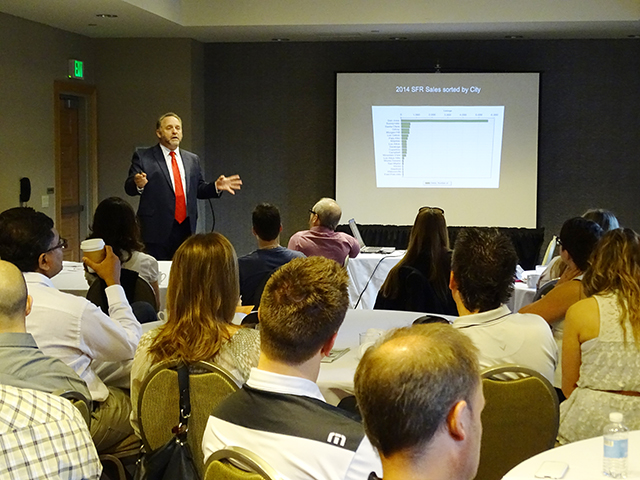
Dave Walsh, vice chair of MLSListings Inc. and vice president and managing broker of Alain Pinel Realtors’ Almaden office in San Jose, gave a group of 25 Canadian home builders an overview of the Santa Clara County housing market during their visit to the San Jose area this month.
Twenty-five members of the Canadian Homebuilders Association – Alberta were on a two-day housing tour of homes in Santa Clara County March 12 and 13, and learned about the Silicon Valley housing market and challenges to urban development from local speakers.
At a breakfast presentation arranged by the Silicon Valley Association of REALTORS®, Dave Walsh, vice chair of MLSListings Inc., shared local housing data with the builders. Walsh described Santa Clara County, which is at the heart of Silicon Valley, as “the single, most crazy market.”
Walsh said the region once filled with orchards, has become the leading hub of high-tech innovation and development in country. Recent growth has led to record-setting home prices. Home prices today have now exceeded the 2007 high, but there are far fewer homes on the market. Santa Clara County’s February median home price of $950,000 is “the best February ever,” said Walsh. The median is 20 percent above the median peak of $790,000 in February 2007. The problem is the county just had 1.4 months of inventory, with only 1,761 single-family homes for sale in February.
Walsh showed how home prices increase the closer one gets to Palo Alto, the central economic focal point of Silicon Valley, home to Stanford University and other prominent tech firms, and close to Facebook in neighboring Menlo Park and Google in Mountain View. Homes in Palo Alto are selling 110 percent of asking price, at an average of $1,491 per square foot. In Gilroy, which is about 50 miles from Palo Alto, homes are selling 99 percent of asking price at an average price of $284 per square feet. In Saratoga, which is about 18 miles from Palo Alto and has an excellent school district, homes are selling 102 percent of list price at an average of $812 per square foot.
Nationally renowned feng shui master and fortune teller Master Y.C. Sun was at the Silicon Valley Association of REALTORS® (SILVAR) Young Professionals Network (YPN)/Global Business Council (GBC) Lunar New Year Celebration last week and gave members advice on what to expect this year which, according to the Lunar Calendar, is the Year of the Wooden Goat. Master Sun also spoke on the principles of feng shui.
Master Sun said goats are graceful, kind, gentle, shy, emotional and caring. They possess humility and sympathy. They dislike conflict and the lack of support from peers, family or friends. This year, agents must focus on teamwork, collaboration and partnership.
2015 will be a good year for real estate, Master Sun told REALTORS®, though the feds are ready to get out of the market and expected to raise short-term rates slightly in April or June. Chinese investment in real estate will focus on bigger ticket items of residential/commercial properties in big cities like New York.
Growth areas with hot markets will be to the north (Chicago, Twin Cities, Sacramento, Denver), southwest (Los Angeles, Long Beach, San Diego, San Jose, Phoenix), east (D.C., Boston, Long Island, Queens, East Bay), and the northwest (Seattle, Portland). The Bay Area will continue to be a hot market, but due to the tight supply and high prices, he urges buyers to focus on their second choice neighborhoods. Booming areas will be by the water, like properties in Oakland, Lake Merced, San Francisco Mission Bay, Richmond Marina Bay, Alameda, etc.
California REALTORS® hailed the Federal Housing Finance Agency’s announcement this week that government-sponsored enterprises Fannie Mae and Freddie Mac will lower down payments to as little as 3 percent for first-time home buyers and permit refinancing borrowers to reduce equity to 3 percent to cover closing costs.
The FHFA decision to lower down payments is in line with its effort to boost the real estate market and expand the pool of first-time home buyers who have been kept in the sidelines even as the housing market has been on the path to recovery. “The new lending guidelines will enable creditworthy borrowers who can afford a mortgage, but lack the resources to pay a substantial down payment plus closing costs, to get a mortgage with 3 percent down,” said FHFA Director Melvin L Watt in a statement released on Monday.
David Tonna, president of the Silicon Valley Association of REALTORS®, applauded the FHFA’s decision to expand access to credit to first-time home buyers. “Despite an improving job market and low interest rates, the share of first-time home buyers in 2014 was the lowest in nearly three decades,” said David Tonna, president of the Silicon Valley Association of REALTORS.
Tonna said according to the 2014 National Association of REALTORS® Profile of Home Buyers and Sellers, the share of first-time home buyers dropped from 38 percent in 2013 to just 33 percent this year. This represents the lowest share since 1987, when the first-time home buyer share was at 30 percent.
“We commend the FHFA’s commitment to expand homeownership and are confident that the underwriting guidelines put in place will mitigate risk,” said Tonna.
Borrowers still need to meet strict criteria under the new programs. Only borrowers who haven’t owned a primary residence within the last three years will be eligible for Fannie Mae’s 3 percent down payment program, which starts Dec. 13. The Freddie Mac program, which will begin in March, is only for borrowers who have never owned a home, those with moderate incomes or are in underserved areas.
Borrowers for both programs will be required to buy private mortgage insurance, provide complete documentation of their income, assets and job status. Borrowers also need a credit score of at least 620 to qualify and are required to receive homeownership counseling.
The income tax exemption on mortgage debt forgiven in a short sale or a workout for principal residences expired at the end of 2013. Without immediate action by Congress, distressed homeowners will have to pay tax on “phantom income” from forgiven debt. Many families have decided not to go through with short sales or seek workouts because of the uncertainty over the status of the waiver. This is not only unfair, but harms families, neighborhoods and communities.
On Wednesday night, the United States House of Representatives passed the bill containing the income tax exemption on forgiven mortgage debt and other expired tax provisions by a vote of 378-46, but the United States Senate has not yet voted on the measure. The National Association of REALTORS® (NAR) is urging all members to contact their senators in Congress and have them extend this tax relief now!
- Despite significant market recovery, more than 5 million are still “under water.”
- Nearly 1 million households are seriously delinquent on their mortgages or in foreclosure.
- Mortgage debt forgiveness tax relief is vital for these families.
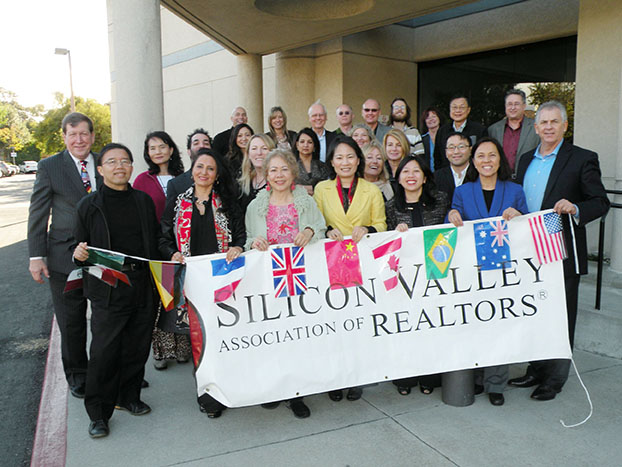
Congratulations 2014 CIPS Institute graduates!
Twenty-three REALTORS® attended the National Association of REALTORS® (NAR) Certified International Property Specialist (CIPS) Institute offered at the Silicon Valley Association of REALTORS® (SILVAR) on November 17-21. Attendees included REALTORS® from SILVAR and other REALTOR® associations around the Bay Area. It was the third CIPS Institute offered by the local trade association to both members and nonmembers, providing them the opportunity to learn more about global real estate so they can better serve their international clients. Florida resident David Wyant, NAR’s 2012 and 2009 International Instructor of the Year, returned to the Bay Area to teach the week-long courses, which focused on ownership and transaction principles of international real estate, including specifics on the real estate markets in Europe, the Americas and Asia. “The great thing about teaching the CIPS classes in Silicon Valley is that the REALTORS® here ‘get it.’ Many of them are already experiencing business with international clients. Others quickly grasp the opportunity that exists here and begin to put their business plan in place to exploit it,” said Wyant. Wyant added, “Silicon Valley is a brand well known in virtually every country in the world, and our CIPS graduates report that they have experienced success reaching out to clients in their preferred ‘niche’” Sales to international buyers reached a record $92.2 billion last year, according to NAR. California, Florida, New York and Texas are the most popular states where international buyers search for properties. Upon completing the required courses and other necessary requirements, the REALTORS® have the opportunity to receive their CIPS designation at the annual REALTOR® Conference and Expo slated for November 2015 in San Diego. Since SILVAR began offering the CIPS Institute in 2012, more than 50 REALTORS® have earned the CIPS designation.
For the second year in a row, the National Association of REALTORS® (NAR) has recognized the Silicon Valley Association of REALTORS® (SILVAR) with its prestigious NAR Platinum Award as part of its Global Achievement Program. The local professional trade organization representing over 4,500 REALTORS® and affiliate members engaged in the real estate business on the Peninsula and in the South Bay, is the only REALTOR® association in Northern California to achieve Platinum status since the program’s inception in 2011.
SILVAR was one of eight REALTOR® associations in the nation that was recognized with the NAR program’s highest honor at the REALTORS® Conference and Expo held in New Orleans Nov. 7-10. SILVAR 2014 President David Tonna accepted the award on behalf of the local trade association at the International Night Event on Nov. 8.
“We are honored to receive the National Association of REALTORS® prestigious Platinum Award for two years in a row. This award reflects SILVAR’s commitment to helping our members expand and excel in the business of global real estate,” said Tonna.
SILVAR’s commitment to international real estate goes beyond members assisting foreign nationals buying property in Silicon Valley. As a membership benefit, SILVAR REALTORS® have free access to Proxio, the global networking platform that connects them with real estate agents in the U.S. and abroad and enables them to share their listings with each other. Members also have access to the Proxio Developer Showcase, which connects REALTOR® members to property developments around the world.
The local association’s global business council conducts activities and education programs to raise members’ awareness of global business in their local market. SILVAR offers NAR-accredited courses for REALTORS® seeking the At Home with Diversity certification and Certified International Property Specialist (CIPS) designation. The CIPS courses focus on ownership and transaction principles of international real estate, and provides training in international business issues, including currency conversion, cultural awareness, and legal and tax requirements. The courses also provide an analysis of the real estate markets in Europe, the Americas, and Asia.
“SILVAR is dedicated to helping our over 4,500 members serve their clients. This award is a testament to SILVAR’s accomplishments and mission to give its members the proper tools that will help them succeed in their business here and abroad,” said Executive Officer Paul Cardus.
In recognizing SILVAR, NAR noted the great strides made in SILVAR’s global initiative over the past year, its impressive CIPS (Certified International Property Specialist) designee growth during that time, the extensive outreach efforts the association conducted over the past year, and specifically its collaboration with ethnic real estate associations in the area.
Despite the housing market recovery, scammers are still attempting to defraud unsuspecting homeowners, according to the California Bureau of Real Estate (CalBRE)). CalBRE is asking consumers and real estate agents to be on the alert and report suspicious fraudulent activity.
CalBRE real estate commissioner Wayne Bell recently told Silicon Valley real estate professionals at a meeting of the Filipino American Real Estate Professionals Association (FAREPA) that the bureau is reaching out to the public and real estate organizations and seeking their help in catching criminals that continue to prey on unsuspecting and financially distressed homeowners. Bell said real estate agents are themselves targets of fraud, along with consumers, especially the elderly. He is asking anyone suspecting scams involving real estate to report their suspicions to the bureau, or visit its website at www.dre.ca.gov and file a complaint.
“We would like to see a culture of compliance with our laws,” said Bell. “We want to educate real estate professionals who want to aspire for professionalism and segregate them from the crooks that don’t.”
Bell said the bureau is seeing a rise in cases of affinity fraud, where criminals prey upon members of ethnic communities. These scams often go unreported because many in these groups are afraid to contact government authorities.
Foreclosure rescue scams and pitching of forensic loan audits are still prevalent. These scams involve fraudulent foreclosure “rescue” professionals who sell services that promise relief to financially strapped homeowners in exchange for an advanced fee.
Unlicensed property management companies are targeting agents, selling them worthless lists of rentals. Then there’s online rental fraud, where scammers hijack a listing and put it up on Craigslist and other websites. These scammers are difficult to catch, said Bell, because they move from one place to another.
Bell said homeowners need to beware of property record fraud, a scam that can be simply done by someone recording a false document in the county recorder’s office. The document makes it appear as if they own someone else’s property. Seniors are often the target of this type of crime and reverse mortgage scams.
Bell advises consumers and agents to make sure a person’s license is legitimate by checking the CalBRE website, which shows license status in real time and disciplinary actions taken against a licensee; be vigilant; be skeptical; don’t send money over the Internet; see the rental property first, or contact a legitimate agent to help you. He also advises homeowners to check the title to their property and make sure there are no liens imposed on the property.

Left to right are moderator Davena Gentry, SILVAR Global Business Council chair, and panelists Amy Sung, Mark Wong, Kenneth Chan and Jessie Wu.
“Doing Business with China,” the first of a quarterly series of programs exploring different aspects of doing business with clients from other countries, was a sell-out. Hosted by the Silicon Valley Association of REALTORS® (SILVAR) Global Business Council at SILVAR yesterday, the program gave members the opportunity to learn the “nuts and bolts” from real estate professionals that have worked with Chinese clients and are familiar with the real estate rules and regulations of that country. They shared their experiences, including challenges they have encountered when closing a deal.
SILVAR Global Business Council Chair Davena Gentry served as moderator. Panelists Amy Sung, a REALTOR® with Pacific Union International Real Estate – Menlo Park, and Mark Wong, a REALTOR® with Alain Pinel REALTORS® – Saratoga, presented the REALTOR® perspective; Kenneth Chan, premier mortgage consultant with HSBC – Palo Alto, presented the lender perspective; and Jessie Wu, escrow officer with First American Title Company – Cupertino, presented the escrow perspective.
The REALTORS® discounted the myth that Chinese buyers prefer Chinese or Chinese-speaking agents. What’s important is to show respect for Chinese buyers who are not well-versed in English. Sung pointed out that just because they don’t speak English well does not mean the Chinese buyer is not educated. Wong said more important than knowing the language is to learn and respect their culture, the principles of Feng Shui, what numbers and colors mean to the Chinese.

 Silicon Valley Association of REALTORS® says ...