
You are currently browsing the category archive for the ‘Silicon Valley Housing Market’ category.
No matter where you are or who you are with, always trust your senses because your subconscious is almost always right. This was the first important safety tip that Santa Clara County Deputy Sheriff Chad Garton shared with SILVAR members at Wednesday’s Los Gatos/Saratoga District tour meeting.
Garton, who is a U.S. veteran who served in Iraq, said trusting your instinct is also what soldiers do in combat. If you feel uneasy about a person you are with or a situation you are in, trust your gut feeling and leave that person or remove yourself from the situation.
“Your subconscious is constantly taking in information; do not ignore that,” said Garton.
Garton said REALTORS® are especially at risk because they meet strangers all the time. He shared what he termed a 5-point Contingency Plan, which those in the military also use: Let people know:
1. WHERE you are going.
2. WHO you will be meeting.
3. WHEN you will be back.
4. What to do if you don’t return.
5. The ACTION to take if they cannot contact you.
Here are other safety tips Garton shared with members:
• It may be part of your job to show your professionalism and success in the way you dress, but be aware that people are watching you and looking for ways to steal valuables.
- Don’t leave valuables in plain sight in your car. It only takes 17 seconds for someone to break into a car.
- Always meet a new person in a public place and get their ID.
- Show strength in whatever you do. When you’re walking, look around; don’t look down. Always make eye contact. Speak in a loud voice because this gives the appearance of strength.
- Do not carry a firearm. If you have to carry a weapon, make sure you are fully trained to use it. Pepper spray and Mace are good, but you still need to train yourself to use these self-defense devices.
- An alarm system can act as a deterrent and video cameras inside and outside the home are even better deterrents because they can identify the robbers.
- Lock all doors and windows even if you are home. If the weather is warm, spend the extra money and turn on the air conditioner, instead of leaving windows open.
- Refrain from announcing open houses and where you will be on social media.
- Do not to hesitate to call 9-1-1 if they see something suspicious, or feel you are in danger.
REALTORS® are concerned about the recent announcement by the U.S. Department of Housing and Urban Development (HUD) that the Federal Housing Administration (FHA) will begin insuring mortgages on certain properties with Property Assessed Clean Energy (PACE) loans. REALTOR® officials say there ought to be more disclosures regarding the risks associated with PACE loans.
A PACE loan allows a homeowner to borrow money to finance energy upgrades. The loan is repaid as a surcharge on the property tax. The PACE loan takes primary position to the mortgage. If the cost of repaying the PACE loan and any mortgages on the property exceeds the home’s purchase price, the seller will be forced to make up the difference.
California Association of REALTORS® President Pat “Ziggy” Zicarelli said in a statement, “Although C.A.R. supports voluntary consumer-friendly energy improvement programs for homeowners, C.A.R. believes that HUD was ill advised to approve placing PACE loans in a senior position to FHA first mortgages. Doing so places FHA homebuyers and taxpayers at risk and does homeowners a disservice by approving a loan product without consumer protections and which is aggressively sold to homeowners who rely on FHA financing for safe and affordable mortgages.”
REALTORS® say PACE loans are unfairly expensive and carry higher interest rates than the first mortgage or a home equity loan. “This loan product has no minimum disclosures, no underwriting of the borrower, no proof that the borrower has the ability to repay, no three-day right to rescind, no marketing limitations, no interest rate or fee caps, no kickback prohibitions; nothing,” added Zicarelli.
The Federal Housing Finance Agency (FHFA) and conservator of Fannie Mae and Freddie Mac prohibits PACE loans to be placed in a senior position to the mortgage. Both the FHA and Fannie Mae currently offer mortgage financing that allows borrowers to finance energy efficiency improvements at lower rates than PACE liens. HUD’s announcement, which is contrary to FHFA’s current policy will only confuse homeowners, homebuyers, REALTORS®, lenders, escrow, title and the housing market overall.
The National Association of REALTORS® also expressed its concern, especially with regard to delinquent foreclosed properties. “A foreclosed property with a PACE loan in the primary position will likely remain on the market longer than it should, further increasing uncertainty in mortgage markets and placing unnecessary pressure on homeowners,” NAR President Tom Salomone said in a statement.
Karen Trolan, president of the Silicon Valley Association of REALTORS®, said, “Now, more than ever, the California legislature must pass AB 2693 (Dababneh), a C.A.R.-sponsored bill that would ensure consumers are aware of the consequences of PACE loans and have the opportunity to rescind after a three-day cooling off period. Current disclosures given to home buyers do not explain the potential consequences of using PACE loans. AB 2693 will require Truth in Lending type disclosures to borrowers.”

Recent news reports about burglaries of vacant homes for sale in the Bay Area are troubling and a good reminder for REALTORS® and their clients to take precautions to prevent this crime from happening to them. Majority of recent burglaries have occurred in homes with “For Sale” signs in the front yard, or homes that are easily identifiable as being vacant. These burglars are taking large appliances, like refrigerators and stoves.
The Silicon Valley Association of REALTORS® shares the following safety tips with homeowners who plan to sell their home or leave their home vacant for an extended time:
- Make your home look occupied. Use automatic timers on lights, a TV and/or radio, and set them to go on and off at different times to make your house appear occupied.
- Install motion detectors on the exterior of your home and garage or shed.
- Keep curtains/blinds closed and lock all doors and windows. Use wooden stakes inside patio door/window frames to prevent them from being opened from the outside.
- Keep your property maintained, grass mowed, and leaves raked. Trim trees and bushes so they can’t conceal burglars.
- Inform the police and trusted neighbors that your house will be vacant for an extended time. Police may be able to patrol your neighborhood periodically and keep an eye on your property. Ask neighbors to keep an eye on the property and call 9-1-1 immediately if they see or hear any suspicious activity.
- Ask a trusted neighbor to pick up flyers or newspapers that may be left on the front porch or driveway. Consider having a neighbor park their vehicle in your driveway while you are gone.
- Install an alarm system and/or security cameras.
- Consider renting your home or hiring a house sitter so the house won’t be vacant.
- Know the risks of putting “For Rent” or “For Sale” signs in front of your property.
- Never leave a spare house key under doormats, flowerpots, or other hiding places.
- Don’t place posts on social media informing others that your house is for sale or that you will be away on vacation.
The California Association of REALTORS® (C.A.R.) has asked all REALTORS® to contact their State Assembly Member and urge them to vote NO on AB 2502, which undermines existing Costa-Hawkins’ protections by allowing local governments to impose mandatory inclusionary zoning (i.e. rent control) on newly constructed rental housing. It is vitally important that you reach out to your elected representative today! Let your Assembly Members know that you say NO to Rent Control!
Please Call YOUR Assembly Member TODAY at (800) 798-6593 between 9-5 p.m.
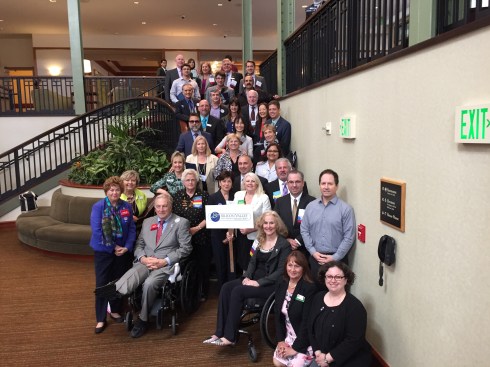 About 50 SILVAR members joined over 2,000 California REALTORS® in Sacramento on Wednesday for the annual California Association of REALTORS® (C.A.R.) Legislative Day, the one day each year that the state’s REALTORS® meet with their legislators and discuss real estate-related policies and issues.
California Governor Jerry Brown spoke to California REALTORS® at the Sacramento Convention Center during the C.A.R. morning briefing. Brown said the economy has its cycles and at present the state’s economy is doing well, thanks to the business sector.
“California is the land of sunshine and smart people. That’s why people want to be here. Silicon Valley has the smartest people in the world,” declared the Governor.
Brown told REALTORS® to stay the course, stating, “REALTORS® are the backbone of what California looks like, of what California is.”
At a joint luncheon with members of the San Mateo County Association of REALTORS® and Santa Clara County Association of REALTORS®, Los Angeles Times Sacramento Bureau Chief John Myers analyzed the state’s political landscape. He indicated California has “places of great success and places of great struggle,” a dichotomy between urban versus rural, haves versus have nots, the highly employed places versus low employed.
Myers said it will be interesting to see how the state plans to implement the $15 minimum wage; how the state will expand the family leave law; and what arises from discussions on affordable housing. Other fundamental issues looming over California are education, transportation and water.
According to Myers, this year’s state elections may be the last chance to bring new blood to the state legislature, since new legislators will be serving 12-year terms due to the passage of Proposition 28. Myers also warned REALTORS® to expect a longer and confusing U.S. Senate ballot for the June 7 primary because of how the names of the 34 candidates seeking to replace retiring Senator Barbara Boxer are laid out on the ballot. Choose only one candidate. Selecting two or more candidates would disqualify your vote.
After the luncheon, SILVAR members met with Senators Jim Beall and Jerry Hill, and Assembly members Rich Gordon and Evan Low. Members asked their support on the following bills:
SUPPORT C.A.R.-sponsored bill AB 2693 (Dababneh) – PACE Loan Disclosure, which seeks to change the super-priority status of PACE loans and to require disclosures to consumers before they obtain such a loan. A PACE loan allows a homeowner to borrow money to finance energy upgrades. The loan is then repaid as a surcharge on the property tax. The PACE loan takes primary position to the mortgage. If a homeowner takes out a PACE loan they may have difficulty refinancing or selling their home if the new mortgage holder, like Federal Housing Finance Agency (FHFA), does not allow for PACE loans. If the cost of repaying the PACE loan and any mortgages on the property exceeds the purchase price of the home, the seller will be forced to make up the difference. This will prevent some homeowners from selling when they need or want to. Current disclosures given to homebuyers do not explain the potential consequences of using PACE loans. AB 2693 will require Truth in Lending type disclosures to borrowers.
SUPPORT C.A.R.-sponsored bill AB 2760 (Mathis) – Support Animal Regulations seeks to distinguish between a medically necessary companion or support animal and other animals kept as pets. C.A.R. wants to clarify current law to allow legitimate support animals to share rental housing and to allow landlords to avoid unnecessary litigation. Service animals, as defined under federal law, are animals individually trained to do work or perform tasks for the benefit of an individual, like guide dogs and signal dogs. Companion animals simply provide comfort to an individual. They are not afforded the same protections under the ADA or California State Law as service animals, even though they are kept as the result of a mental health professional’s prescription, causing confusion for housing providers. The vagueness in state law allows individuals without a legitimate need to claim a status for pets that is not deserved. AB 2760 will allow tenants to keep a support animal on the property provided that the tenant has a prescription validating the need for the support animal from a California-licensed mental health professional. They must also comply with all federal, state and local requirements, such as vaccination or sterilization mandates.
OPPOSE SB 1053 (Leno) – Sec. 8 Housing Mandate, which seeks to expand protected classes under the Fair Employment and Housing Act to include those who receive government rental subsidies. SB 1053 forces residential rental property owners to participate in the federal and local government’s voluntary Section 8 housing program. Section 8 was always intended to be a voluntary program. By forcing property owners to accept tenants with housing vouchers or other subsidies, SB 1053 forces landlords to participate in Section 8 without regard to the property owner’s specific circumstances. It forces landlords to endure administrative burdens and increased costs due to delays that result from understaffed housing authorities and requires landlords to accept objectionable and burdensome lease terms. Under HUD rules, housing authorities must use a HUD formula to determine an “acceptable” rental rate.
At yesterday’s Silicon Valley Association of REALTORS® (SILVAR) Cupertino/Sunnyvale District tour meeting, Carol Burnett, vice president and managing broker of Alain Pinel Realtors Saratoga, warned members about hackers who have been breaking into email accounts of buyers and real estate agents in order to get information about upcoming real estate transactions. She said the National Association of REALTORS® (NAR) has urged all REALTORS®, their clients and other real estate professionals to be on high alert for these email and money wiring scams, also known as mortgage phishing scams.
Scammers are hacking into email accounts and using information about a real estate transaction to trick people, often home buyers, into a fraudulent wire transfer. The hacker sends a bogus email, which appears to be legitimate, informing the buyer that there has been a last minute change to the wiring instructions. The email instructs the buyer to wire closing costs to a different account, which is actually the scammer’s account. If the buyer takes the bait, they could lose all that money in a matter of minutes.
Burnett said a similar scam happened to an agent in their office and their client, a first-time home buyer. The buyer received a phone call from someone claiming to be a representative of the title company who told the buyer to wire the closings costs of $500,000 to a different account. When the scam was discovered, all parties were immediately contacted, including the FBI. The buyer was able to recover most of the money, but not all. Not all buyers are as lucky, said Burnett.
Online scams targeting REALTORS® and their clients are on the rise. Burnett has learned other agents and clients in the Bay Area have been victims of these mortgage phishing scams. One victim lost close to a million dollars.
“This is really an important, serious matter. You have got to be careful,” Burnett told members.
Burnett shared the following tips to avoid being a victim of these mortgage phishing scams for REALTORS® and their clients.
• Never send any wiring information in an email.
• Always introduce the title company representative to your client.
• Put the phone number and other contact information of another party directly into your phone. Do not take it off an email that has been sent to you.
• Do not wire money until you get the okay from the title company.
• If you are instructed to wire money to a bank outside California, don’t. All banks have offices in the state.
See more Prevention and Damage Control Tips from NAR.
After intense pressure from REALTORS® and coalition partners, the Bay Area Air Quality Management District (BAAQMD) has withdrawn a controversial proposal to ban fireplaces at the point of sale.
The ordinance, if adopted by the BAAQMD Board of Directors, would have taken effect November 1, 2016. The original proposal would require anyone selling their home to upgrade all fireplaces to an EPA certified wood burning device, gas or electric, or remove the fireplace entirely. Projects like these can run in the tens of thousands of dollars depending on the nature of the fireplace. Additionally, finding contractors with the skills to do this work could have greatly delayed sales.
Members of the Silicon Valley Association of REALTORS® and staff joined forces with all of the Bay Area REALTOR® Associations, as well as coalition partners, to fight this ordinance. Members spoke out at public hearings; SILVAR President Christopher Isaacson submitted a detailed letter commenting on the onerous nature of the ordinance; and SILVAR members and staff met one-on-one with BAAQMD staff to explain how detrimental this ordinance would be to the housing industry.
BAAQMD recently released a revised proposal which eliminates the point-of-sale requirement. In its place, BAAQMD staff will ask the BAAQMD Board of Directors to approve a mandatory disclosure for all home sales on the dangers of wood-burning smoke. If this disclosure is adopted, it will be incorporated into the PRDS disclosure forms available to members.
The Consumer Financial Protection Bureau (CFPB) announced a proposal to postpone the effective date of the new Truth in Lending Act and Real Estate Settlement Procedures Act Integrated Disclosure (TRID) rule to October 1 instead of August 1. The CFPB cited an “administrative error” and consumers’ busy schedules at the start of the school year as reasons why it is proposing the two-month delay. The National Association of REALTORS® and nearly 300 members of Congress had pushed for the delay or a period of restrained enforcement of the new rule so all parties can become accustomed to the changes.
The new rule, which is also referred to as the Know Before You Owe rule, is intended to benefit consumers by creating more accountability and offering consumers more time to understand the mortgage process and their options, but industry experts anticipate complying with the new rule could add at least a week to closings. They are concerned the potential delays might even give all-cash buyers an edge over home buyers who are depending on financing, especially when closing quickly is critical in a hot market.
The Know Before You Owe rule is essentially a consolidation of several forms. The Good Faith Estimate (GFE) and the initial Truth-in-Lending disclosures will be combined into a new form called the Loan Estimate. The HUD-1 and the final Truth-in-Lending disclosures will be combined into another new form called the Closing Disclosure.
It is the timing requirements to deliver the Closing Disclosure that have real estate professionals concerned about potential delays in the closing process. If the Closing Disclosure is not actually received in person, the new rule requires an additional three-day period if it is delivered by mail or electronically. Sunday is not counted; then add a federal holiday to the mix the Closing Disclosure may have to be delivered seven days or more before consummation.
Also, since the responsibility for compliance with the new rule falls heavily on lenders, it is very likely that lenders will retain tight control over the process of issuing the Closing Disclosure. Any last minute changes to the contract, such as seller credits to buyers or removing a loan contingency, could trigger cause for reissuance of a new Closing Disclosure. This could create further delays in the transaction.
“Starting the loan approval process early will reduce the risk of delayed closings. It is imperative that buyers work with a REALTOR® who understands these new guidelines and can prepare the buyer for all possibilities,” advises Chis Isaacson, president of the Silicon Valley Association of REALTORS®.
The Consumer Financial Protection Bureau (CFPB) announced on Wednesday that it would be “sensitive” to companies that make a good-faith effort to comply with the new Truth in Lending Act and Real Estate Settlement Procedures Act Integrated Disclosure (TRID) regulation that goes into effect on August 1, 2015. Although the announcement by the CFPB is less than what some members of Congress requested, which was a hard deadline five-month testing or “grace” period, it is a net win and a welcome development toward clarifying the changes coming to real estate closings on August 1.
The National Association of REALTORS® (NAR) has been leading the effort to ensure an effective implementation of the TRID regulation. NAR has advocated a period of restrained enforcement and liability for the TILA-RESPA Integrated Disclosure rule.
NAR will continue to have a dialogue with Congress and the CFPB to minimize possible market disruptions or uncertainty when the rule takes effect August 1. It was through member efforts during the 2015 REALTOR® Legislative Meetings and Trade Expo that more than 275 U.S. Senators and Representatives signed onto a letter to CFPB Director Richard Cordray to ask for clarification of the new rule.
For the latest information on this issue, visit www.realtor.org/respa.

REALTORS® meet with Congresswoman Anna Eshoo.
On May 11-16, REALTOR® leaders from across the country converged on the nation’s capital to advance key real estate issues with regulators and members of Congress during the National Association of REALTORS® Legislative Meetings & Trade Expo. SILVAR’s leadership was among nearly 8,000 REALTORS® and guests who met with legislators, regulatory officials and top industry executives to ensure qualified buyers and investors have access to safe and affordable mortgage financing and protect and advance the operations of REALTOR® businesses and real estate-related tax policies.
SILVAR REALTORS® met with U.S. Representatives Anna Eshoo, Jackie Speier, and staff of Congressman Mike Honda. They urged their elected officials to preserve current real estate-related tax policies and extend the Mortgage Forgiveness Tax Relief Act, which expired at the end of 2014 and prevents distressed homeowners from facing excessive income tax bills on forgiven home loan debt. They also actively engaged with lawmakers on protecting commercial real estate related tax provisions, such as retaining like-kind exchange provisions and making permanent the 15-year depreciation period for leasehold improvements. In addition, REALTORS® urged members of Congress to enact legislation reforming patent demand letters, setting nationwide data security standards.
REALTORS® likewise raised concerns about the upcoming implementation of the TILA-RESPA Integrated Disclosure (TRID). The new rule takes effect August 1, and if not understood by all parties involved, could delay the closing of escrow. SILVAR REALTORS® requested that Congress approve a grace period for the enforcement of the new closing process, so parties can become accustomed to the changes.
REALTORS® also attended sessions with government officials and industry experts, including Secretary of Housing and Urban Development Julián Castro, Donna Brazile, vice chair of the Democratic National Committee, and Republican political strategist and 61st chair of the Republican National Committee Ed Gillespie.
Attending the NAR Legislative Meetings from SILVAR were SILVAR President Chris Isaacson, President-elect Karen Trolan, NAR Directors Leannah Hunt, John Tripp and Suzanne Yost, Carole Feldstein (Federal Political Coordinator for U.S. Representative Anna Eshoo), Judy Ellis (NAR Committee member), Jim Hamilton (NAR Executive Committee members), Jeff Barnett (NAR Finance Committee member), Executive Officer Paul Cardus and Government Affairs Director Jessica Epstein.


 Silicon Valley Association of REALTORS® says ...