
You are currently browsing the category archive for the ‘Real Estate’ category.

This is a rendering of the REALTOR® Village to be built in the Philippines. NAR provided seed money to help construct containerized housing in the town of Bogo, Cebu in the Philippines.
The National Association of REALTORS® (NAR) has partnered with the Chamber of Real Estate & Builders’ Association, Inc. (CREBA) to build a REALTOR® Village in the Philippines. CREBA is the exclusive partner of NAR in the Philippines, one among over 82 real estate organizations delegated with stewardship of the NAR name and programming. SILVAR is NAR’s Ambassador Association to the Philippines and maintains a cooperative relationship with CREBA.
The REALTOR® Village is a project of the Philippine American Society of Arts & Culture in cooperation with NAR and CREBA that will provide containerized housing, the first of its kind, to promote socialized housing in the town of Bogo, which is located in the island of Cebu, Philippines. NAR provided seed money for the project.
Super typhoon Haiyan (Yolanda) that struck the country in November 2013 killed over 6,000 people and disrupted the lives of over a quarter of a million Filipinos, leaving them homeless. The proposed containerized housing can withstand wind of up to 100 miles an hour. The units are considered green buildings. The sustainability plan will consist of equipping recipients with aquaponics and dry hog farming. The recipients will also be planting fruit trees. The target is to build a village of 60 units, including a multipurpose center, health center and library.
A ribbon cutting ceremony attended by NAR Past President Steve Brown and NAR Treasurer Michael McGrew was held a day before the July 27-30 NAR International RELATORS® Conference hosted by CREBA in the Philippines. SILVAR member and past Global Business Council chair Jennifer Tasto, who currently serves as NAR’s President’s Liaison to the Philippines, represented NAR and SILVAR at both events.
After intense pressure from REALTORS® and coalition partners, the Bay Area Air Quality Management District (BAAQMD) has withdrawn a controversial proposal to ban fireplaces at the point of sale.
The ordinance, if adopted by the BAAQMD Board of Directors, would have taken effect November 1, 2016. The original proposal would require anyone selling their home to upgrade all fireplaces to an EPA certified wood burning device, gas or electric, or remove the fireplace entirely. Projects like these can run in the tens of thousands of dollars depending on the nature of the fireplace. Additionally, finding contractors with the skills to do this work could have greatly delayed sales.
Members of the Silicon Valley Association of REALTORS® and staff joined forces with all of the Bay Area REALTOR® Associations, as well as coalition partners, to fight this ordinance. Members spoke out at public hearings; SILVAR President Christopher Isaacson submitted a detailed letter commenting on the onerous nature of the ordinance; and SILVAR members and staff met one-on-one with BAAQMD staff to explain how detrimental this ordinance would be to the housing industry.
BAAQMD recently released a revised proposal which eliminates the point-of-sale requirement. In its place, BAAQMD staff will ask the BAAQMD Board of Directors to approve a mandatory disclosure for all home sales on the dangers of wood-burning smoke. If this disclosure is adopted, it will be incorporated into the PRDS disclosure forms available to members.
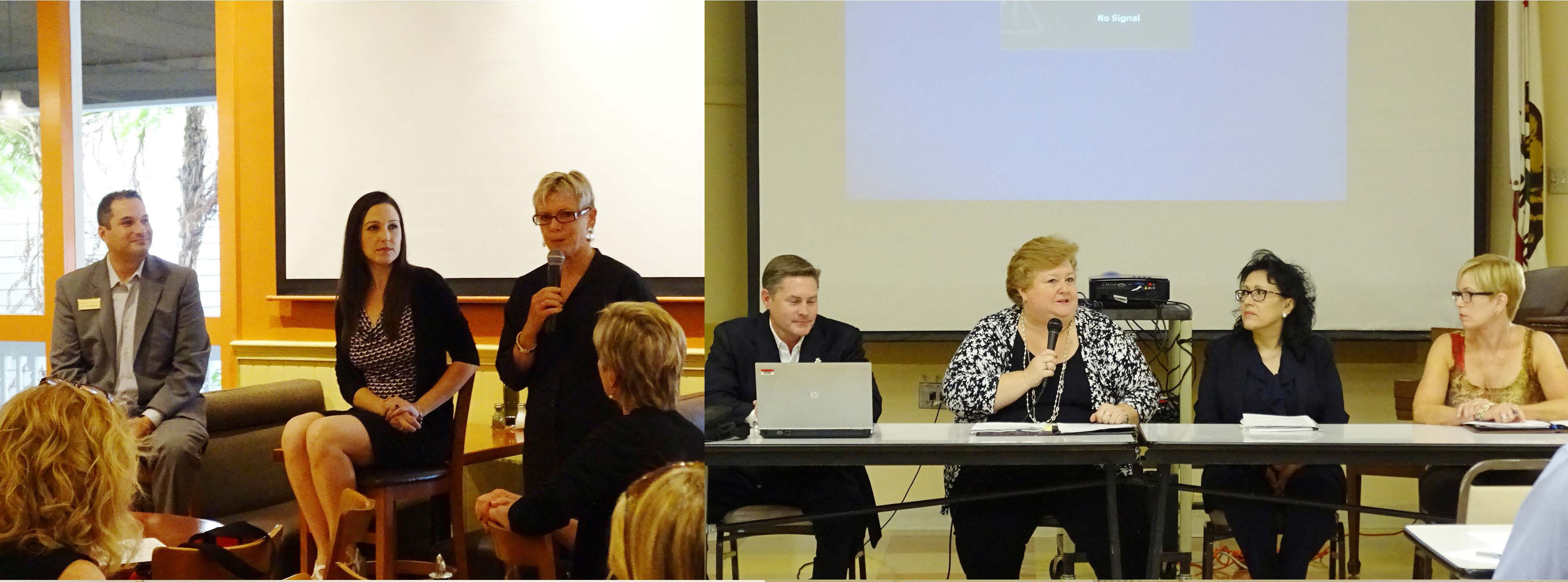
Left, the Los Gatos/Saratoga District panel with Sal Covarrubias, Annie Delgado and Cindy Stanford. Right, the Palo Alto District panel with Eric Trailer, Caroline Wolf, Janine Dietiker and Jackie Griffin.
Silicon Valley Association of REALTORS® (SILVAR) Districts are educating members on what they need to know about the new disclosure forms, the result of the new Truth in Lending Act and Real Estate Settlement Procedures Act Integrated Disclosure (TRID) rule that goes into effect October 3.
At a July SILVAR Los Gatos/Saratoga District tour meeting, the topic was discussed by a panel with Sal Covarrubias, who is with First American Title Company, and mortgage lenders Annie Delgado and Cindy Stanford, both with Opes Advisors. At the SILVAR Palo Alto August monthly meeting, the panel on TRID included mortgage lenders Eric Trailer, with EverBank and Caroline Wolf, with Princeton Capital, and title company representatives Jackie Griffin, with Old Republic Title Company and Carol Boyden, with Chicago Title Company.
The new rule combines the Good Faith Estimate (GFE) and the initial Truth-in-Lending disclosures into a new form called the Loan Estimate. The new rule also combines HUD-1 and the final Truth-in-Lending disclosures into another new form called the Closing Disclosure.
The good news is it will be easier for buyers to compare the loan estimate with the disclosure, panelists say, but many are concerned that the new rule could delay closings because of timing requirements concerning delivery of the Closing Disclosure. The Closing Disclosure must be delivered and received three days in advance of “consummation” of the loan, which is the day loan documents are signed. If the Closing Disclosure is not received in person, the new rule requires an additional three-day period if it is delivered by mail or electronically. Sunday is not counted; then, add a federal holiday into the mix and the possibility is great that the Closing Disclosure may have to be delivered seven days before consummation.
Also, since compliance with the new rule falls heavily on lenders, it is very likely that lenders will retain tight control over much of the disclosure process. Any last minute changes to the contract, such as seller credits to buyers or removing a loan contingency, could cause the reissuance of a new Closing Disclosure, further delaying the transaction.
The panelists said three changes would definitely require a new 3-day review:
- If the APR (annual percentage rate) increases by more than 1/8 of a percent for fixed-rate loans or 1/4 of a percent for adjustable loans. A decrease in APR will not require a new 3-day review if it is based on changes to interest rate or other fees.
- If a prepayment penalty is added, making it expensive to refinance or sell.
- If the basic loan product changes, such as a switch from fixed rate to adjustable interest rate or to a loan with interest-only payments
Any other changes in the days leading up to closing do not require a new 3-day review, although the lender will still have to provide an updated disclosure.
What can REALTORS® do to avoid pitfalls? Panelists advise:
- Be conservative regarding the timeline. Start the process early. Even if signing is a month away, encourage clients to get the required documents and information to the lender early. Avoid the last-minute scramble. It is critical to get the information sooner than later.
- There needs to be open communication and transparency among all parties – the client, the REALTOR®, the title officer and the lender. Tell your loan officer everything. There should be no surprises.
- Get clients solidified into a loan program as soon as possible. Make sure the financing is in order. Tell the lender about all fees associated with the transaction. Always give updated versions.
- Completeness is critical. Make sure all documents are completely filled out and accurate.
- Educate your consumers, get a commitment, and take control.
The Consumer Financial Protection Bureau (CFPB) today just released a new online toolkit to help real estate professionals understand the new TILA-RESPA Integrated Disclosure (TRID) rule and how to explain those changes to their clients. As part of the CFPB’s larger mortgage initiative campaign called “Know Before You Owe”, the “Real Estate Professional’s Guide” explains the new changes coming to the home buying process on October 3 and offers tools that real estate professionals can provide their clients about the “Know Before You Owe” campaign. Visit http://bit.ly/1IQVfgf
Another source about the October 3 changes to the closing forms and procedures in an hour-long webcast entitled, “The New Closing Rules,” with closing expert Phil Schulman and National Association of REALTORS® Senior Counsel Finley Maxson.
REALTORS® can also visit www.car.org/legal and watch the California Association of REALTORS® Legal Live Webinar entitled “RESPA/TILA Integration Overview.”

On Wednesday, September 23, members of the Silicon Valley Association of REALTORS® (SILVAR) will hold “REALTORS® Honor Veterans,” from 4-8:00 p.m. at the Palo Alto Hills Golf and Country Club, 3000 Alexis Dr, Palo Alto. This event will be an evening of connecting with colleagues, enjoying tasty food, beverages and live music, while bidding on fabulous items at our live and silent auctions. All proceeds from this event will go to the SILVAR Veterans Scholarship Fund
Planning for this event began already in the spring with SILVAR’s Membership Committee, its five Districts and professional Affiliates, the Silicon Valley YPN Chapter and the Charitable Foundation Trust joining together to make this fundraising event a success and an incredibly exciting experience for everyone.
The SILVAR Veterans Scholarship Fund is a new component of the Silicon Valley REALTORS® Charitable Foundation’s focus on education. The scholarship fund will support eligible U.S. veterans and eligible dependents of deceased veterans residing in SILVAR’s traditional service area who wish to further their education. SILVAR’s Charitable Foundation will join in partnership with area schools, like Foothill College, West Valley College, De Anza College, Cañada College and Menlo College.
The scholarship program is SILVAR’s way of supporting our veterans, to thank them for their brave and invaluable service to our country, and to help them be successful. With SILVAR membership support, we will be able to assist our veterans in achieving their education goals.
The Silicon Valley REALTORS® Charitable Foundation focuses on helping others through grants for housing, education and youth. SILVAR members want to make a big difference in people’s lives throughout our SILVAR communities.
For more information about this event and donations for the live and silent auctions and prizes, please contact Lehua Greenman, SILVAR 2015 Membership Chair and Silicon Valley REALTORS® Charitable Foundation Trustee at lgreenman@cbnorcal.com.
The Silicon Valley Association of REALTORS® (SILVAR) joins the National Association of REALTORS® (NAR) and California Association of REALTORS® (C.A.R.) in opposing a provision in the highway transportation bill that taxes homebuyers and those looking to refinance by increasing the fees Fannie Mae and Freddie Mac charge on their loans. This bill is now being considered by the U.S. Senate.
Of particular concern to REALTORS® is this tax pays for government needs that are totally unrelated to housing. This extends a 2011 fee increase that NAR opposed. NAR, in coalition with many other groups, urged the Senate not to adopt these fees and treat homeownership as the nation’s piggybank. This tax also will have a disproportionally higher impact on those using FHA loans, first-time home buyers and low and moderate-income buyers.
The United States Supreme Court recently held that a private or public entity can be sued for discrimination even if there was no intent by that entity to discriminate, upholding the validity of disparate impact claims in fair housing issues.
The ruling touches on the concept of “disparate impact” which, under the Fair Housing Act, states that any policy or practice that creates a disproportionate “adverse impact” on any group based on race, national origin, color, religion, sex, familial status, or disability may be considered discriminatory or illegal. Opponents have maintained there needs to be intent for a discrimination suit to be valid, but all federal courts of appeal have interpreted the law to mean that an entity can get sued for housing discrimination if its actions have a disparate impact on a protected class, regardless of intent.
In its ruling, however, the Court clarified that just because an action has a disparate impact, it does not mean it is discriminatory. The plaintiff must point to a specific policy that the defendant had and show that the policy had a negative impact on the plaintiff’s protected class. The defendant can avoid liability if it can prove that the policy is necessary to achieve a legitimate business interest. The plaintiff also must be able to show there is an alternative business practice with a less discriminatory effect that would equally serve the defendant’s legitimate business interest in order for the plaintiff’s disparate impact claim to be valid.
As an example, a REALTOR® having a policy of only selling homes to members of their religious institution could face a disparate impact claim if a member of a different faith claims that this policy causes members of the another faith to miss the best homes. In the same light, when considering the adoption of any policy, real estate professionals operating as property managers or housing developers should make sure the policy will not have an unintended disparate impact on a protected class.
The Consumer Financial Protection Bureau (CFPB) announced on Wednesday that it would be “sensitive” to companies that make a good-faith effort to comply with the new Truth in Lending Act and Real Estate Settlement Procedures Act Integrated Disclosure (TRID) regulation that goes into effect on August 1, 2015. Although the announcement by the CFPB is less than what some members of Congress requested, which was a hard deadline five-month testing or “grace” period, it is a net win and a welcome development toward clarifying the changes coming to real estate closings on August 1.
The National Association of REALTORS® (NAR) has been leading the effort to ensure an effective implementation of the TRID regulation. NAR has advocated a period of restrained enforcement and liability for the TILA-RESPA Integrated Disclosure rule.
NAR will continue to have a dialogue with Congress and the CFPB to minimize possible market disruptions or uncertainty when the rule takes effect August 1. It was through member efforts during the 2015 REALTOR® Legislative Meetings and Trade Expo that more than 275 U.S. Senators and Representatives signed onto a letter to CFPB Director Richard Cordray to ask for clarification of the new rule.
For the latest information on this issue, visit www.realtor.org/respa.

REALTORS® meet with Congresswoman Anna Eshoo.
On May 11-16, REALTOR® leaders from across the country converged on the nation’s capital to advance key real estate issues with regulators and members of Congress during the National Association of REALTORS® Legislative Meetings & Trade Expo. SILVAR’s leadership was among nearly 8,000 REALTORS® and guests who met with legislators, regulatory officials and top industry executives to ensure qualified buyers and investors have access to safe and affordable mortgage financing and protect and advance the operations of REALTOR® businesses and real estate-related tax policies.
SILVAR REALTORS® met with U.S. Representatives Anna Eshoo, Jackie Speier, and staff of Congressman Mike Honda. They urged their elected officials to preserve current real estate-related tax policies and extend the Mortgage Forgiveness Tax Relief Act, which expired at the end of 2014 and prevents distressed homeowners from facing excessive income tax bills on forgiven home loan debt. They also actively engaged with lawmakers on protecting commercial real estate related tax provisions, such as retaining like-kind exchange provisions and making permanent the 15-year depreciation period for leasehold improvements. In addition, REALTORS® urged members of Congress to enact legislation reforming patent demand letters, setting nationwide data security standards.
REALTORS® likewise raised concerns about the upcoming implementation of the TILA-RESPA Integrated Disclosure (TRID). The new rule takes effect August 1, and if not understood by all parties involved, could delay the closing of escrow. SILVAR REALTORS® requested that Congress approve a grace period for the enforcement of the new closing process, so parties can become accustomed to the changes.
REALTORS® also attended sessions with government officials and industry experts, including Secretary of Housing and Urban Development Julián Castro, Donna Brazile, vice chair of the Democratic National Committee, and Republican political strategist and 61st chair of the Republican National Committee Ed Gillespie.
Attending the NAR Legislative Meetings from SILVAR were SILVAR President Chris Isaacson, President-elect Karen Trolan, NAR Directors Leannah Hunt, John Tripp and Suzanne Yost, Carole Feldstein (Federal Political Coordinator for U.S. Representative Anna Eshoo), Judy Ellis (NAR Committee member), Jim Hamilton (NAR Executive Committee members), Jeff Barnett (NAR Finance Committee member), Executive Officer Paul Cardus and Government Affairs Director Jessica Epstein.
On May 14, 30 members and guests of the Silicon Valley Association of REALTORS® attended “Doing Business with Mexico” and celebrated Cinco de Mayo afterwards with Mexican delicacies. With Global Business Council (GBC) Chair Mark Wong and GBC member Sara Spang both moderating, panelists shared valuable information about both inbound and outbound transactions with clients from Mexico.
Panelists included Nancy MacLeod, a real estate broker/owner of Homes2Buy.com, who owns a villa in San Miguel de Allende, Mexico, where she also represents buyers from the U.S.; Alicia Sandoval, a REALTOR® with Keller Williams Realty in Palo Alto and a native of Mexico; Amber Neil, a REALTOR® with No Borders Realty in San Jose, who has dual U.S. and Mexican citizenship and has been doing business in Mexico and California since 2006. Another panelist, Sal Covarrubias, sales manager for First American Title Company, discussed title vesting concerns, proper identification needs for sellers, and the differences in holding title between the U.S. and Mexico.
The REALTORS® said the best way to tap into the Mexican market is to join AMPI (Asociación Mexicana de Profesionales Inmobiliarios), the largest real estate association in Mexico. Join the organization as an affiliate and attend their conventions and events.
AMPI has ties with the National Association of REALTORS® and is strongly advocating for the licensing of real estate agents in Mexico, because right now, anyone can be a real estate agent there. Travel and networking is key to learning more about the real estate business there and AMPI would be a good source, they said.
Covarrubias said issues regarding Mexicans buying property in the U.S. are similar to that of other foreign buyers. “Timing is important and whether the foreign buyer will be personally present at closing. Also, agents need to verify their client’s legal name. It may not matter much when the client buys the house, but it will matter when it is time for that client to sell the property,” said Covarrubias.
Transactions can take months to conclude in Mexico so Mexicans who buy property here get culture shock when the process is quick, and they can close as soon as three or seven days. Also, there is no disclosure when buying property in Mexico, so REALTORS® need to take time to explain to their Mexican clients the transaction process in the U.S. “Mexicans are very social and want to get to know you personally first before deciding to do business with you. They value social graces, mannerisms and respect,” said Neil. “And they are not keen on email or text. They want one-on-one, eye-to-eye conversations with you, and many meetings.”
Like any country, there are places that are dangerous, but MacLeod said, “Mexico is still very safe, especially the tourist areas and places like San Miguel de Allende.”
Sandoval said while payoffs were prevalent in the past, business there is now done in a more professional way.
Lastly, don’t believe you have to sign a 99-year lease and can’t own property in Mexico. “I’m not sure where that myth came from,” chuckled Neil.
VIEW PHOTOS HERE
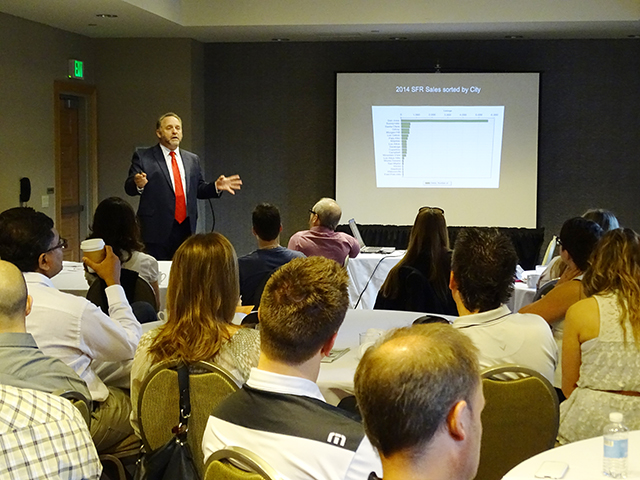
Dave Walsh, vice chair of MLSListings Inc. and vice president and managing broker of Alain Pinel Realtors’ Almaden office in San Jose, gave a group of 25 Canadian home builders an overview of the Santa Clara County housing market during their visit to the San Jose area this month.
Twenty-five members of the Canadian Homebuilders Association – Alberta were on a two-day housing tour of homes in Santa Clara County March 12 and 13, and learned about the Silicon Valley housing market and challenges to urban development from local speakers.
At a breakfast presentation arranged by the Silicon Valley Association of REALTORS®, Dave Walsh, vice chair of MLSListings Inc., shared local housing data with the builders. Walsh described Santa Clara County, which is at the heart of Silicon Valley, as “the single, most crazy market.”
Walsh said the region once filled with orchards, has become the leading hub of high-tech innovation and development in country. Recent growth has led to record-setting home prices. Home prices today have now exceeded the 2007 high, but there are far fewer homes on the market. Santa Clara County’s February median home price of $950,000 is “the best February ever,” said Walsh. The median is 20 percent above the median peak of $790,000 in February 2007. The problem is the county just had 1.4 months of inventory, with only 1,761 single-family homes for sale in February.
Walsh showed how home prices increase the closer one gets to Palo Alto, the central economic focal point of Silicon Valley, home to Stanford University and other prominent tech firms, and close to Facebook in neighboring Menlo Park and Google in Mountain View. Homes in Palo Alto are selling 110 percent of asking price, at an average of $1,491 per square foot. In Gilroy, which is about 50 miles from Palo Alto, homes are selling 99 percent of asking price at an average price of $284 per square feet. In Saratoga, which is about 18 miles from Palo Alto and has an excellent school district, homes are selling 102 percent of list price at an average of $812 per square foot.


 Silicon Valley Association of REALTORS® says ...