
You are currently browsing the category archive for the ‘Real Estate’ category.
After hearing from REALTORS® from around the country, including a significant percentage of the Silicon Valley Association of REALTORS® membership, the U.S. Senate passed H.R. 3700, the “Housing Opportunity Through Modernization Act of 2016.” This This legislation makes dramatic improvements to the Federal Housing Administration (FHA) rules around purchasing condominiums.
Changes include efforts to make FHA’s recertification process “substantially less burdensome” while lowering FHA’s current owner-occupancy requirement from 50 percent to 35 percent. The bill also requires FHA to replace existing policy on transfer fees with the less-restrictive model already in place at the Federal Housing Finance Agency.
Representatives from the National Association of REALTORS® (NAR) testified last year in support of the bill, which passed in the House of Representatives 427-0 in February. NAR initiated the Call for Action soon after and asked REALTORS® from across the country to contact their senators and urge them to pass the legislation.

Recent news reports about burglaries of vacant homes for sale in the Bay Area are troubling and a good reminder for REALTORS® and their clients to take precautions to prevent this crime from happening to them. Majority of recent burglaries have occurred in homes with “For Sale” signs in the front yard, or homes that are easily identifiable as being vacant. These burglars are taking large appliances, like refrigerators and stoves.
The Silicon Valley Association of REALTORS® shares the following safety tips with homeowners who plan to sell their home or leave their home vacant for an extended time:
- Make your home look occupied. Use automatic timers on lights, a TV and/or radio, and set them to go on and off at different times to make your house appear occupied.
- Install motion detectors on the exterior of your home and garage or shed.
- Keep curtains/blinds closed and lock all doors and windows. Use wooden stakes inside patio door/window frames to prevent them from being opened from the outside.
- Keep your property maintained, grass mowed, and leaves raked. Trim trees and bushes so they can’t conceal burglars.
- Inform the police and trusted neighbors that your house will be vacant for an extended time. Police may be able to patrol your neighborhood periodically and keep an eye on your property. Ask neighbors to keep an eye on the property and call 9-1-1 immediately if they see or hear any suspicious activity.
- Ask a trusted neighbor to pick up flyers or newspapers that may be left on the front porch or driveway. Consider having a neighbor park their vehicle in your driveway while you are gone.
- Install an alarm system and/or security cameras.
- Consider renting your home or hiring a house sitter so the house won’t be vacant.
- Know the risks of putting “For Rent” or “For Sale” signs in front of your property.
- Never leave a spare house key under doormats, flowerpots, or other hiding places.
- Don’t place posts on social media informing others that your house is for sale or that you will be away on vacation.
Some sectors of Silicon Valley may be prospering, but there is another side to the valley, that of individuals and families struggling to make ends meet. Their number is rising, according to non-profit agency officials, and striking is these days is more among the needy are younger clients, many of them students.
At last week’s Silicon Valley Association of REALTORS® (SILVAR) Cupertino/Sunnyvale District tour meeting, Marie Bernard, Sunnyvale Community Services (SCS) executive director, said in response to the rising need, SCS has deepened its programs and will be extending services to those in need in the Alviso area.
SCS helps over 7,000 residents in the Sunnyvale area with food, in-kind assistance and financial aid. Bernard said SCS is very focused on the young and seniors – 39 percent of SCS clients are under the age of 18 and 14 percent are seniors.
Every Monday, the agency distributes 30 to 40 pounds of free fresh produce to an estimated 900 families. Clients are able to pick up for additional bags of nutritious food to help stretch their budgets a little further. SCS also provides children school meals throughout the year, including the summer months. In addition to all these, the SCS has a food pantry program, where families can shop once a month for meats, dairy items, canned food, household supplies, paper products, and more.
The nonprofit provides emergency financial assistance to low-income Sunnyvale residents who have been hit with an unexpected expense, like a major car repair, medical bills and other emergencies that can throw them off their budget.
“We help those who are one bill away from being homeless,” said Bernard.
Bernard explained by the time residents come to the SCS for help, they are already strapped with loans. Many are victims of payday lenders who charge interest rates as high as 459 percent on an annual basis, and owe these lenders thousands of dollars.
Kohinoor Chakravarty, director of Development and Communications for West Valley Community Services (WVCS), painted the same sad picture of the plight of the needy when she presented an overview of the agency’s services at the SILVAR district REALTORS® tour meeting last May.
Like SCS, WVCS is a non-profit, community-based agency that provides direct assistance and referral services to needy individuals and families. Clients served by the agency reside in Cupertino, Los Gatos, Monte Sereno, Saratoga, West San Jose and the unincorporated mountain regions.
Chakravarty noted the agency is seeing many students who are homeless and hungry. There are 200 students from De Anza College who are homeless. Their families cannot afford the rising rents in the area and have moved away. The students have chosen to stay so they can finish their studies. Since they cannot afford to rent an apartment, some couch surf; others live in their cars.
“It’s a sad situation,” said Chakravarty. In response to the rising needs of homeless and hungry students, she announced WVCS will be establishing food pantries at the De Anza and West Valley community colleges.
Currently 1,614 individuals are served through the WVCS food pantry and 770,515 pounds of food are distributed to clients. There are 231 individuals enrolled in food stamps, free/reduced lunches and health insurance.
WVCS also provides $100,615 in emergency financial assistance to 69 households. Among the agency’s special programs are its holiday food baskets, which are distributed to 212 needy families; holiday shopping spree serving 593 families; and its Back-to-School event, which helps 120 children shop for clothes for school.
In addition to the opening of the food pantries at the community colleges, the WVCS executive director announced the agency will be starting a mobile care service. With a newly acquired vehicle, the agency will be dropping off basic food and health services to its beneficiaries, since many clients travel two hours to receive the services.

The Silicon Valley Association of REALTORS®’ (SILVAR) fifth Certified International Property Specialist (CIPS) Institute took place this week with 17 students registered. The students, many of whom are SILVAR members, hail from the San Francisco Bay Area. One traveled all the way from Canada. Many are well-traveled and come from different cultural backgrounds. All were eager to learn more about the international real estate market and how to grow their global business.
The courses were once again taught by 2012 and 2009 National Association of REALTORS® International Instructor of the Year David Wyant, assisted by his wife, Patsy. The Wyants travel around the country and the world teaching the CIPS courses. This is their fifth trip to Cupertino. Each time they come, they remark about Silicon Valley’s growth.
Wyant also noted, “Silicon Valley REALTORS® are among the most intelligent in the nation.”
The CIPS Institute provides training in international business issues, including currency conversion, cultural awareness, legal and tax requirements, ownership and transaction principles of international real estate, and specifics about the real estate markets in Europe, the Americas, and Asia. The week-long CIPS Institute includes two required core courses and three elective courses. Students must pass a multiple-choice exam at the end of each course.
Upon completing the required five courses and fulfilling other necessary requirements, graduates of this year’s CIPS Institute can receive their CIPS designation and have the opportunity to be recognized at the 2016 NAR REALTORS® Conference and Expo, which will be held in Orlando, Fl. on November 4-7.
Thank you to this year’s CIPS Sponsors of the Day, who provided breakfast and lunch each day. They are Amy Ku, VP Mortgage Sales Manager for Northern California with HSBC Bank; Janet Case, CEO of Proxio; Anita Rodal, international liaison with AFEX (Associated Foreign Exchange) and president of SBPI Services, Inc.; Darrell Monda, owner of TourFactory Bay Area; and Larry Tringali, owner of Property Inspection Service.
The National Association of REALTORS® (NAR) is asking all REALTORS® across the country to TAKE ACTION NOW and urge your Senators to pass H.R. 3700, the “Housing Opportunity Through Modernization Act of 2016.” This bill makes needed reforms to the Federal Housing Administration (FHA) condominium loan program, federal-assisted housing programs and Rural Housing Service loan programs. The reforms would make buying a condominium easier by expanding opportunities for first-time homebuyers and streamlining rural housing programs for low-income rental residents.
Early in February the U.S. House of Representatives voted unanimously to advance legislation that will expand opportunities for homeownership, especially for first-time home buyers. H.R.3700 takes aim at the difficulties in getting mortgages for condominiums. NAR has supported the inclusion of reforms to current FHA restrictions on condominium financing.
Condominiums are among the most affordable homeownership options for first-time home buyers, as well as lower income borrowers, but barriers to safe, affordable mortgage credit for condos still exist. H.R. 3700 takes a number of steps to address those concerns. These include efforts to make FHA’s recertification process “substantially less burdensome,” improving a process that is often costly and which condo developments must repeat every 24 months.
H.R. 3700 also lowers FHA’s current owner-occupancy requirement (the number of units in the development owned by the people living in them) from 50 percent to 35 percent and requires FHA to replace existing policy on transfer fees with the less restrictive model already in place at the Federal Housing Finance Agency.
Additionally, the bill streamlines the process for exemptions to FHA’s rule requiring that condominium projects have no more than 25 percent of the space dedicated to commercial use. This effort is in line with the Department of Housing and Urban Development’s initiative to promote neighborhoods with a mix of residential housing, businesses and access to public transportation, which has become a trend in housing development today.
Finally, H.R. 3700 includes further support for rural housing loans and multifamily housing initiatives.
H.R. 3700 removes a burdensome and expensive FHA condo approval process, reduces the FHA restrictions on the number of condos available to homebuyers, and permanently streamlines the Rural Housing Service loan program.
NAR is encouraging all members to take action even if they do not do business with condominiums or in rural areas. SILVAR members can take action by going to https://realtorparty.realtoractioncenter.com/site/Advocacy

Last chance to register or audit a class!
SILVAR’s 5th Certified International Property Specialist Institute (CIPS) is on June 20-24. If you would like to learn how to expand your global real estate business and earn the National Association of REALTORS® (NAR) CIPS designation, enroll in the CIPS Institute. Classes start next week, so you need to register right away. Cost for the entire CIPS Institute, which includes five courses, is $450 for the paperless option $500 for the paper version, which includes a manual for each of the five courses for both members and nonmembers. Regular price is $600.
Members may enroll online at ims.silvar.org. Non-members and those who want the paperless option may register by calling SILVAR at (408) 200-0100. Breakfast and lunch are provided and included in the cost, thanks to our generous sponsors Darrell Monda of TourFactory; Larry Tringali of Property Inspection Service; Anita Rodal, international liaison with AFEX (Associated Foreign Exchange) and president of SBPI Services, Inc.; Janet Case, CEO of Proxio; and Suzette Reboton of HSBC.
If you are a CIPS designee, you can audit a course for $20 for paperless and $30 for the paper option. Cost also includes breakfast and lunch. There are always new developments taking place in real estate markets around the world. Every two to three years CIPS courses are revised with updated statistics and relevant information. The most recent courses updated are Global Real Estate: Local Markets (May 2016) and Global Real Estate: Transactions Tools (May 2016). Instructor David Wyant, who will be teaching the courses again this year, also regularly furnishes students with information on the latest developments in international real estate.
If you would like to audit a CIPS course, please contact SILVAR Public Affairs and Communications Director Rose Meily at (408) 200-0109 or email rmeily@silvar.org.
The CIPS Institute provides training in international business issues, including currency conversion, cultural awareness, legal and tax requirements, ownership and transaction principles of international real estate, and specifics about the real estate markets in Europe, the Americas, and Asia. Members using Proxio, which is a SILVAR benefit, may find the CIPS courses very useful in advancing their global real estate business. See registration form and class schedule below.
CIPS SCHEDULE AND REGISTRATION FORM
For the 17th straight year, the Silicon Valley REALTORS® Charitable Foundation is awarding scholarship awards to 18 graduating high school seniors in Silicon Valley at the end of the 2015-2016 school year. Scholarship recipients each receive $1,000 and are selected from public high schools in communities served by members of the Silicon Valley Association of REALTORS®. The Silicon Valley REALTORS® Charitable Foundation scholarship program recognizes students who have exemplified outstanding achievements in academics, extracurricular/employment activities and community involvement. The selection committee includes representatives from the local business community, area high schools, area colleges and the local trade association.
“We are happy we are able to assist our youth with their education. Thank you to the teachers and staff for their help in making this program the success that it is. The scholarship program is truly a partnership effort between the Silicon Valley REALTORS® Charitable Foundation and the wonderful educators in our service area,” said Nina Yamaguchi, Charitable Foundation scholarship program chair.
Students receiving scholarships, the schools from which they are graduating, and the colleges and universities they will be attending this fall are Kelly Jiaying Chen, Cupertino High School (UC Berkeley); Alexandra Tan, Fremont High School (UC San Diego); Audrey Cheng, Gunn High School (Princeton University); Angela Grace Wang, Homestead High School (USC); Sara Lucero, Leigh High School (UC San Diego); Bailey Thayer, Los Altos High School (Cal Poly San Luis Obispo); Molly Ilana Ball, Los Gatos High School (Barnard College); Sally Zhengyuan Wan, Lynbrook High School (University of Chicago); Ritwik Kesavath, Menlo-Atherton High School (Cal Poly San Luis Obispo); Woo Chul Kim, Monta Vista High School (West Point); Samantha Rubinstein, Mountain View High School (UC Berkeley); Lavanya Mahadevan, Palo Alto High School (Stanford University); Shravan Davuluri, Prospect High School (University of Texas at Austin); Ajaipal Chahal, Santa Clara High School (Dartmouth College); Isha Mangal, Saratoga High School (UC Berkeley); Nguyen Dang, Westmont High School (University of San Francisco); Yu-Bin Moon, Wilcox High School (UC Irvine); and Frederique Corcoran, Woodside High School (UC Santa Barbara).
Members of the Silicon Valley Association of REALTORS® who presented the scholarship awards to the recipients at their respective senior award ceremonies include Chris Alston (Keller Williams), Sue Bose (Referral Realty), Mark Burns (Referral Realty), Davena Gentry (Sereno Group), Mary Kay Groth (Sereno Group), Theresa Loya (Coldwell Banker), Cassie Maas (Alain Pinel Realtors), Russell Morris (Coldwell Banker), Bill Rehbock (Coldwell Banker), Robert Reid (Keller Williams), Amy Sung (Pacific Union), Susan Sweeley (Alain Pinel Realtors), Mary Tan (Coldwell Banker), David Tonna (Alain Pinel Realtors).
The scholarship awards presented by the Silicon Valley REALTORS® Charitable Foundation are made possible by donations from Realtor and affiliate members. Since its creation, the scholarship program has provided $306,000 in scholarships to high school seniors in Silicon Valley.

At this morning’s Palo Alto District tour meeting, SILVAR member Davena Gentry presented the last of 18 $1,000 scholarships awarded by the Silicon Valley REALTORS® Charitable Foundation to graduating seniors from public high schools to Audrey Cheng. Cheng graduated this week from Gunn High School.
The California Association of REALTORS® (C.A.R.) has asked all REALTORS® to contact their State Assembly Member and urge them to vote NO on AB 2502, which undermines existing Costa-Hawkins’ protections by allowing local governments to impose mandatory inclusionary zoning (i.e. rent control) on newly constructed rental housing. It is vitally important that you reach out to your elected representative today! Let your Assembly Members know that you say NO to Rent Control!
Please Call YOUR Assembly Member TODAY at (800) 798-6593 between 9-5 p.m.
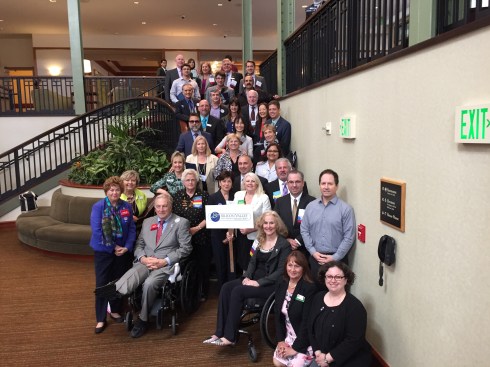 About 50 SILVAR members joined over 2,000 California REALTORS® in Sacramento on Wednesday for the annual California Association of REALTORS® (C.A.R.) Legislative Day, the one day each year that the state’s REALTORS® meet with their legislators and discuss real estate-related policies and issues.
California Governor Jerry Brown spoke to California REALTORS® at the Sacramento Convention Center during the C.A.R. morning briefing. Brown said the economy has its cycles and at present the state’s economy is doing well, thanks to the business sector.
“California is the land of sunshine and smart people. That’s why people want to be here. Silicon Valley has the smartest people in the world,” declared the Governor.
Brown told REALTORS® to stay the course, stating, “REALTORS® are the backbone of what California looks like, of what California is.”
At a joint luncheon with members of the San Mateo County Association of REALTORS® and Santa Clara County Association of REALTORS®, Los Angeles Times Sacramento Bureau Chief John Myers analyzed the state’s political landscape. He indicated California has “places of great success and places of great struggle,” a dichotomy between urban versus rural, haves versus have nots, the highly employed places versus low employed.
Myers said it will be interesting to see how the state plans to implement the $15 minimum wage; how the state will expand the family leave law; and what arises from discussions on affordable housing. Other fundamental issues looming over California are education, transportation and water.
According to Myers, this year’s state elections may be the last chance to bring new blood to the state legislature, since new legislators will be serving 12-year terms due to the passage of Proposition 28. Myers also warned REALTORS® to expect a longer and confusing U.S. Senate ballot for the June 7 primary because of how the names of the 34 candidates seeking to replace retiring Senator Barbara Boxer are laid out on the ballot. Choose only one candidate. Selecting two or more candidates would disqualify your vote.
After the luncheon, SILVAR members met with Senators Jim Beall and Jerry Hill, and Assembly members Rich Gordon and Evan Low. Members asked their support on the following bills:
SUPPORT C.A.R.-sponsored bill AB 2693 (Dababneh) – PACE Loan Disclosure, which seeks to change the super-priority status of PACE loans and to require disclosures to consumers before they obtain such a loan. A PACE loan allows a homeowner to borrow money to finance energy upgrades. The loan is then repaid as a surcharge on the property tax. The PACE loan takes primary position to the mortgage. If a homeowner takes out a PACE loan they may have difficulty refinancing or selling their home if the new mortgage holder, like Federal Housing Finance Agency (FHFA), does not allow for PACE loans. If the cost of repaying the PACE loan and any mortgages on the property exceeds the purchase price of the home, the seller will be forced to make up the difference. This will prevent some homeowners from selling when they need or want to. Current disclosures given to homebuyers do not explain the potential consequences of using PACE loans. AB 2693 will require Truth in Lending type disclosures to borrowers.
SUPPORT C.A.R.-sponsored bill AB 2760 (Mathis) – Support Animal Regulations seeks to distinguish between a medically necessary companion or support animal and other animals kept as pets. C.A.R. wants to clarify current law to allow legitimate support animals to share rental housing and to allow landlords to avoid unnecessary litigation. Service animals, as defined under federal law, are animals individually trained to do work or perform tasks for the benefit of an individual, like guide dogs and signal dogs. Companion animals simply provide comfort to an individual. They are not afforded the same protections under the ADA or California State Law as service animals, even though they are kept as the result of a mental health professional’s prescription, causing confusion for housing providers. The vagueness in state law allows individuals without a legitimate need to claim a status for pets that is not deserved. AB 2760 will allow tenants to keep a support animal on the property provided that the tenant has a prescription validating the need for the support animal from a California-licensed mental health professional. They must also comply with all federal, state and local requirements, such as vaccination or sterilization mandates.
OPPOSE SB 1053 (Leno) – Sec. 8 Housing Mandate, which seeks to expand protected classes under the Fair Employment and Housing Act to include those who receive government rental subsidies. SB 1053 forces residential rental property owners to participate in the federal and local government’s voluntary Section 8 housing program. Section 8 was always intended to be a voluntary program. By forcing property owners to accept tenants with housing vouchers or other subsidies, SB 1053 forces landlords to participate in Section 8 without regard to the property owner’s specific circumstances. It forces landlords to endure administrative burdens and increased costs due to delays that result from understaffed housing authorities and requires landlords to accept objectionable and burdensome lease terms. Under HUD rules, housing authorities must use a HUD formula to determine an “acceptable” rental rate.

With improved snow pack and reservoir levels, California water providers want the state to reduce or eliminate emergency drought measures imposed last year. Some experts caution abandoning conservation measures would be a bad move. They say although El Niño brought heavy rains to California this winter, it’s not enough for the state to recover from four dry years.
Even if the state and cities relax water restrictions, we should not ease up on water conservation measures, according to Rebecca Jepsen, a University of California Cooperative Extension (UCCE) Master Gardener who writes a monthly gardening column in the San Jose Mercury News.
Jepsen, who is also a REALTOR® with Alain Pinel Realtors, is passionate about saving water. “We all need to continue cutting back on water usage,” she recently told members of the Silicon Valley Association of REALTORS®.
According to Jepsen, as of 2014, California needed 11 trillion gallons of rain to recover – that’s 17 million Olympic-sized swimming pools. From June through February, California residents were able to cut water usage 23.9 percent compared to their 2013 usage, almost reaching Gov. Jerry Brown’s target of 25 percent. The state is currently at about 80 percent of normal.
The State Water Resources Control Board is scheduled to meet next month and will possibly ease rules for Northern California, which received much of the winter’s rainfall. Southern California wasn’t quite as lucky and has experienced less rain and hotter, drier temperatures.
Jepsen said dropping water conservation measures altogether would be unwise. She explained 50 percent of water goes to the environment – to streams, rivers and wetlands. The remaining 50 percent is controlled – 80 percent is devoted to agriculture, which is needed to grow food, and 20 percent to municipal/residential use, of which 50 percent goes to outdoor irrigation.
Outdoor usage of water is an area residents need to improve upon. According to the UCCE Master Gardener, a typical turf lawn uses 57 inches of water per year. She suggests removing or replacing turf lawns with eco-lawns, meadow lawns, sedges and herbs. Use thyme and manzanita as groundcover. These lawn options save water and are attractive, she said.
Jepsen shared the following outdoor water-saving tips with REALTORS® to share with their clients: 1. Don’t run irrigation systems during the middle of the day. The best time to water is between 5-8 a.m.
- Use efficient low-flow irrigation and check for leaks. Leaky irrigation systems can waste 6,000 gallons a month. Invest in a SmartController, which doesn’t run when it rains and runs more frequently during hot, dry spells.
- Remove overgrown, tired, inappropriate plants.
- Apply 2-3 inches of compost and mulch around plants and trees to retain water and feed the soil.
- Water just enough to keep plants healthy. Jepsen noted contrary to what some people think, lawns and outdoor plants do not need to be watered as often or as much.
Jepsen also encourages families to grow their own food. “You’ll have food at your table and it’s a relaxing. Grow what you want to eat and share with your neighbors,” said Jepsen.

 Silicon Valley Association of REALTORS® says ...